Diversity of Living Organisms (LC 2026) (Leaving Cert Biology): Revision Notes
📚Revision Notes
Diversity of Living Organisms
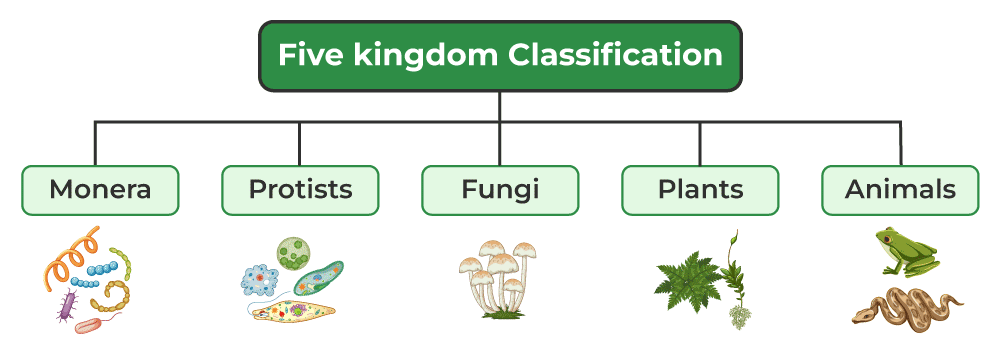
Living things are divided into five kingdoms:
- Monera
- Protista
- Fungi
- Plants
- Animals
Key terms:
Note
Prokaryotic cells do not have a nucleus or membrane-bound organelle e.g. bacteria.
Note
Eukaryotic cells have a nucleus and membrane bound organelle e.g. animals, plants.
1. Monera
Bacteria belong to this kingdom.
- All members of this kingdom are prokaryotic.
- Usually single celled.
- Usually asexual reproduction.
- Monera have a cell wall. This is for protection and structural support**.**
- The cell wall helps prevent the organism from bursting due to osmotic pressure, which is especially important since most Monera are single-celled.
2. Protista
Algae and amoeba belong to this kingdom.
- All members of this kingdom are eukaryotic.
- Mostly single celled or simple multi-celled organisms.
- Amoeba is single celled.
- Algae is multi-celled.
- Protista are usually found in water.
- Many protista are autotrophic.
Note
Autotrophic: organisms that produce their own food e.g. plants produce their food through photosynthesis.
3. Fungi
Yeasts, moulds and mushrooms are members of this kingdom.
- All members of this kingdom are heterotrophic.
- Usually multi-celled and contain hyphae.
- Hyphae walls are made from chitin.
- Fungi usually reproduce by spores.
Note
Heterotrophic: organisms that cannot make food and must use food made by other organisms, e.g. animals, fungi.
Note
Revision:
- Chitin is a structural carbohydrate found in the cell wall of hyphae.
- Cellulose is a structural carbohydrate found in the cell wall of plant cells.
4. Plants
Trees, grass and flowers belong to this kingdom.
- All members of this kingdom are autotrophic.
- This kingdom is made up of complex multi-cellular organisms.
- Plant cell walls are made from cellulose, a structural polysaccharide (carbohydrate).
- Can reproduce sexually and asexually.
- Plant cells contain large vacuoles for storage.
5. Animals
Humans, birds, insects, cows etc belong to this kingdom.
- Animals are multi-celled, complex organisms.
- Members are heterotrophic.
- Members usually have a nervous and muscular system.
- Usually reproduce sexually.
- Animal cells do not have cell walls.
Note
Past Exam Questions: 2010 Higher Level
- To which kingdom does Amoeba belong?
- Answer: Protista
- To which kingdom do bacteria belong?
- Answer: Monera or Prokaryotae