Microorganisms (LC 2027) (Leaving Cert Biology): Revision Notes
📚Revision Notes
Microorganisms in Industry and in the Human Body
Microorganisms are incredibly important in both industrial applications and maintaining human health. These tiny living organisms play crucial roles in producing medicines, improving agriculture, processing food, and keeping our bodies functioning properly.
Microorganisms in agriculture
Agricultural practices rely heavily on beneficial microorganisms to maintain healthy farming systems. These microscopic helpers perform several vital functions that support crop production and soil health.
Note
Key Agricultural Functions of Microorganisms:
Microorganisms in agriculture work by:
- Controlling harmful pests such as insects and parasites that can damage crops
- Increasing the supply of essential nutrients like nitrates and phosphates in the soil
- Improving soil structure and helping soil retain water, oxygen and nutrients more effectively
Important
Not All Microorganisms Are Beneficial
However, not all microorganisms are beneficial in agriculture. Some cause serious plant and animal diseases, while others lead to crop decay and food spoilage, resulting in significant agricultural losses.
Microorganisms in medicine
The medical importance of microorganisms is enormous and includes both beneficial and harmful effects on human health. Understanding these relationships is crucial for maintaining good health and developing medical treatments.
Beneficial microorganisms in our intestines help digest food, prevent the growth of harmful organisms, and produce essential vitamins that our bodies need. Many of these helpful microorganisms are called probiotics and are deliberately included in our diet to improve health.
Note
Disease-Causing Microorganisms
On the harmful side, microorganisms cause many diseases including:
- Bacterial diseases: pneumonia, tuberculosis (TB), sore throats, typhoid and cholera
- Fungal diseases: ringworm and thrush
Understanding these disease-causing organisms helps medical professionals develop effective treatments.
Microorganisms in food production
Food production relies extensively on microorganisms for creating many products we consume daily. These applications range from traditional fermentation processes to modern biotechnology approaches.
Microorganisms are used to make fermented products like yoghurt, cheese, vinegar, silage, alcohol and many other foods we enjoy regularly. The fermentation process transforms basic ingredients into more complex, flavourful, and often more nutritious products.

Note
Modern Biotechnology Applications
Genetically modified microorganisms now make specialised products such as:
- Vitamins and amino acids
- Flavourings and colourings
- Taste enhancers
These are added to processed foods to improve nutrition and taste. Unfortunately, some microorganisms also cause food decay, leading to food spoilage and waste.
The microbiome
A microbiome consists of all the microorganisms that exist in a particular environment, including bacteria, archaea, fungi, protists and viruses. This concept is essential for understanding how communities of microorganisms interact with their surroundings.
In humans, the microorganisms found in our microbiome vary from person to person and from place to place in the body. For example, the microorganisms on our skin differ from those in our mouth or gastrointestinal tract (digestive system). The microbiome can even vary depending on exercise, diet, medication and other lifestyle factors.
Important
Microbiome Acquisition
We acquire our microbiome from other people and from our surroundings. Initially, a baby gets its microbiome from the birth canal of its mother and from breast milk. Later, humans pick up microorganisms from food, by contact with those close to them and from their surroundings.
Note
Did you know?
The human microbiome consists of about 100 trillion cells, which is or three times more than the number of human cells in the body!
The role of microorganisms in the gastrointestinal tract
The gastrointestinal (GI) tract is our alimentary canal, and the microorganisms in our gut microbiome play several crucial roles in maintaining our health and wellbeing.
Digestion
Bacteria in our intestines help break down complex carbohydrates and dietary fibre that humans cannot break down by themselves. During this process, they form small chains of fatty acids which are essential for our health.
Note
Vitamin Production
Bacteria also contain enzymes necessary to produce vitamins such as B1, B9, B12 and K, which our bodies need but cannot manufacture independently.
Immune signalling
Our microbiome causes cells in our immune system (70% of which are found in our intestines) to send out signals that help us distinguish between beneficial microorganisms and harmful or pathogenic microorganisms.
Additionally, our microbiome prevents the growth of disease-causing (pathogenic) bacteria and fungi by competing with them for resources and space.
Metabolic health
The microbiome in our intestines helps control numerous metabolic processes in the body. For example, a correctly balanced microbiome helps:
- Reduce inflammation
- Allow insulin to work properly
- Decrease fat storage
- Assist hormones controlling appetite and fullness
- Allow the liver to function properly
Growth curves of microorganisms
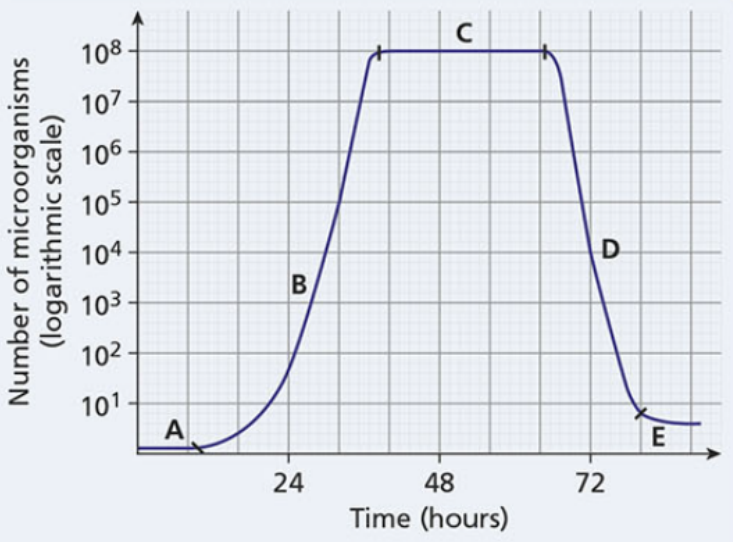
When microorganisms such as bacteria and yeast are growing in a closed system (such as being grown in a container in a laboratory), their numbers follow a predictable pattern called a growth curve.
Important
Understanding Growth Curves
The growth curve for a typical population of microorganisms shows how the number of microorganisms changes over time. The number of microorganisms is represented on a logarithmic or exponential scale to allow huge numbers of microorganisms to be represented on the same graph.
This type of growth curve is an example of an S-shaped logistic curve, commonly used for environments with limited resources.
The graph can be divided into five phases, each with distinct characteristics.
Lag phase (A)
During the lag phase, the number of microorganisms remains constant. This happens because the microorganisms are adapting themselves to their new environment. For example, they may be producing new enzymes to digest the nutrients on which they need to grow.
Log phase (B)
In the log phase, the number of microorganisms increases rapidly. This occurs because the microorganisms are reproducing at their maximum rate. The number of microorganisms doubles in every new generation as a result of ideal conditions such as plenty of food, moisture, space and oxygen.
Note
The log phase is also called the exponential phase.
Stationary phase (C)
In the stationary phase, there is no change in the number of microorganisms. This happens because the production of new microorganisms is compensated for by the death of equal numbers of microorganisms.
Note
Factors Causing Growth Slowdown:
The rate of growth slows down because of factors such as:
- Lack of food
- Lack of space
- Lack of moisture
- Lack of oxygen
- Unsuitable pH
- The build-up of toxic waste products
Decline phase (D)
In the decline (or death) phase, the number of microorganisms falls rapidly. Microorganism numbers fall when the death rate is greater than the rate of reproduction. The slow rate of reproduction is caused by the same factors that caused the stationary phase.
Survival phase (E)
In the survival phase, a small number of microorganisms survive by remaining dormant as endospores. Endospores have thick walls and can survive for a long time during adverse conditions by remaining dormant until conditions are suitable again.
Knowledge of growth curves increases product yields in industries
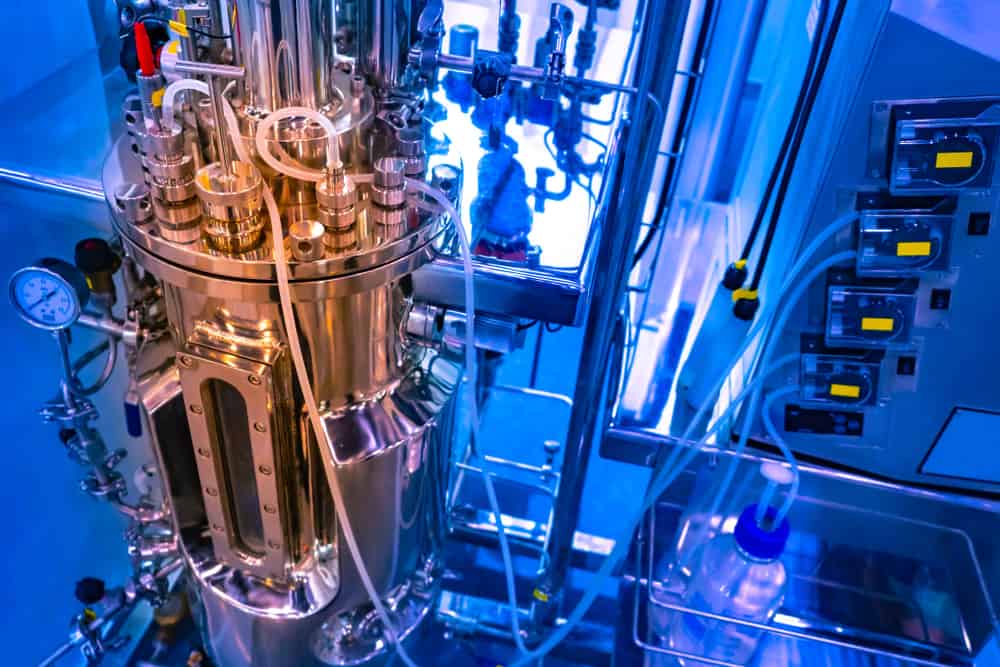
A wide range of microorganisms are used in industry to produce products such as drugs, antibiotics, enzymes and food additives. In industry, the conditions in growth containers (called bioreactors) are controlled to maintain the microorganisms in the most suitable growth phase to increase the yield of the product being made.
Note
Industrial Growth Phase Control
- For some products, the microorganisms are maintained in the log phase because this is when they are most active and producing the desired substances
- For other products, the microorganisms are maintained in the stationary phase when they produce different compounds
- Normally, the microorganisms are not allowed to reach the decline (or death) stage because very little product is formed at this stage and there is a risk of unwanted side products forming
Summary
Key Points to Remember:
- Microorganisms have diverse industrial applications - from producing medicines and antibiotics to fermenting food products and improving agricultural practices
- The human microbiome is essential for health - it helps with digestion, supports immune function, and maintains metabolic processes throughout the body
- Growth curves follow predictable patterns - understanding the five phases (lag, log, stationary, decline, survival) helps industries optimise production conditions
- Controlled growth maximises product yields - industries use bioreactors to maintain microorganisms in optimal growth phases for maximum efficiency
- Balance is key in the human body - beneficial microorganisms protect against harmful ones while supporting vital bodily functions