Carbohydrates and Lipids (Leaving Cert Biology): Revision Notes
📚Revision Notes
Carbohydrates and Lipids
Introduction to biomolecules
Biomolecules are essential chemicals produced by living organisms. These include carbohydrates, lipids, proteins, and nucleic acids. All biomolecules are built from naturally occurring elements, with carbon, hydrogen, and oxygen being the most abundant in living matter.
Note
The three most abundant elements in living matter - carbon, hydrogen, and oxygen - form the foundation of most biological molecules, making them the building blocks of life itself.
Carbohydrates
Carbohydrates are one of the most important groups of biomolecules. They contain the elements carbon (C), hydrogen (H), and oxygen (O) in a specific ratio, typically represented as . This means that for every carbon atom, there are usually two hydrogen atoms and one oxygen atom.
Types of carbohydrates
Carbohydrates are classified into three main categories based on their size and complexity:
Monosaccharides are the simplest carbohydrates, consisting of a single sugar unit. They are the building blocks for all other carbohydrates and serve as the primary energy source for cells. Key examples include:
- Glucose () - the main sugar used in respiration and produced during photosynthesis
- Fructose - sweeter than glucose, commonly found in fruits and honey
- Ribose - essential for forming RNA molecules
Disaccharides are formed when two monosaccharide units join together. They taste sweet and dissolve easily in water. Important examples include:
- Maltose - composed of two glucose molecules, found in cereals
- Sucrose - table sugar, made from glucose and fructose
- Lactose - milk sugar, containing glucose and galactose
Polysaccharides consist of many monosaccharide units bonded together. Unlike mono- and disaccharides, they are not sweet-tasting and are often insoluble in water. Key examples include:
- Starch - plants' main storage carbohydrate, easily broken down into glucose
- Glycogen - animals' storage carbohydrate, found in muscles and liver
- Cellulose - provides structural support in plant cell walls
Structures of starch and cellulose
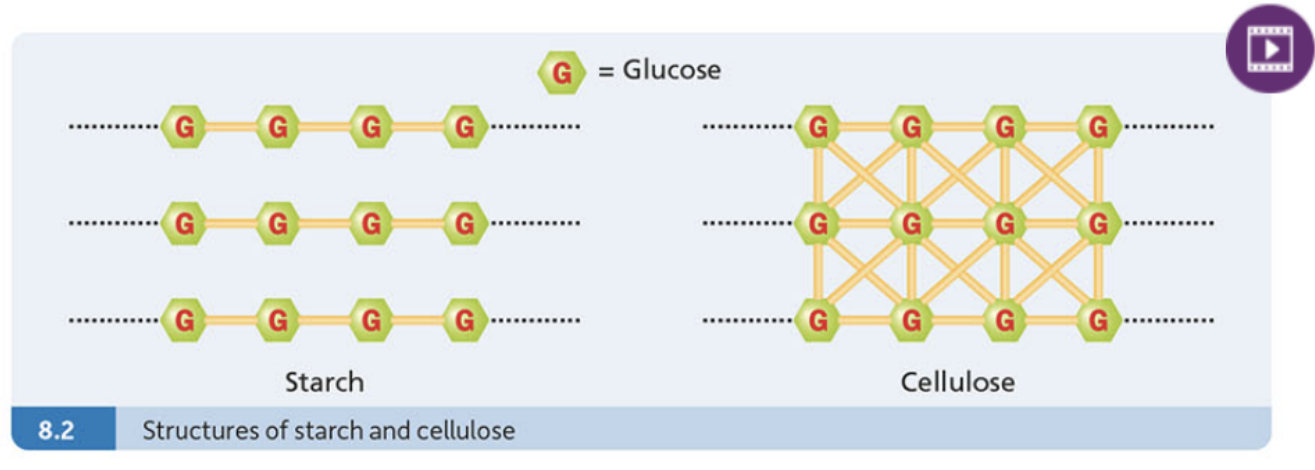
Both starch and cellulose are made from glucose units, but their structures differ significantly. Starch consists of glucose molecules arranged in linear chains that can be easily broken apart during digestion. Cellulose, however, has extensive cross-bonding between glucose chains, making it much stronger but impossible for humans to digest.
Important
Critical Structural Difference: While both starch and cellulose are made from glucose, their different bonding patterns mean that humans can digest starch for energy but cannot break down cellulose. This is why we can't digest wood or paper, despite them being made of the same basic sugar units as our food!
Nutritional sources of carbohydrates
Common dietary sources of carbohydrates include:
- Bread, potatoes, rice, and pasta (rich in starch)
- Fruits and sweets (containing various sugars)
- Vegetables (containing different types of sugars and starch)
- Cereals (containing maltose and other carbohydrates)
Metabolic roles of carbohydrates
Carbohydrates serve several crucial functions in living organisms:
- Energy provision - glucose is broken down during respiration to release energy (catabolic process)
- Energy storage - starch in plants and glycogen in animals store energy for later use
- Structural support - cellulose forms strong plant cell walls
- Building other molecules - carbohydrates can be converted into other biomolecules when needed
Note
Catabolic vs Anabolic Processes: The breakdown of carbohydrates to release energy is called a catabolic process, while building larger molecules from smaller ones (like making starch from glucose) is an anabolic process.
Lipids
Lipids are another major group of biomolecules with distinctly different properties from carbohydrates. They contain carbon, hydrogen, and oxygen, but have much less oxygen compared to carbohydrates. Some lipids, called phospholipids, also contain phosphorus.
The difference between fats and oils
Understanding the distinction between fats and oils is crucial:
Important
Temperature-Based Classification:
- Fats are lipids that remain solid at room temperature (20°C)
- Oils are lipids that stay liquid at room temperature
This difference affects how they function in cooking and in our bodies.
Structure of lipids
Most lipids share a common basic structure consisting of:
- One glycerol molecule (the backbone)
- Three fatty acid chains attached to the glycerol
This structure is called a triglyceride and represents the most common form of lipid found in our diet and stored in our bodies.
There are many different types of fatty acids, which gives lipids their variety. Sometimes two fatty acids are identical, but often they differ from each other, creating diverse lipid molecules with different properties.
Phospholipids
Phospholipids have a slightly different structure where a phosphate group replaces one fatty acid. This creates molecules that are essential for forming biological membranes around cells and cellular structures.
Nutritional sources of lipids
Lipids are found in many foods, including:
- Butter, margarine, and cooking oils
- Meat and fish (containing various fats)
- Cream and cheese (dairy fats)
- Nuts and seeds (natural plant oils)
Note
Water and Oil Don't Mix: Lipids don't dissolve in water, which is why oil and water separate. This hydrophobic property affects how our bodies process and store lipids, requiring special transport mechanisms in our bloodstream.
Metabolic roles of lipids
Lipids serve multiple important functions:
- Energy storage - lipids store more than twice the energy per gramme compared to carbohydrates, making them efficient long-term energy reserves
- Insulation and protection - adipose tissue under the skin helps maintain body temperature and protects organs
- Membrane formation - phospholipids are essential components of all cell membranes
- Hormone production - some lipids are converted into important hormones that regulate body functions
- Energy release - like carbohydrates, lipids can be broken down in respiration to release energy (catabolic process)
Summary
Key Points to Remember:
-
Carbohydrates contain C, H, and O in a ratio and come in three types: monosaccharides (single sugars), disaccharides (double sugars), and polysaccharides (many sugars joined together)
-
Glucose is the most important monosaccharide - it's used for energy in respiration and made during photosynthesis
-
Lipids contain C, H, and O (with little oxygen) and include fats (solid at room temperature) and oils (liquid at room temperature)
-
Both carbohydrates and lipids can be broken down to release energy, but lipids store more than twice as much energy per gramme
-
Structural differences matter - starch can be easily digested while cellulose cannot, and phospholipids form cell membranes while triglycerides store energy