Structure, Functions, and Uses (Leaving Cert Biology): Revision Notes
📚Revision Notes
Structure, Functions, and Uses
What are enzymes?
Enzymes are specialised proteins that act as biological catalysts, speeding up chemical reactions without being consumed in the process. These remarkable molecules are essential for life, controlling virtually all metabolic processes in living organisms. Understanding their structure, function, and practical applications is crucial for appreciating how life processes work at the molecular level.
Note
A catalyst is a substance that speeds up a reaction without itself being used up in the reaction. Enzymes are proteins that act as catalysts, making them reusable and highly efficient.
Enzyme structure and specificity
The importance of enzyme shape
The structure of an enzyme is critical to its function. Enzymes are made up of long chains of amino acids folded into complex three-dimensional shapes. The most important part of an enzyme is its active site - a specifically shaped region where substrate molecules bind.
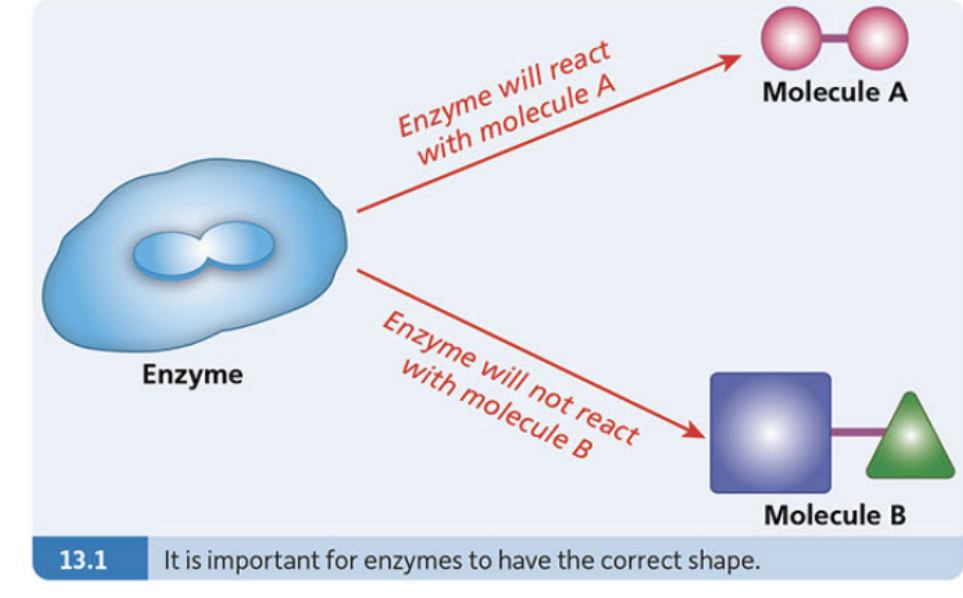
The relationship between enzyme shape and function follows the lock-and-key model. Just as a specific key fits into a particular lock, only substrate molecules with the correct complementary shape can bind to an enzyme's active site. This explains why enzymes are highly selective catalysts - they will only work with specific substrates.
Important
The shape of an enzyme's active site is absolutely crucial - if this shape is altered or destroyed, the enzyme loses its ability to function. This is why factors like temperature and pH can have such dramatic effects on enzyme activity.
How enzymes work
When an enzyme encounters its correct substrate, the following process occurs:
Example
How Enzyme Catalysis Works: Step-by-Step Process
- The substrate binds to the enzyme's active site, forming an enzyme-substrate complex
- The enzyme catalyses the reaction, converting the substrate into products
- The products are released from the active site
- The enzyme remains unchanged and can be used again
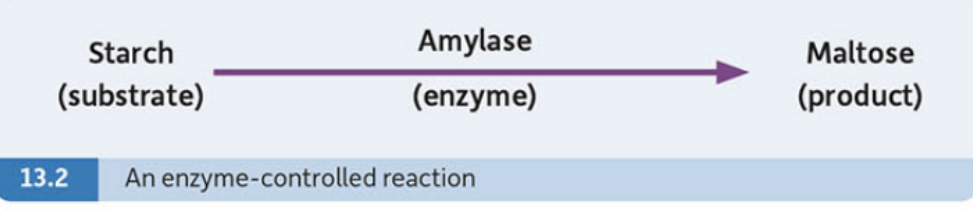
This diagram shows amylase enzyme breaking down starch (substrate) into maltose (product), demonstrating a typical enzyme-controlled reaction.
Factors affecting enzyme activity
Several environmental factors influence how effectively enzymes work. Understanding these factors is essential because enzymes must operate under optimal conditions to function properly.
Temperature effects
Temperature has a profound impact on enzyme activity, and this relationship follows a predictable pattern.
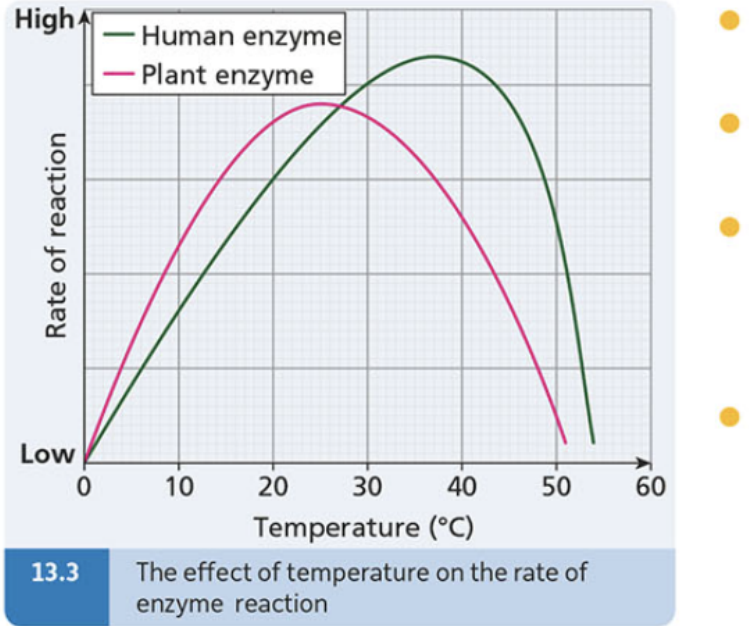
At low temperatures (around 0°C), enzymes work very slowly because there is insufficient kinetic energy for substrate molecules to collide frequently with the enzyme's active site. As temperature increases, molecular movement increases, leading to more frequent collisions between enzymes and substrates, thus increasing the reaction rate.
However, there is an optimal temperature for each enzyme:
- Human enzymes work best at 37°C (normal body temperature)
- Plant enzymes typically work best at 20-30°C
Important
Beyond the optimal temperature, enzyme activity decreases rapidly. This happens because high temperatures cause the enzyme's protein structure to unfold or denature. Once denatured, the active site loses its specific shape, making it impossible for substrates to bind properly.
pH effects
The pH of the environment significantly affects enzyme activity because it influences the enzyme's shape and the charges on its amino acids.
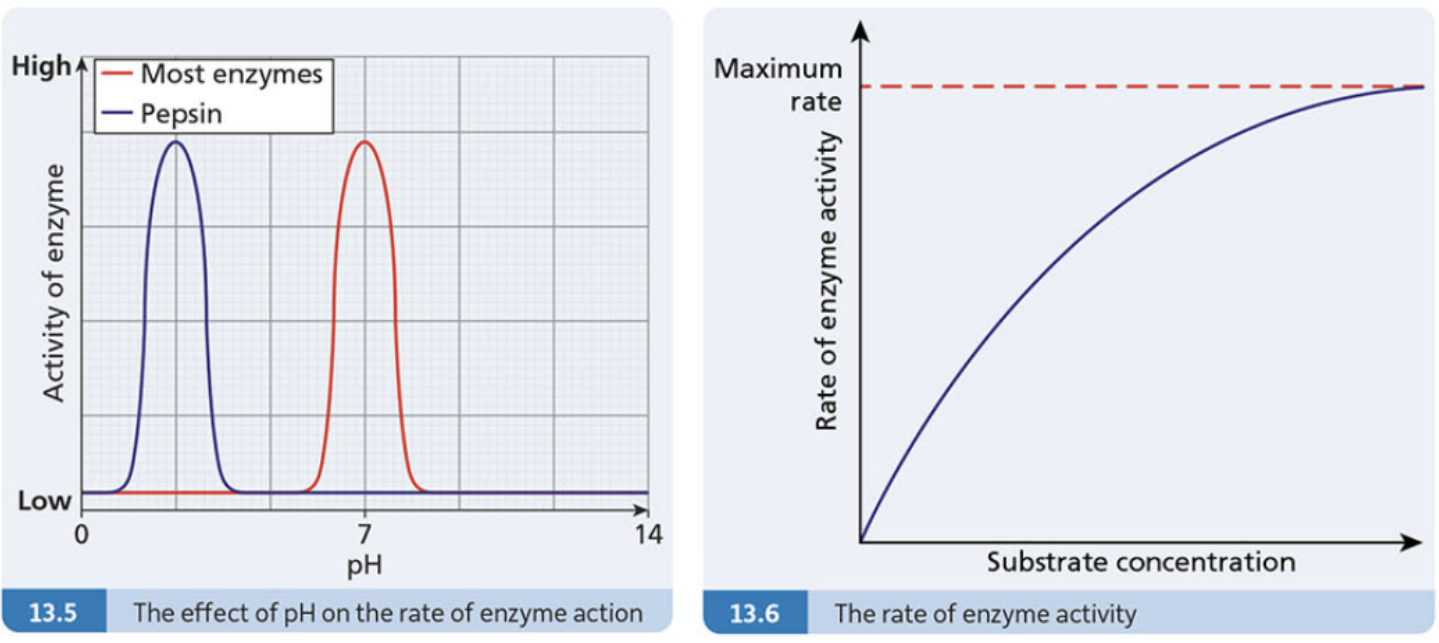
Most enzymes work best at a pH around 6-8 (near neutral), but there are important exceptions. For example, pepsin, which works in the acidic environment of the stomach, has an optimal pH of 2. This adaptation allows pepsin to function effectively in the highly acidic stomach conditions.
Note
Remember the connection: Pepsin in stomach = acidic conditions = pH 2. This is a perfect example of how enzymes have evolved to work in their specific environments.
When the pH moves away from an enzyme's optimum, the enzyme's shape begins to change, reducing its effectiveness. Extreme pH values can cause permanent denaturation, completely destroying the enzyme's ability to function.
Substrate concentration
The concentration of substrate molecules available affects how quickly an enzyme can work.
At low substrate concentrations, increasing the amount of substrate leads to a proportional increase in reaction rate because more substrate molecules are available to bind with enzyme active sites. However, at high substrate concentrations, the reaction rate plateaus. This happens because all enzyme active sites become saturated with substrate - they are working at maximum capacity.
Enzyme concentration
The amount of enzyme present directly affects the reaction rate, provided there is sufficient substrate available.
Increasing enzyme concentration leads to a linear increase in reaction rate because more enzyme molecules mean more active sites available to catalyse reactions. This relationship continues until substrate becomes the limiting factor.
Industrial uses of enzymes
Enzymes have revolutionised many industries due to their efficiency, specificity, and ability to work under relatively mild conditions.
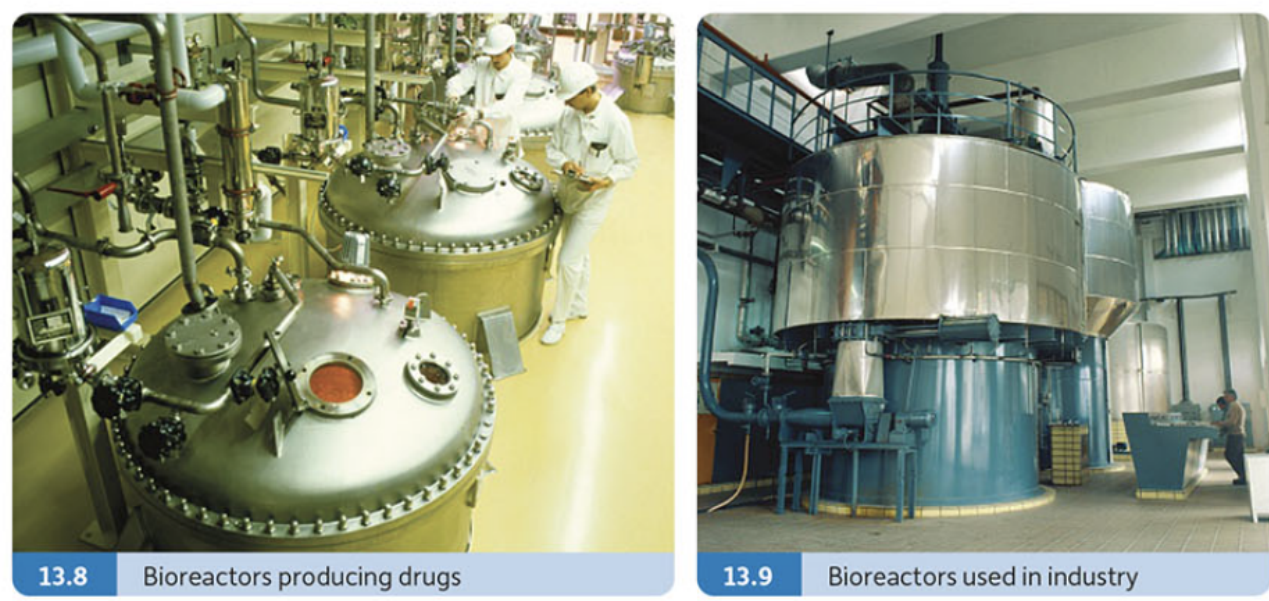
Modern industrial processes use large bioreactors to produce enzymes or use enzymes to manufacture products on a commercial scale.
Food and beverages
Enzymes play crucial roles in food production:
- Yeast enzymes are essential in baking, producing carbon dioxide that causes bread dough to rise and creating the light texture we expect in bread
- Amylase is used in brewing to break down starches into sugars, and to prevent bread from becoming stale
- Protein-digesting enzymes (proteases) are used in baby foods to pre-digest proteins, making them easier for infants to digest, and to tenderise meat
- Pectinases break down pectin in fruit cell walls to produce clearer fruit juices
- Lactase is used to produce lactose-free milk for people who are lactose-intolerant
Biofuels
Enzymes are essential for producing renewable energy sources:
- Fat-digesting enzymes (lipases) are used to make biodiesel from plant oils and waste cooking oils
- Cellulose-digesting enzymes (cellulases) break down plant materials to produce ethanol biofuel
- Amylase converts starch into sugars that can then be fermented into bioethanol
Note
Enzymes offer environmentally friendly alternatives to harsh chemical processes in biofuel production, operating under mild conditions and producing fewer harmful byproducts.
Medicines and pharmaceuticals
The pharmaceutical industry relies heavily on enzymes:
- Microorganisms containing specific enzymes produce antibiotics, vaccines, and other medications
- Genetically modified organisms produce important medicines like insulin and growth hormones
- Enzymes in bioreactors create compounds that fight cancer, lower cholesterol, reduce blood pressure, and treat various other medical conditions
Enzyme immobilisation
While free enzymes are effective catalysts, they have limitations in industrial applications. Immobilised enzymes - enzymes attached to solid supports or trapped within matrices - offer significant advantages.
Methods of immobilisation
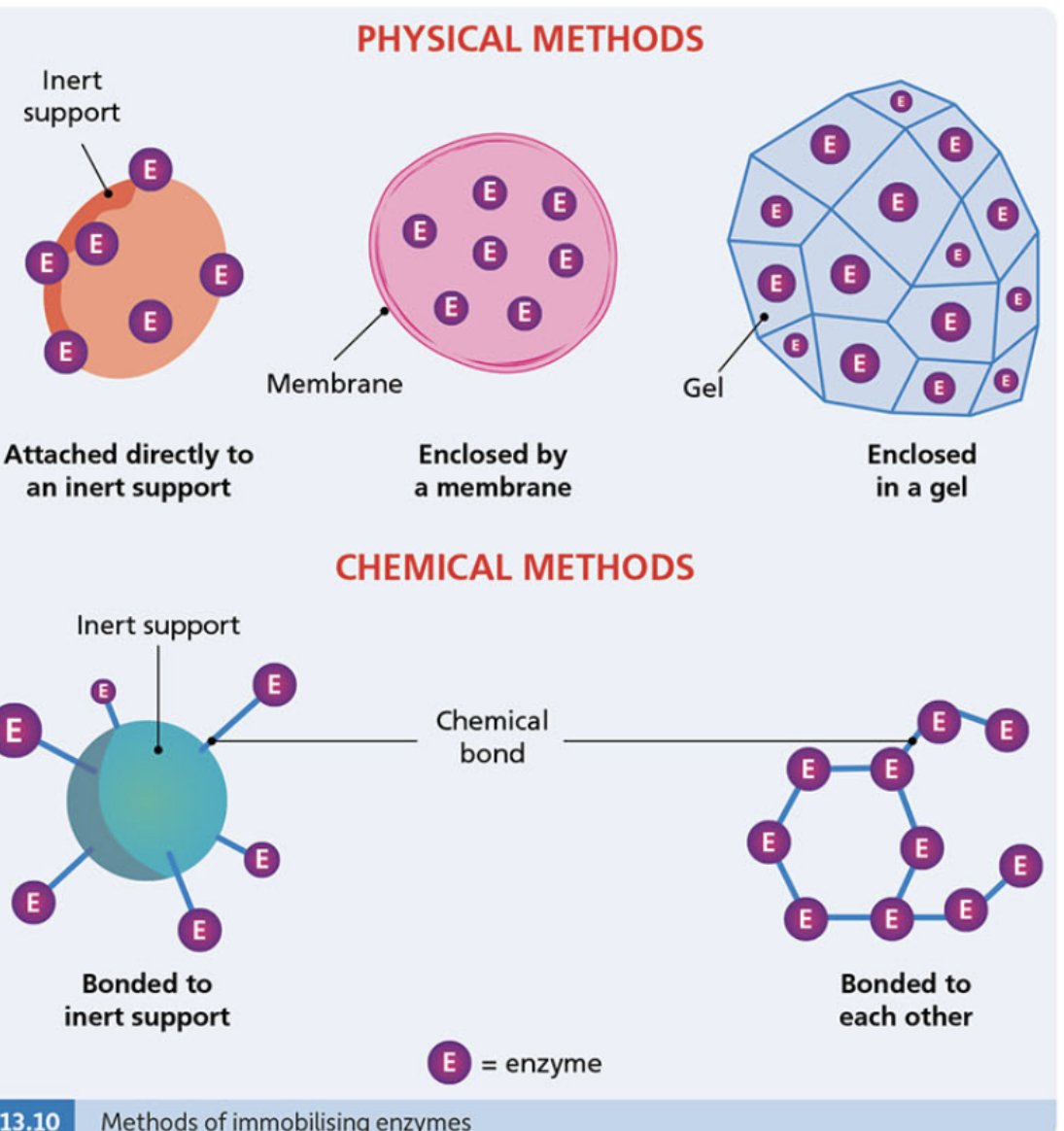
Enzymes can be immobilised using two main approaches:
Physical methods:
- Attachment to inert supports - enzymes are bound to solid materials like glass beads or plastic
- Enclosure by membrane - enzymes are contained within semi-permeable membranes that allow substrates and products to pass through
- Enclosure in gel - enzymes are trapped within gel matrices while remaining accessible to substrates
Chemical methods:
- Bonding to inert supports - enzymes are chemically linked to solid supports through covalent bonds
- Bonding to each other - enzymes are cross-linked together to form enzyme networks
Advantages of immobilised enzymes
Immobilising enzymes provides several important benefits for industrial processes:
- Reusability - Unlike free enzymes that are lost after one use, immobilised enzymes can be used repeatedly, making processes more economical
- Easy separation - Products can be easily separated from the immobilised enzymes, eliminating the need for complex purification steps
- Increased stability - The immobilisation process often makes enzymes more resistant to changes in temperature and pH
- Cost-effective production - While initial setup costs may be higher, the ability to reuse enzymes makes long-term production much cheaper
Note
Immobilised enzymes are particularly valuable in continuous production processes where the same reaction needs to occur repeatedly over extended periods. They are widely used in food processing, pharmaceutical manufacturing, and biotechnology applications where product purity and production efficiency are critical.
Remember!
Summary
Key Points to Remember:
-
Enzyme specificity depends on the precise shape of the active site - only substrates with complementary shapes can bind (lock-and-key model)
-
Optimal conditions vary between enzymes: human enzymes work best at 37°C and pH 6-8, while pepsin works at pH 2 in the acidic stomach
-
Denaturation occurs when temperature or pH extremes cause enzymes to lose their shape permanently, destroying their catalytic ability
-
Industrial applications span food production, renewable energy, and pharmaceuticals, with enzymes offering environmentally friendly alternatives to harsh chemical processes
-
Immobilised enzymes can be reused multiple times and are easily separated from products, making industrial processes more economical and efficient