Factors Affecting the Rate of Enzyme Activity (Leaving Cert Biology): Revision Notes
📚Revision Notes
Factors Affecting the Rate of Enzyme Activity
What factors affect the rate of enzyme action?
- Temperature
- pH
- Enzyme inhibitors
Note
Factors affecting the rate of enzyme action are conditions that can speed up or slow down how quickly an enzyme catalyses reactions.
1. Temperature
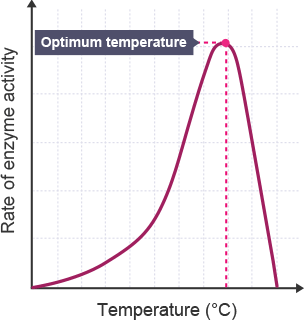
- All enzymes have an optimum temperature, which is the temperature at which they work best.
- At 0°C, water freezes, and enzyme and substrate molecules cannot move. The enzyme action rate is zero.
- As the temperature rises, molecules move faster. This causes enzymes and substrates to collide more often, which speeds up reactions.
- As temperature increases, the rate of enzyme action also increases.
- Above a certain temperature, the enzyme's shape begins to change. The rate of enzyme action decreases. In humans, this happens above 37°C.
- At very high temperatures, the enzyme's active site changes permanently and the enzyme stops working. This is called denaturation.
- The optimum temperature for plant enzymes is between 25°C and 35°C.
Note
Note: Enzymes are denatured at high temperatures, not low temperatures. At low temperatures, enzymes just move slower, and their active sites don't permanently change shape.
Note
Optimum temperature: the specific temperature at which an enzyme works best.
Note
Denatured: the active site of an enzyme has been destroyed. The enzyme can no longer act on the substrate.
2. pH
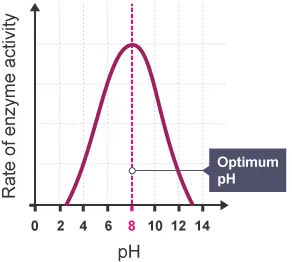
- All enzymes have an optimum pH, which is the pH at which they work best.
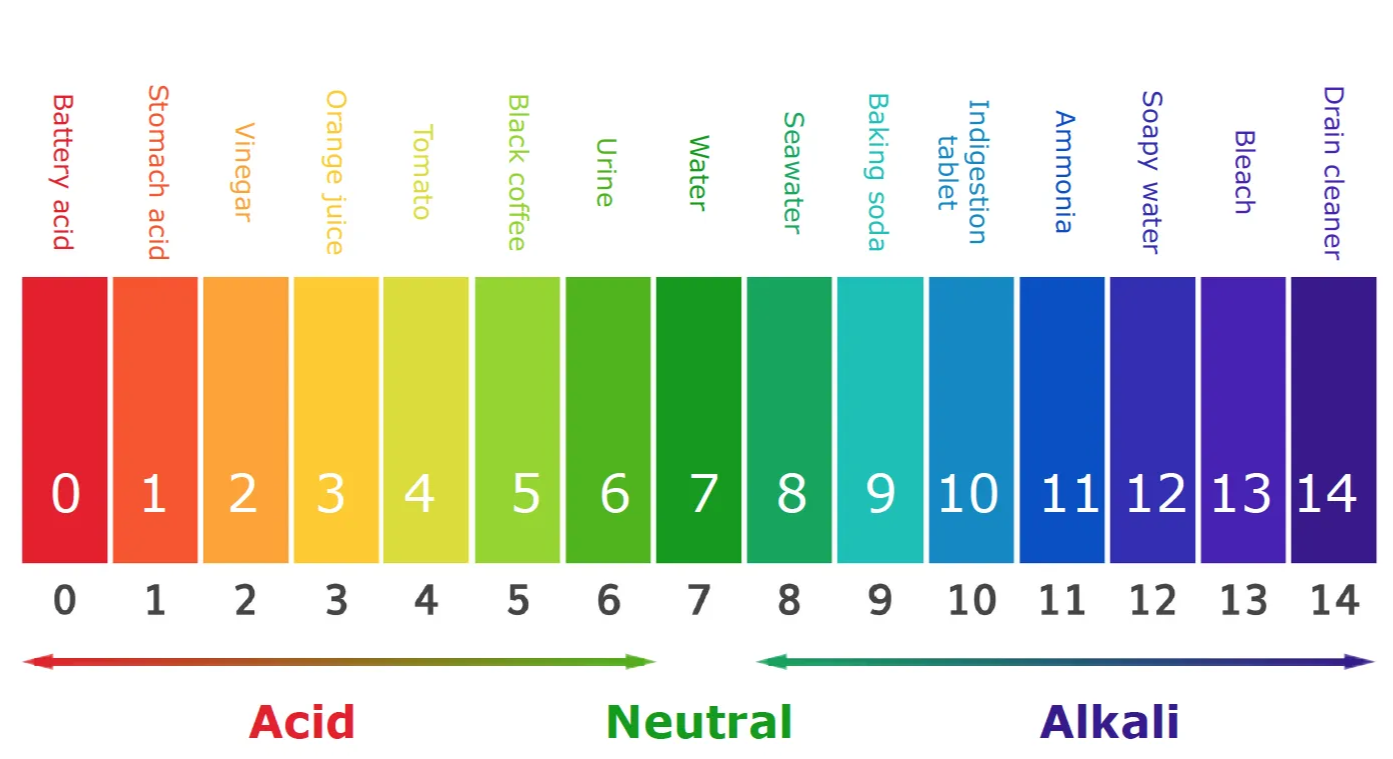
- The pH scale ranges from 0 to 14.
- pH below 7: Acidic
- pH 7: Neutral
- pH above 7: Alkaline
- Many enzymes work best between a pH of 6 and 8.
- Outside this range, the enzyme becomes denatured. The active site changes shape permanently.
- A buffer solution is used to keep the pH constant in experiments.
- For example, a buffer 5 solution keeps the pH at 5.
3. Enzyme Inhibitors
Note
Enzyme inhibitors: inhibitors are chemicals that attach to an enzyme and destroy its shape.
- Cyanide blocks enzymes involved in respiration.
- Heavy metals like mercury and lead.
- Nerve gases like sarin attack enzymes involved in transmitting nerve impulses.
Experiments
There are three experiments related to this section. Check out our experiment notes:
- To investigate the effect of pH on enzyme activity
- To investigate the effect of temperature on enzyme activity
- To investigate the effect of denaturation by heat on enzyme activity
Note
Keep pushing forward—you've got this!