Aerobic Respiration (Leaving Cert Biology): Revision Notes
📚Revision Notes
Aerobic Respiration
Note
Aerobic respiration: the enzyme-controlled release of energy from food using oxygen.
Note
C₆H₁₂O₆ + 6O₂ → 6CO₂ + 6H₂O + Energy (ATP)
Glucose + Oxygen → Carbon Dioxide + Water + Energy (ATP)
- Aerobic respiration involves the complete breakdown of glucose.
- It produces more energy than anaerobic respiration.
- There are two stages of aerobic respiration:
- Glycolysis
- Krebs cycle and the electron transport chain
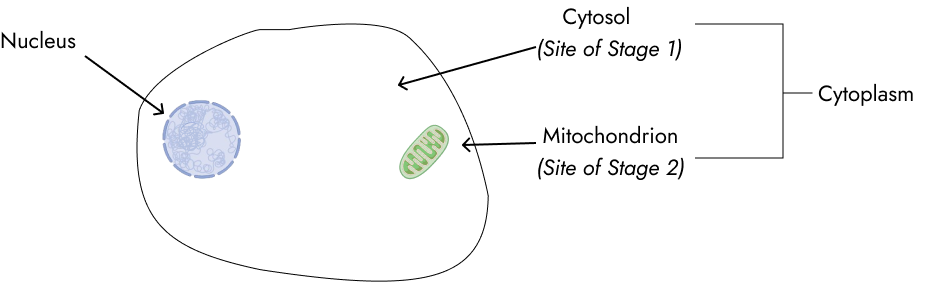
Mitochondrion:
Note
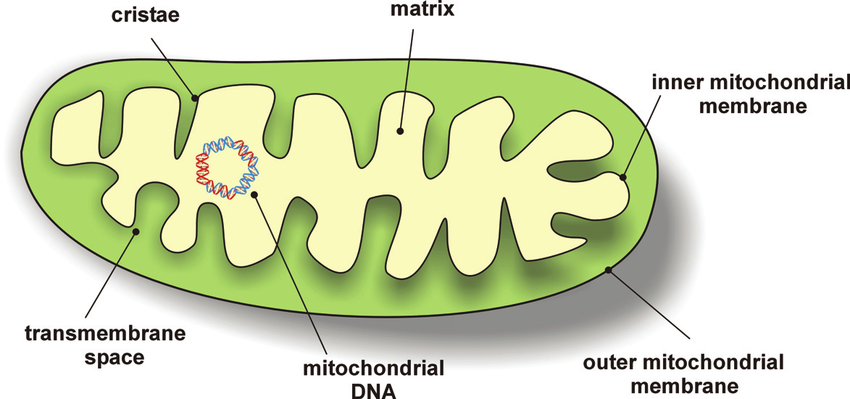
Mitochondria have a double membrane with inner folding of cristae. This increases the surface area, allowing more reactions to occur and producing more energy e.g. muscles in the legs have heavily folded mitochondria as they require lots of energy.
Stage 1: Glycolysis
- Glycolysis takes place in the cytosol of the cell.
- The cytosol is the cytoplasm without any organelles.
- This stage is anaerobic, meaning it does not require oxygen to occur.
- As this stage is anaerobic, it releases very little energy - only 2 ATP molecules are produced for each glucose molecule broken down.
- Glucose is broken down into two 3-carbon molecules called pyruvic acid (or pyruvate).
- 2 ADP molecules are converted into 2 ATP molecules.
- When glucose is broken into 2 pyruvic acids, 4 high-energy electrons and 2 protons are released.
- These are captured by 2 NAD⁺ molecules, forming 2 NADH.
- Most of the energy originally stored in the bonds of glucose remains in the bonds of the two 3-carbon molecules (pyruvate).
Stage 2: Krebs Cycle and the Electron Transport Chain
-
Stage 2 takes place in the mitochondria.
-
This stage is aerobic, meaning it requires oxygen.
-
A large amount of energy is released in this stage as many ATP molecules are produced.
-
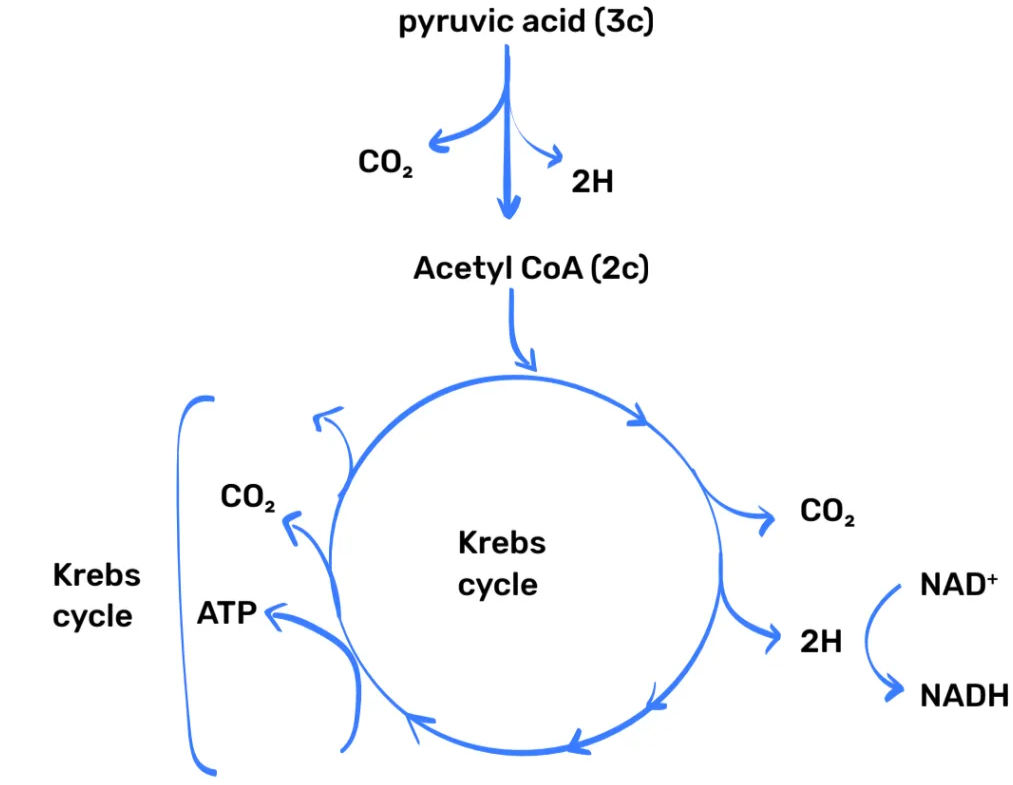
NADH molecules are also produced and sent to the electron transport chain. When oxygen is present, pyruvic acid enters the mitochondrion:
-
Pyruvic acid is converted into a small 2-carbon molecule called acetyl coenzyme A (acetyl CoA).
-
Acetyl CoA then enters a series of reactions known as the Krebs cycle.
Krebs Cycle
- In the Krebs cycle, acetyl CoA is broken down into carbon dioxide (CO₂) and water (H₂O).
- High-energy electrons are released during this process.
- These electrons are picked up by NAD⁺, forming NADH, which is sent to the electron transport chain.
- Additionally, ADP is converted into ATP during the cycle.
- As part of the process, two CO₂ molecules are produced.
Electron Transport System/Chain
- The NADH molecules produced during the Krebs cycle move to the inner membrane (cristae) of the mitochondrion.
- Here, NADH breaks down to release high-energy electrons and protons (H⁺).
- The electrons pass along a series of chemicals in the electron transport chain.
- As the electrons move through the chain, they release energy, which is used to convert ADP into ATP.
- At the end of the chain, the electrons combine with oxygen and hydrogen ions to form water (H₂O).
Note
Key Features of Aerobic Respiration
- Location:
- Aerobic respiration occurs in the cytosol (glycolysis) and mitochondria (Krebs cycle and electron transport chain).
- Oxygen Requirement:
- Oxygen is required for the second stage of respiration.
- It acts as the final electron acceptor in the electron transport chain.
- Main Products:
- ATP: Energy used by cells for growth, movement, repair, and other activities.
- Carbon dioxide (CO₂): Released as a waste product and exhaled.
- Water (H₂O): Produced as a by-product and reused or excreted.
-
Stages of Aerobic Respiration: Aerobic respiration is divided into two main stages:
-
Stage 1: Glycolysis (Occurs in the Cytosol)
-
Stage 2: Krebs Cycle and Electron Transport Chain (Occurs in the Mitochondria)