Food Chains, Food Webs, and Pyramids of Numbers (Leaving Cert Biology): Revision Notes
📚Revision Notes
Food Chains, Food Webs, and Pyramids of Numbers
Food chains
A food chain represents a linear sequence that shows how energy moves from one living organism to another. Think of it as nature's energy highway, where each organism serves as both a meal for the next level and a consumer of the previous one.
In every food chain, organisms occupy different trophic levels based on their feeding relationships:
Note
Understanding Trophic Levels
Each level represents a feeding position in the food chain, with energy flowing from lower to higher levels:
- Producers (1st trophic level): Green plants that capture energy from sunlight
- Primary consumers (2nd trophic level): Herbivores that eat plants
- Secondary consumers (3rd trophic level): Carnivores that eat herbivores
- Tertiary consumers (4th trophic level): Top predators that eat other carnivores
Energy flow and the 10% rule
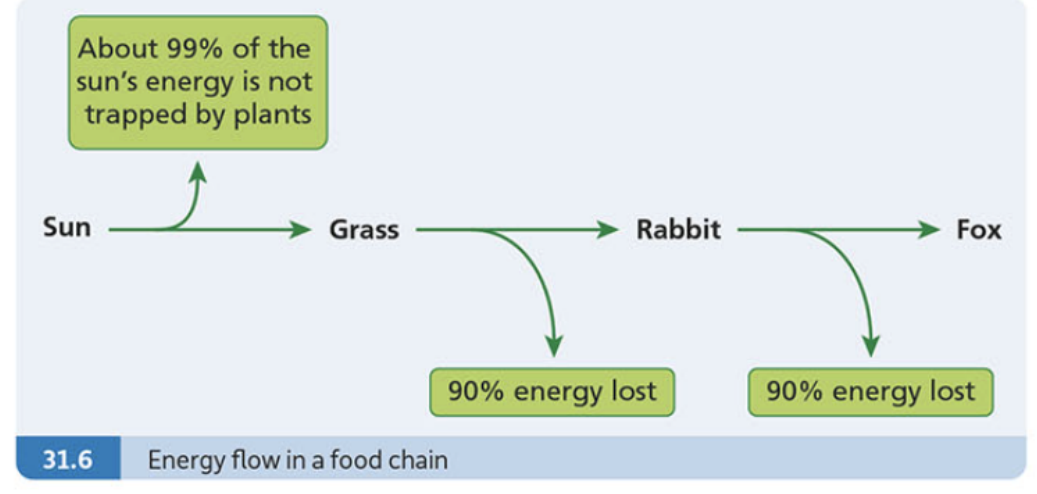
Energy transfer in food chains follows a predictable pattern that's crucial for understanding ecosystem dynamics. As energy moves from one trophic level to the next, approximately 90% is lost at each stage through metabolic processes, movement, heat production, and waste.
Important
The 10% Rule
Only about 10% of available energy passes from one trophic level to the next. This dramatic energy loss is the fundamental principle that shapes all ecosystem structures.
Example
Energy Transfer Example
Let's trace energy through a simple food chain:
- Grass (Producer): Contains 1000 energy units
- Rabbit (Primary consumer): Receives only ~100 energy units (10%)
- Fox (Secondary consumer): Receives only ~10 energy units (10% of 100)
This demonstrates why each level can support fewer organisms than the level below it.
Length of food chains
The significant energy loss at each level naturally limits how long food chains can be. Top predators require vast amounts of energy to survive, which means they need access to large territories to find enough prey. This energy constraint explains why there are always fewer predators than prey in healthy ecosystems.
Food webs
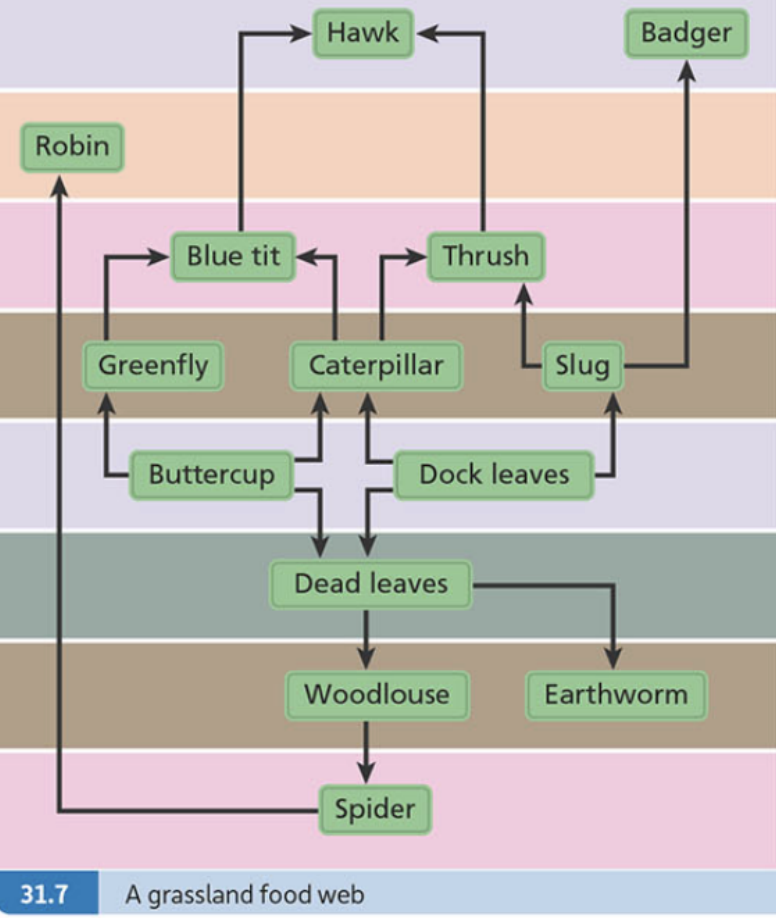
Real ecosystems are far more complex than simple linear food chains. A food web consists of multiple interconnected food chains that show the intricate feeding relationships within an ecosystem. Most organisms don't rely on just one food source, and many serve as prey for several different predators.
Note
Why Food Webs Matter
Food webs provide a more accurate picture of energy flow and nutrient cycling in nature. They demonstrate how organisms are interconnected and how changes to one species can ripple through the entire ecosystem.
For instance, the removal of a key predator might cause herbivore populations to explode, which could then lead to overgrazing of plant communities. This interconnectedness highlights the delicate balance that maintains ecosystem stability.
Pyramids of numbers
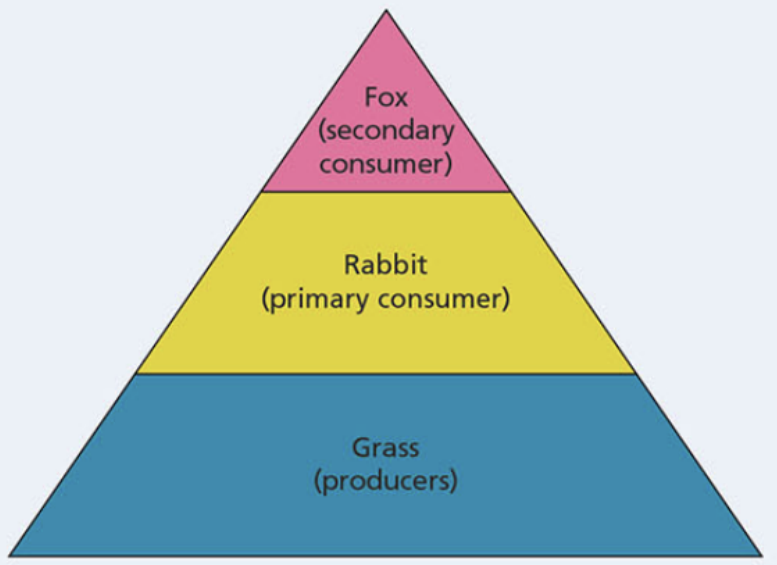
A pyramid of numbers provides a visual representation of how many organisms exist at each trophic level in a food chain or food web. These diagrams typically show a pyramid shape because the number of individuals generally decreases as you move up trophic levels.
Why numbers decrease up the pyramid
Two main factors explain this pattern:
Note
Factors Limiting Higher Trophic Levels
Energy availability: Since 90% of energy is lost at each level, there's simply less energy available to support large numbers of organisms at higher trophic levels.
Size relationships: Organisms typically increase in size as you move up trophic levels. Larger predators require more energy and territory than smaller prey, naturally limiting their population sizes.
Uses of pyramids of numbers
Pyramids of numbers serve several important purposes in ecological studies:
- Health indicators: They help scientists assess ecosystem health and stability
- Energy flow visualisation: They provide clear pictures of how energy moves through different trophic levels
- Biodiversity assessment: They help evaluate ecosystem biodiversity and its ability to withstand environmental changes
- Threat identification: They can identify threats to different trophic levels and guide conservation efforts
- Prediction tool: They help predict how ecosystems might respond to future changes
- Human impact assessment: They can evaluate how human activities affect natural ecosystems
Ecological niches
An organism's niche refers to its functional role within an ecosystem - essentially, it's "how" an organism makes its living. A niche includes what an organism eats, what eats it, when it's active, where it lives, and how it interacts with both other organisms and its physical environment.
Niche partitioning
Two species with identical niches cannot coexist in the same habitat for long periods because they would compete directly for the same resources. This leads to niche partitioning, where similar species evolve to occupy slightly different roles to reduce competition.
Example
Spatial Niche Partitioning: Bird Feeding Strategies
Different bird species avoid competition by feeding in different locations:
- Swallows: Hunt aerial insects during flight
- Thrushes: Search for ground-dwelling insects and snails
- Blackbirds: Take insects from trees but prefer fruit and worms
Example
Temporal Niche Partitioning: Day vs. Night Hunters
Some species avoid competition by being active at different times:
- Bats: Hunt flying insects at night using echolocation
- Swallows: Hunt flying insects during daylight hours using vision
This temporal separation allows both species to exploit similar food sources without direct competition.
Summary
Key Points to Remember:
-
Energy flow is unidirectional: Energy moves from the sun through producers to consumers, with 90% lost at each trophic level
-
Food webs are more realistic than food chains: Most ecosystems contain complex, interconnected feeding relationships rather than simple linear chains
-
Pyramids of numbers typically decrease upwards: Fewer organisms can be supported at higher trophic levels due to energy constraints
-
Niches prevent direct competition: Similar species evolve different functional roles to coexist in the same ecosystem
-
The 10% rule limits food chain length: Massive energy losses explain why ecosystems rarely support more than four or five trophic levels