Population Control: Competition, Predation & Symbiosis (Leaving Cert Biology): Revision Notes
📚Revision Notes
Population Control: Competition, Predation & Symbiosis
Note
A population consists of all the members of a species in an area. Species: a group of similar organisms capable of interbreeding and producing fertile offspring.
Example: All the rabbits in a field make up a population of rabbits.
While the number of individuals in a population can rise and fall, nature generally ensures that the number of different species in a habitat stays relatively stable over time.
Note
Definition Review! Habitat: place where a plant or animal lives
Factors that control population numbers:
- Competition
- Predation
- Parasitism
- Symbiosis
1. Competition
Note
Competition is the struggle between two or more organisms for a resource that is in short supply.
- Animals compete for food, shelter, mates etc.
- Plants compete for light, space, water etc.
- Interspecific competition: competition between members of different species.
- Intraspecific competition: competition between members of the same species. There are two main types of competition:
- Contest competition
- Scramble competition
Note
Contest Competition
- An active physical struggle between different organisms.
- Produces one winner and one loser.
- E.g. two male deer fighting for female mates.
Note
Scramble Competition
- All competing organisms get some of the resource.
- E.g. plant seedlings competing for light and space.
Benefits of Competition
-
Maintains a species at a sustainable level Competition helps control population sizes, making sure species don't overpopulate and use up all the resources in their environment.
-
Driving factor for evolution Competition pushes species to adapt. Those with better traits for survival will thrive, leading to changes in the species over time.
2. Predation
Note
Predation is the catching, killing and eating of another organism for food. The prey is the animal killed by the predator.
Adaptations
Adaptation: a characteristic or behaviour that helps an organism survive and reproduce in its environment.
Note
Adaptations of Predators
- Fox: Coat provides camouflage to avoid detection.
- Behavioural adaptation: hunts at night (nocturnal).
- Hawk: Excellent eyesight to spot prey.
Note
Plant Adaptations
Blackberry: Thorns to protect berries from being eaten.
Note
Adaptations of Prey
- Rabbits: Long ears to hear predators
- Behavioural adaptation: hide in burrows for safety.
- Frogs: Camouflage to avoid being seen and caught.
Predator-Prey Relationship
Predator: Frog
Prey: Cricket
- As the population of prey increases, the population of predators will increase (more food available).
- As predator population begins to increase, prey population decreases.
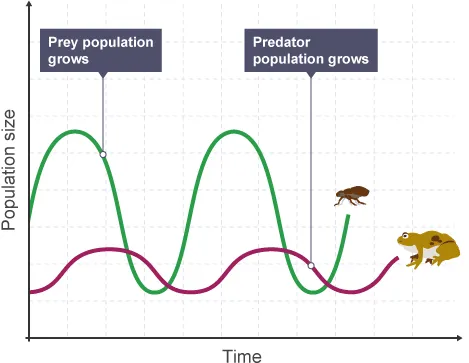
This graph illustrates the predator-prey relationship between frogs (predators) and crickets (prey), showing how their populations change over time.
- Prey population grows (green line): When the cricket population increases, there's more food available for the frogs.
- Predator population grows (purple line): As the number of crickets rises, frogs have more to eat, so their population increases too.
- Prey population decreases: As the frog population grows, they consume more crickets, causing the cricket population to decrease.
- Predator population decreases: With fewer crickets available as food, the frog population starts to fall because there's less food to support them.
- Prey population rises again: As the number of frogs decreases, the remaining cricket population can start to reproduce again.
- Cycle repeats: As the cricket population grows, the number of frogs increases again, and the cycle continues.
Important Points:
- Prey is never completely wiped out: Some crickets may hide, escape, or find ways to avoid predators, allowing small groups to survive and eventually reproduce.
- Predators may move to new areas: If the number of crickets falls too low, frogs may move to an area with more available prey. This gives the remaining crickets a chance to grow in numbers again. This cycle demonstrates how predator and prey populations are interdependent and how they influence each other's numbers over time.
Note
Key Point: The predators (frogs) rely on the prey (crickets) for food. As the prey decreases, so does the predator population. This allows the prey to recover.
Note
An interdependent relationship is when two or more species rely on each other for survival, with changes in one population affecting the other.
Note
Exam Tip: You may be asked to draw this graph in your exam. Remember:
- Predator always follows prey.
- The peak value for prey is always higher than the peak value for predator.
Factors that Affect Predator-Prey Populations:
- Disease
- Availability of food: A larger prey population can lead to an increase in the predator population, due to more food availability.
- Migration of predators: If the prey population is too low, predators be forced to move to another area. This allows the prey population in the original area to recover.
3. Parasitism & Symbiosis
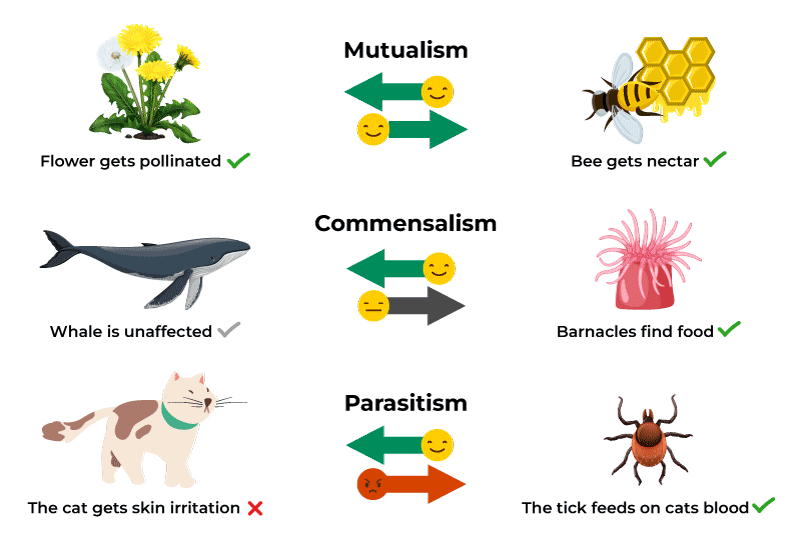
- Symbiosis: two organisms from different species that live in close association, where at least one of them benefits.
- Parasitism: a form of symbiosis in which one species gains and the other species loses.
- Parasite: A living organism that takes its food from another living organism, called a host, and usually causes harm.
- E.g. fleas on the skin of dogs and cats.
- Mosquitoes on humans.
- Mutualism: a form of symbiosis in which both organisms benefit
- E.g. Bacteria in the small intestine of humans produce vitamin K for the human.
- The bacteria gets food and shelter from the host**.**