Structure (Leaving Cert Biology): Revision Notes
📚Revision Notes
Structure

Nucleic acids - what are they?
Nucleic acids are essential large molecules found in all living cells. They are the molecules that store and carry genetic information, making them absolutely crucial for life. There are two main types of nucleic acids that you need to understand: DNA (deoxyribonucleic acid) and RNA (ribonucleic acid).
These biomolecules are built from smaller units called nucleotides, which link together to form long chains. Think of nucleotides as the building blocks, similar to how bricks build a wall.
Note
Nucleic acids are found in every living cell on Earth - from the smallest bacteria to complex organisms like humans. Without these molecules, life as we know it could not exist because they carry the instructions that tell cells how to function and reproduce.
The structure of DNA
DNA, or deoxyribonucleic acid, is the molecule that contains the genetic instructions for all living organisms. Understanding its structure was one of the greatest scientific discoveries of the 20th century.
The structure of DNA can be understood by looking at three key aspects: nucleotides, base pairs, and the double helix.
Nucleotides - the building blocks
Every nucleotide in DNA is made up of three essential components:
Important
The Three Components of Every DNA Nucleotide:
- Phosphate group - provides the negative charge and links nucleotides together
- Deoxyribose sugar - a five-carbon sugar that forms the backbone
- Nitrogenous base - carries the genetic information
Remember: ALL nucleotides must have these three parts to function properly!
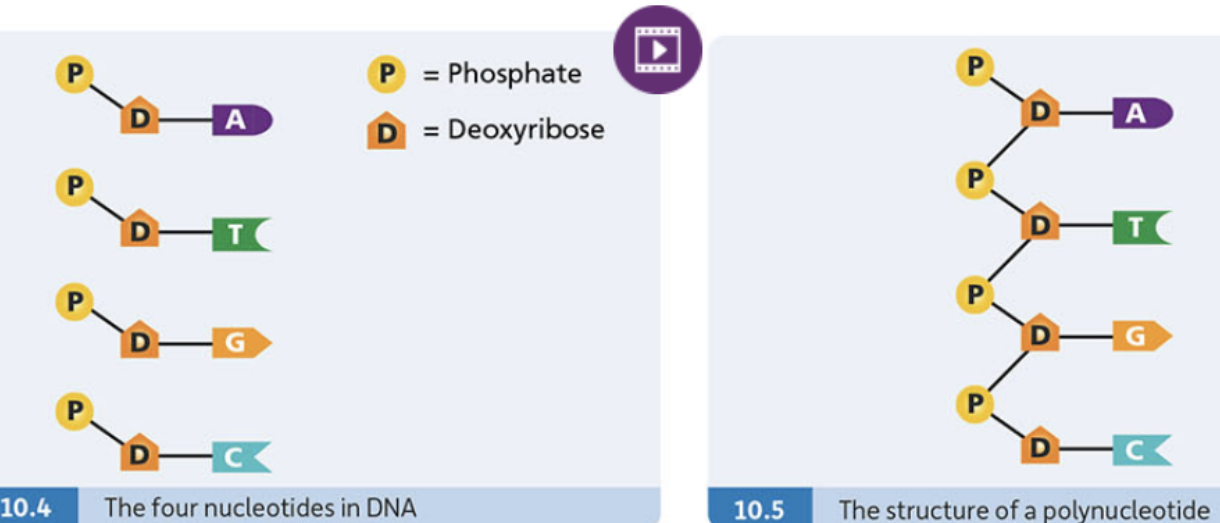
There are four different nitrogenous bases in DNA:
- Adenine (A) - a purine base
- Thymine (T) - a pyrimidine base
- Guanine (G) - a purine base
- Cytosine (C) - a pyrimidine base
When nucleotides join together, they form a polynucleotide chain. The phosphate group of one nucleotide bonds to the deoxyribose sugar of the next, creating a strong backbone.
Base pairs
One of the most important features of DNA is how the bases pair up with each other. This pairing follows strict rules:
- Adenine always pairs with Thymine (A-T) using 2 hydrogen bonds
- Guanine always pairs with Cytosine (G-C) using 3 hydrogen bonds
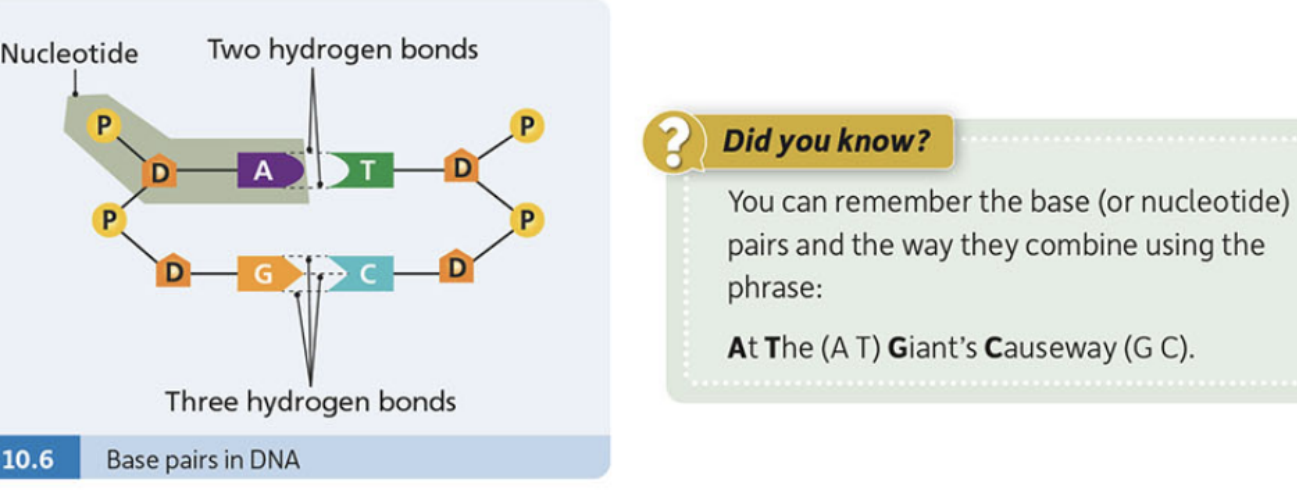
This specific pairing is called complementary base pairing. It means that if you know the sequence of bases on one strand, you can predict the sequence on the opposite strand.
Example
Worked Example: Complementary Base Pairing
If one DNA strand has the sequence: A-T-G-C-C-A
Then the complementary strand must be: T-A-C-G-G-T
Step-by-step:
- A pairs with T
- T pairs with A
- G pairs with C
- C pairs with G
- C pairs with G
- A pairs with T
Note
Memory tip: Remember "At The Giant's Causeway" - Adenine with Thymine, and Guanine with Cytosine!
The double helix
DNA doesn't exist as a single chain - it forms a famous double helix structure. This looks like a twisted ladder where:
- The sides of the ladder are made from the phosphate-sugar backbone
- The rungs of the ladder are formed by the paired bases
- The whole structure spirals to form the characteristic double helix shape
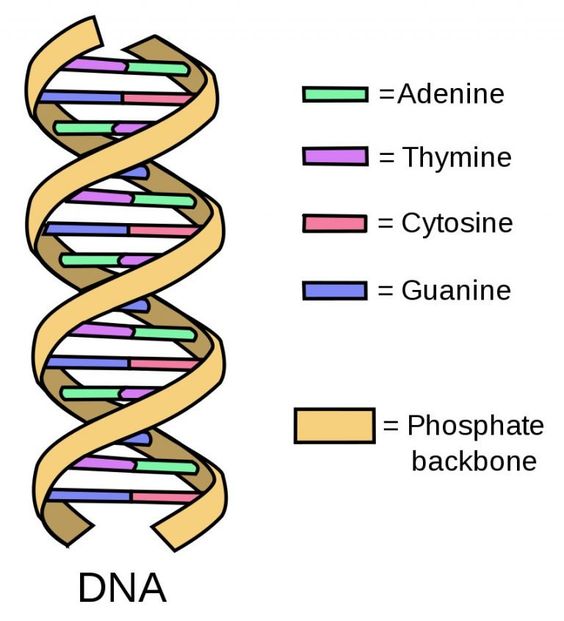
The two strands of DNA run in opposite directions and are held together by hydrogen bonds between the complementary base pairs. This structure is incredibly stable yet can be "unzipped" when needed for processes like DNA replication.
Note
The double helix structure was discovered by Watson and Crick in 1953, building on X-ray crystallography work by Rosalind Franklin. This discovery revolutionised our understanding of genetics and earned them the Nobel Prize.
The structure of RNA
RNA (ribonucleic acid) is similar to DNA but has several key differences that make it perfect for its different roles in the cell.
RNA nucleotides
Like DNA, RNA is made of nucleotides, but these have slightly different components:
- Phosphate group - identical to DNA
- Ribose sugar - similar to deoxyribose but with one extra -OH group
- Nitrogenous base - four types, but one is different from DNA
The four bases in RNA are:
- Adenine (A)
- Uracil (U) - replaces thymine from DNA
- Guanine (G)
- Cytosine (C)
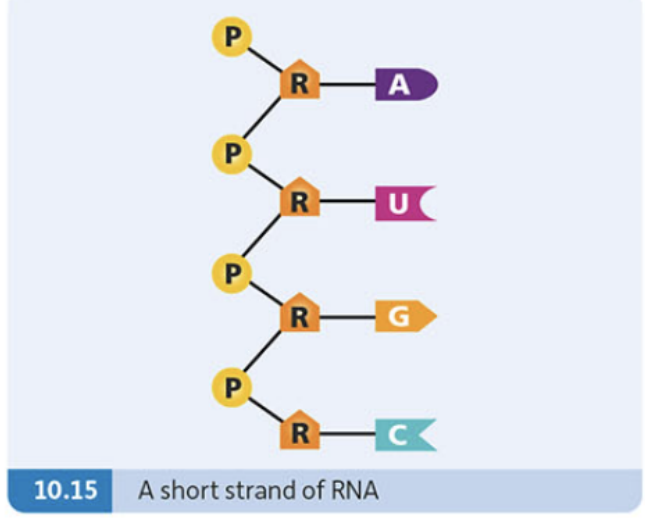
Differences between DNA and RNA
Understanding the key differences between DNA and RNA is crucial:
Important
Critical Differences Between DNA and RNA:
Sugar type:
- DNA contains deoxyribose sugar
- RNA contains ribose sugar (has an extra -OH group)
Bases used:
- DNA uses A, T, G, C
- RNA uses A, U, G, C (uracil instead of thymine)
Structure:
- DNA is double-stranded (double helix)
- RNA is typically single-stranded
Base pairing in RNA:
- A pairs with U
- G pairs with C
Location:
- DNA is mainly found in the nucleus
- RNA can be found in both nucleus and cytoplasm
Chromosomes, DNA and genes
DNA doesn't just float around freely in cells - it's carefully packaged into structures called chromosomes.

Chromosomes are composed of:
- 60% protein (mainly histones)
- 40% DNA
The DNA molecule is incredibly long, so it needs to be tightly wrapped around proteins called histones to fit inside the cell nucleus. This creates a compact, organised structure.
Genes are specific sections of DNA found along chromosomes. Each gene contains the instructions for making a particular protein or controlling a specific trait. In humans:
- We have 46 chromosomes (23 pairs)
- Each chromosome contains thousands of genes
- Genes can be located anywhere along the chromosome
- Some genes are clustered together, others are spread out
Note
If you could unravel all the DNA in a single human cell and stretch it out, it would be about 2 metres long! The packaging of DNA into chromosomes is essential for fitting this enormous amount of genetic material into the tiny cell nucleus.
Remember!
Summary
Key Points to Remember:
- Nucleotides are the building blocks - each contains a phosphate, sugar, and base
- DNA uses A-T and G-C base pairing with hydrogen bonds holding them together
- RNA uses A-U and G-C base pairing and contains ribose sugar instead of deoxyribose
- DNA forms a double helix structure while RNA is typically single-stranded
- Chromosomes package DNA efficiently by wrapping it around histone proteins
- Complementary base pairing allows prediction of one DNA strand from another
- The extra -OH group in RNA makes it less stable but more chemically active than DNA