Genetic Inheritance (LC 2027) (Leaving Cert Biology): Revision Notes
📚Revision Notes
Non-Nuclear DNA
What is non-nuclear DNA?
Non-nuclear DNA is genetic material found outside the nucleus in plant and animal cells. Unlike the DNA we usually study, this extranuclear DNA exists in special organelles within the cell's cytoplasm. The two main locations for non-nuclear DNA are:
- Mitochondria (found in both plant and animal cells)
- Chloroplasts (found only in plant cells)
The DNA in mitochondria is called mtDNA, while the DNA in chloroplasts is called cpDNA. This genetic material is quite different from nuclear DNA in several important ways.
Characteristics of non-nuclear DNA
Non-nuclear DNA has several unique features that set it apart from the DNA in the nucleus:
Structure and size: Non-nuclear DNA exists as small, circular loops rather than the long, linear chromosomes found in the nucleus. These loops contain relatively few genes compared to nuclear DNA.
Gene numbers:
- Mitochondrial DNA contains approximately 37 genes
- Chloroplast DNA contains approximately 100 genes
Note
Both mitochondria and chloroplasts can reproduce on their own inside cells, independently of cell division. This ability suggests these organelles have a special evolutionary history and supports the idea that they were once free-living bacteria.
How non-nuclear DNA is inherited
The inheritance pattern of non-nuclear DNA is completely different from nuclear DNA inheritance. Most importantly, non-nuclear DNA follows maternal inheritance.
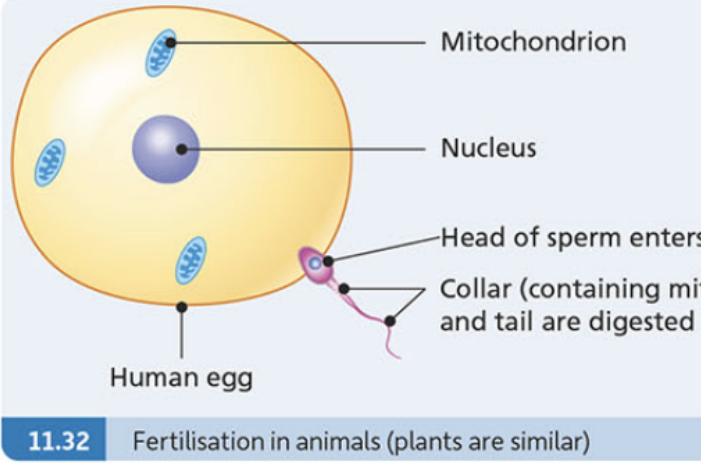
During fertilisation, something fascinating happens. While sperm cells do contain mitochondria in their collar region, only the sperm head enters the egg during fertilisation. The collar and tail, which contain the sperm's mitochondria, are digested and don't contribute to the developing embryo.
This means that almost all mitochondria (and their DNA) in offspring come from the mother's egg cell. In plants, the same pattern occurs - the pollen typically doesn't contribute mitochondria or chloroplasts to the developing seed.
Important
Because of maternal inheritance, you inherit your mitochondrial DNA almost entirely from your mother, not from both parents like nuclear DNA. This creates a unique inheritance pattern that can be traced through maternal family lines.
Functions of non-nuclear genes
The genes found in mitochondria and chloroplasts have very specific and important roles:
Mitochondrial DNA (mtDNA)
Mitochondrial genes are primarily involved in energy production. They control the processes that allow mitochondria to produce ATP, the cell's main energy currency. These genes help make:
- Proteins needed for cellular respiration
- Components of the electron transport chain
- Essential enzymes for energy metabolism
Chloroplast DNA (cpDNA)
Chloroplast genes mainly control photosynthesis and pigment formation. They're responsible for:
- Making proteins needed for capturing light energy
- Producing chlorophyll and other photosynthetic pigments
- Controlling various aspects of photosynthesis

This coleus plant shows the effects of chloroplast genes in action - the different colours and patterns in the leaves are controlled by genes in the chloroplasts that determine pigment production.
Medical significance of non-nuclear DNA
Important
Critical Medical Information
Disorders involving non-nuclear DNA have distinctive characteristics because they affect energy production systems. These conditions typically:
- Cause problems with energy metabolism
- Affect organs and systems with high energy demands (such as muscles, brain, heart, and nervous system)
- Show maternal inheritance patterns in families
- Cannot be treated using traditional genetic therapies designed for nuclear DNA
Common symptoms might include muscle weakness, neurological problems, or issues with organs that require lots of energy to function properly.
Evolutionary origin
The presence of DNA in mitochondria and chloroplasts provides strong evidence for the endosymbiotic theory. This theory suggests that millions of years ago, ancient bacteria were taken into early cells and formed a mutually beneficial relationship.
Note
Understanding Endosymbiotic Theory
Over time, these bacteria evolved into the mitochondria and chloroplasts we see today. This explains why:
- These organelles have their own DNA (like bacteria)
- They can reproduce independently
- Their DNA is circular (like bacterial DNA)
- They have double membranes (from being engulfed by other cells)
This evolutionary relationship means that mitochondria and chloroplasts are essentially ancient bacterial partners living inside our cells!
Summary
Key Points to Remember:
-
Non-nuclear DNA is found in mitochondria (mtDNA) and chloroplasts (cpDNA), not in the cell nucleus
-
Maternal inheritance - you inherit non-nuclear DNA almost entirely from your mother because sperm mitochondria don't enter the egg
-
Fewer genes - mtDNA has about 37 genes, cpDNA has about 100 genes (much less than nuclear DNA)
-
Energy and photosynthesis - mtDNA controls energy production, cpDNA controls photosynthesis and pigment formation
-
Medical disorders involving non-nuclear DNA typically affect high-energy systems like muscles, brain and heart