Growth Curve (Leaving Cert Biology): Revision Notes
📚Revision Notes
Growth Curve
- Population growth of microorganisms can be measured by counting the number of cells produced at fixed intervals.
- Bacteria are given nutrients, put in a warm place and allowed to grow e.g. on an agar plate.
Note
Note: The growth curve for bacteria also applied to fungi. You must be able to draw, label and explain this curve for the exam.
Note
Agar is a solid jelly substance, derived from seaweed. It is rich in nutrients and used as a growth medium for microorganisms.
The Growth Curve
- Lag
- Log (exponential phase)
- Stationary
- Decline (death phase)
- Survival
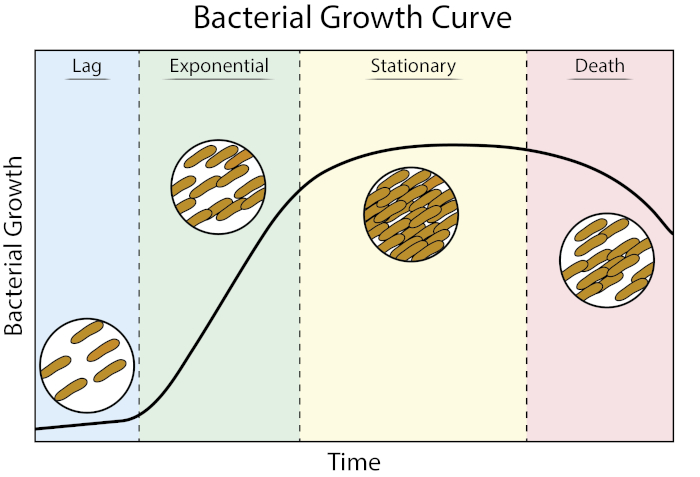
1. Lag Phase - Number Stays Constant
- Bacteria are adjusting to their environment.
- Growth is slow as bacteria begin to produce the enzymes needed to digest available nutrients.
2. Log Phase (Exponential Phase) - Number Increases
- The bacteria have fully adjusted to their environment.
- They digest nutrients quickly.
- The rate of cell division is at its maximum.
- Population grows rapidly.
3. Stationary Phase - Number Stays Constant
- The rate of growth slows down.
- Nutrients begin to run out and waste products start to build up.
- Waste products include substances such as CO₂, a product of respiration.
- The graph shows a horizontal line at this stage because the rate at which new cells are being produced is equal to the rate at which other cells are dying.
- The rate of cell production equals the rate of cell death.
4. Decline Phase (Death Phase) - Number Decreases
- The nutrients have almost run out and there are high levels of toxins.
- Death of bacteria is much higher than the rate of reproduction.
- Population declines.
5. Survival Phase
- When conditions are unfavourable, some bacteria form endospores.
- Endospores are highly resistant structures that can remain dormant for years, ensuring survival until conditions improve.
Note
When drawing the bacterial growth curve in the exam, ensure that the line does not reach zero in the death phase. Remember that some bacteria form endospores, allowing them to survive unfavourable conditions.
Note
An endospore is a thick, tough-walled, dormant, dehydrated bacterial cell formed during unsuitable conditions.