Structure and Classification of Bacteria (Leaving Cert Biology): Revision Notes
📚Revision Notes
Structure and Classification of Bacteria
- Bacteria belong to the kingdom monera.
- All members of this kingdom are prokaryotes.
- Bacteria are single celled living organisms found in all parts of the biosphere.
Note
Biosphere: part of the planet that contains living organisms.
Note
Prokaryotic cells do not have a nucleus or membrane-bound organelle e.g. bacteria.
Structure of Bacteria
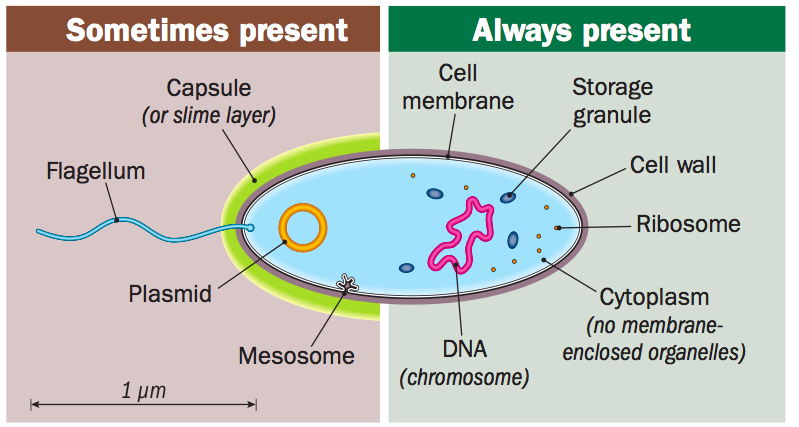
- Genetic material
- Bacteria do not contain a nucleus (prokaryotic).
- Bacteria contain both DNA and RNA.
- DNA: Found loose in the cytoplasm.
- RNA: Found in the ribosome.
- Many bacteria also have a plasmid.
- A plasmid is a circular loop of DNA that contains genes that benefit the bacteria, such as those for antibiotic resistance.
- Bacterial cells do not contain mitochondria or chloroplasts.
- Respiration takes place in the cytoplasm.
- Cell wall: provides structure and protection.
- Some bacteria have a capsule or slime layer.
- Surrounds the cell wall to prevent the bacterial cell from drying out.
- Particularly bacteria in dry environments.
- Some bacteria have a flagellum.
- A tail like structure for movement.
- Particularly bacteria in wet environments.
Note
All living organisms contain both DNA and RNA.
Classification of Bacteria
Bacteria are classified by shape.
- Rod-shaped e.g. tetanus, TB, typhoid
- Round e.g. food poisoning, pneumonia, sore throat
- Spiral e.g. syphilis, cholera