Classification (Leaving Cert Biology): Revision Notes
📚Revision Notes
Classification
What is classification?
Classification is the systematic arrangement of living organisms into groups based on their similarities and differences. This process helps scientists organise and study the incredible diversity of life on Earth. Taxonomy is the specific study of classification systems and how organisms are grouped together.
Note
The main purpose of biological classification is to create a universal system that allows scientists worldwide to communicate effectively about different species. By grouping organisms with similar characteristics together, we can better understand their relationships and evolutionary history.
Historical development of classification systems
Aristotle's early contributions
The earliest known classification system was developed by the ancient Greek philosopher Aristotle around 2,000 years ago. Aristotle, often called the father of science, made the first attempt to organise living things systematically. His simple system divided organisms into two main groups: plants and animals. He further divided animals into groups such as those with blood and those without blood.
Note
Aristotle's classification system, while basic by modern standards, was revolutionary for its time as it represented the first systematic attempt to organise the natural world based on observable characteristics.
Linnaeus and the binomial system
In the 1750s, Swedish physician and botanist Carl Linnaeus (also known as Carolus Linnaeus) revolutionised biological classification. He developed a more sophisticated system where organisms were placed into categories based on their physical characteristics, known as morphology. His system proposed that all living things were either in the plant or animal kingdom.
Linnaeus created the binomial system of naming, where each organism receives two names: the genus name and the species name. This two-name system is still used today. For example, humans are known as Homo sapiens, where Homo is the genus and sapiens is the species. The genus name always begins with a capital letter, whilst the species name is written in lowercase, and both names are written in italics.
Important
The binomial naming system established by Linnaeus remains the foundation of modern taxonomy. Every species on Earth has a unique two-part scientific name, ensuring clear communication between scientists regardless of language barriers.
Modern taxonomic hierarchy
The seven levels of classification
Modern classification systems use a hierarchical structure with seven main levels, each called a taxon (plural: taxa). These levels become increasingly specific as you move down the hierarchy:
- Kingdom - The broadest grouping (e.g., Animalia)
- Phylum - Major body plan differences (e.g., Chordata)
- Class - Similar lifestyle and characteristics (e.g., Mammalia)
- Order - Similar feeding methods and behaviour (e.g., Primates)
- Family - Closely related groups (e.g., Hominids)
- Genus - Very similar organisms (e.g., Homo)
- Species - Organisms that can interbreed (e.g., sapiens)
As you move from kingdom to species, organisms become more similar to each other, whilst the number of organisms in each group decreases.
Mnemonic for remembering taxonomic levels
To help remember the order of taxonomic levels, you can use this helpful memory aid:
Note
"Kids Prefer Candy Over Fresh Green Salad"
- Kingdom Phylum Class Order Family Genus Species
This mnemonic device makes it much easier to recall the correct order of taxonomic hierarchy!
Classification of humans - a practical example
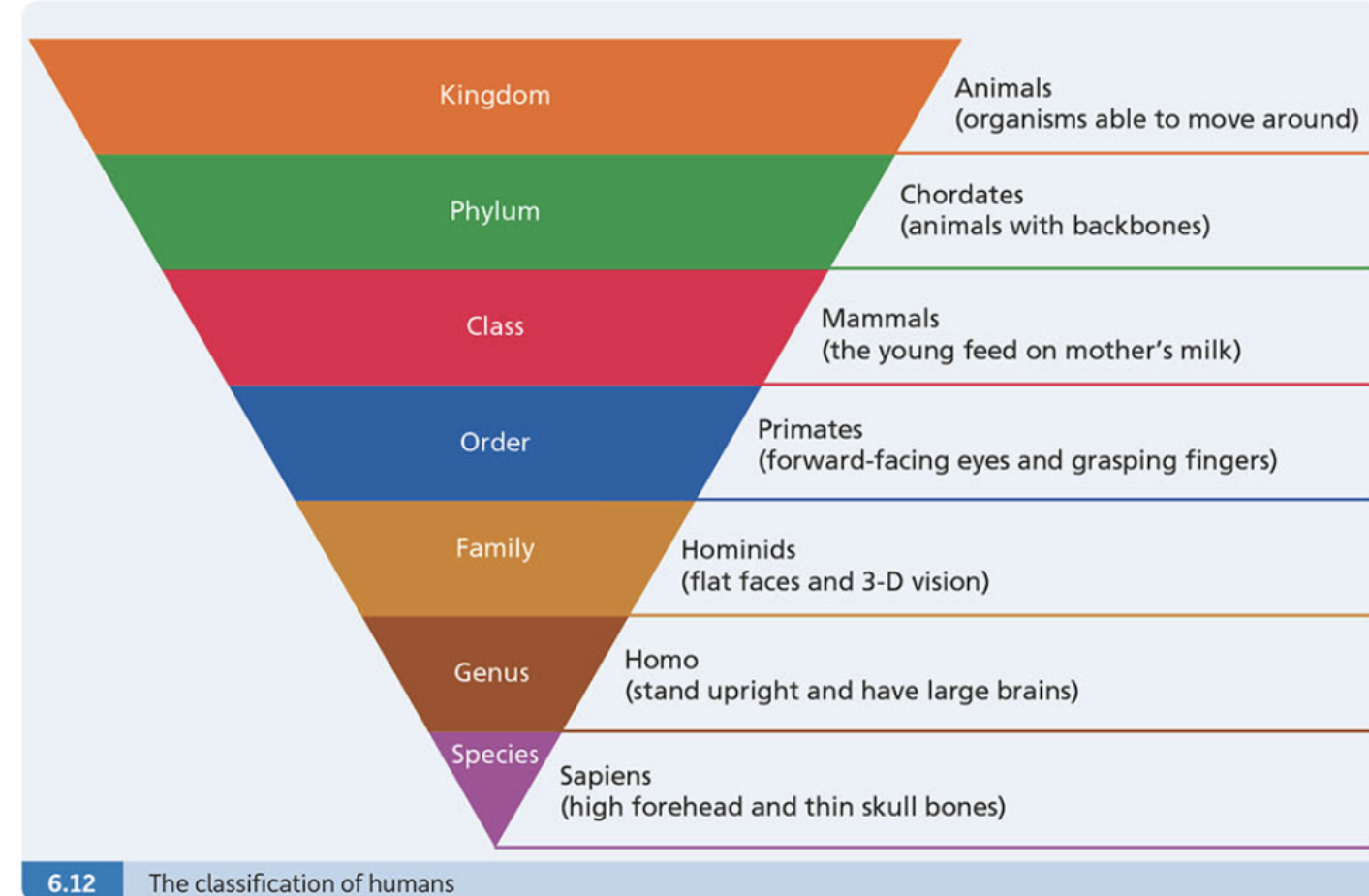
Let's look at how humans are classified within this system to understand how the hierarchy works in practice:
Example
Worked Example: Human Classification
Here's how humans fit into each taxonomic level:
- Kingdom Animalia: Organisms able to move around
- Phylum Chordata: Animals with backbones
- Class Mammalia: Young feed on mother's milk
- Order Primates: Forward-facing eyes and grasping fingers
- Family Hominids: Flat faces and 3-D vision
- Genus Homo: Stand upright and have large brains
- Species sapiens: High forehead and thin skull bones
This demonstrates how each level becomes more specific, narrowing down the characteristics that define the group.
Cell types and classification
Understanding the differences between cell types is fundamental to modern classification systems. The distinction between these cell types forms the basis for the highest levels of biological organisation.
Prokaryotic organisms
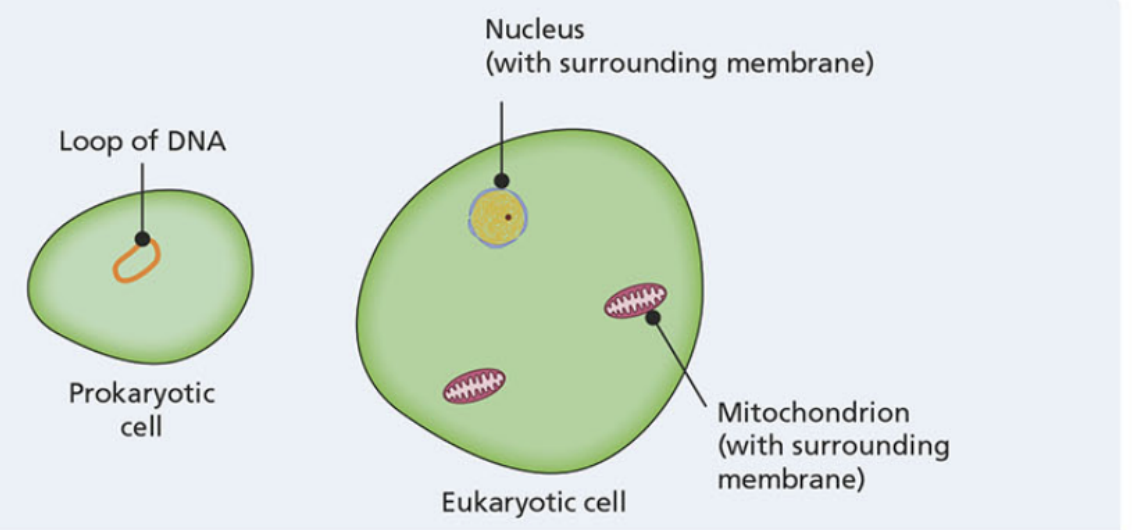
Prokaryotic organisms have relatively simple cell structures. Their key characteristics include:
- Single-celled organisms
- Genetic material exists as a circular loop of DNA that is not enclosed by a membrane
- No membrane-enclosed organelles (such as mitochondria or chloroplasts)
- Generally smaller cells
- Include bacteria and archaea
Eukaryotic organisms
Eukaryotic organisms have more complex cell structures. Their characteristics include:
- May have membrane-enclosed organelles such as mitochondria and chloroplasts
- Genetic material is contained within a nucleus that has a surrounding membrane
- Generally larger cells than prokaryotes
- Include animals, plants, fungi, and protists
- More advanced and complex than prokaryotes
Important
The distinction between prokaryotic and eukaryotic cell structure is so fundamental that it forms the basis for the highest level of biological classification - the domain system. This cellular difference represents one of the most significant evolutionary developments in the history of life.
Modern developments in classification
The six kingdom system
In the 1960s, advances in microscope technology and biochemistry led to new developments in classification. Scientists realised that the simple two-kingdom system (plants and animals) was insufficient. By the 1960s, life was divided into five kingdoms: Bacteria, Fungi, Protists, Plants, and Animals.
Later research by Carl Woese and his colleagues in the 1970s led to further refinements. They discovered that bacteria could be subdivided into two separate groups based on differences in their cell structures and biochemistry, leading to a six-kingdom system.
The three domains of life
The most significant development in modern classification came with the recognition of three domains - the highest level of classification:
- Bacteria - Single-celled prokaryotic organisms
- Archaea - Single-celled prokaryotic organisms that are genetically and biochemically distinct from bacteria
- Eukarya (Eukaryotes) - Organisms with membrane-bound nuclei and organelles
Note
Research in the 1980s showed that the four eukaryotic kingdoms (Protists, Fungi, Plants, and Animals) are more closely related to each other than they are to the two bacterial kingdoms. The two kingdoms Bacteria and Archaea are as different from each other as they are from the four eukaryotic kingdoms.
Importance of classification
Classification systems are essential in biology because they provide numerous benefits for scientific understanding and communication:
- Simplify study: It's much easier to study the features of a group such as mammals than to study the details of every individual mammal species (about 6,500 different types!)
- Help understand evolution: Classification reveals evolutionary relationships between organisms
- Show inter-relationships: We can see how different organisms are related to each other
- Reveal biodiversity: Classification makes us aware of the incredible variety of life on Earth
- Enable communication: Scientists worldwide can communicate reliably about different species using the same naming system
Summary
Key Points to Remember:
- Classification is the systematic grouping of organisms based on similarities and differences
- The modern taxonomic hierarchy has seven main levels: Kingdom, Phylum, Class, Order, Family, Genus, Species
- The binomial system gives each organism two names: genus and species
- Prokaryotic cells lack a membrane-bound nucleus, whilst eukaryotic cells have one
- The three domains (Bacteria, Archaea, Eukarya) represent the highest level of modern classification
- Classification systems are essential for organising biological knowledge and enabling scientific communication worldwide