Sexual Reproduction (Rhizopus) (Leaving Cert Biology): Revision Notes
📚Revision Notes
Sexual Reproduction (Rhizopus)
- Sexual reproduction in Rhizopus occurs when hyphae of opposite strains grow close together and come into contact.
- Hyphae can be of a plus (+) strain type or a minus (-) strain type.
- Sexual reproduction can only occur between a plus and a minus strain.
- Chemotropism attracts the hyphae to one another (hyphae release chemicals).
Note
Chemotropism: growth response to chemicals.
Sexual Reproduction in Rhizopus
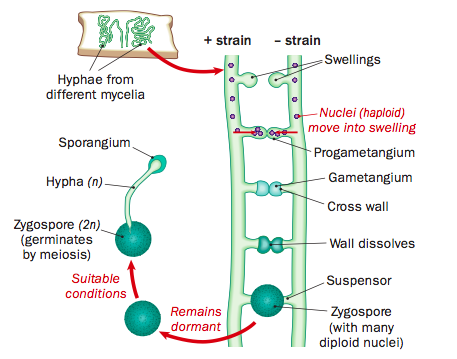
- Two hyphae of opposite strains grow close to one another.
- Swellings develop on each hypha.
- Nuclei (sex cells/gametes) move into each swelling. Each swelling is now called a progametangium.
- The swellings touch and cross walls form behind the progametangia, dividing them from the rest of the hyphae. The progametangia are now called gametangia.
- The end walls between the gametangia break down. The nuclei mix.
- Fertilisation occurs as two haploid (n) nuclei join. A diploid zygote is formed (2n).
- A tough wall forms around the zygote, creating a zygospore.
- The parent hyphae die. The zygospore remains dormant until conditions become favourable.
- When conditions are suitable, the zygospore germinates. The diploid zygote divides by meiosis and a new haploid hypha forms.
- The new hypha forms a sporangium, which disperses haploid spores to restart the life cycle.
Note
Zygospores
- Zygospores are small and light. They are easily dispersed by the wind.
- This is an advantage, as if conditions are unfavourable, the wind can transport the zygospore to conditions that are more favourable.