Virus Replication (Leaving Cert Biology): Revision Notes
📚Revision Notes
Virus Replication
- Viruses are obligate parasites.
- They must live in a host cell in order to replicate.
Stages in Viral Replication
-
Attachment
-
Entry
-
Synthesis
-
Assembly
-
Release
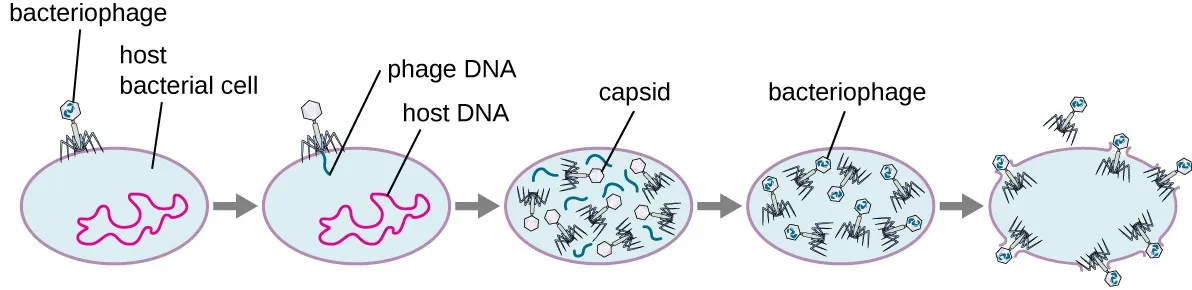
-
Attachment
- The virus attaches to the host cell.
- Entry
- The virus creates a hole in the host cell membrane.
- Viral nucleic acid is injected into the host cell.
- In bacteriophages, the protein coat remains outside the bacterial cell.
- In animal cells, the protein coat enters the cell but is digested.
- Synthesis
- The host nucleic acid becomes inactive.
- The viral nucleic acid uses the host's organelles to produce new viral nucleic acid and proteins.
- Assembly
- New viruses are assembled inside the host cell.
- Release
- The host cell bursts to release the new viruses.
- This bursting of the host cell is called lysis.
- These newly formed viruses infect other cells.
Note
Note: A retrovirus contains RNA instead of DNA and an enzyme that changes the viral RNA into DNA.
Example: the virus that causes AIDs.