Fertilisation (Leaving Cert Biology): Revision Notes
📚Revision Notes
Fertilisation
Note
Fertilisation is the union of the male and female gametes to form a diploid zygote.
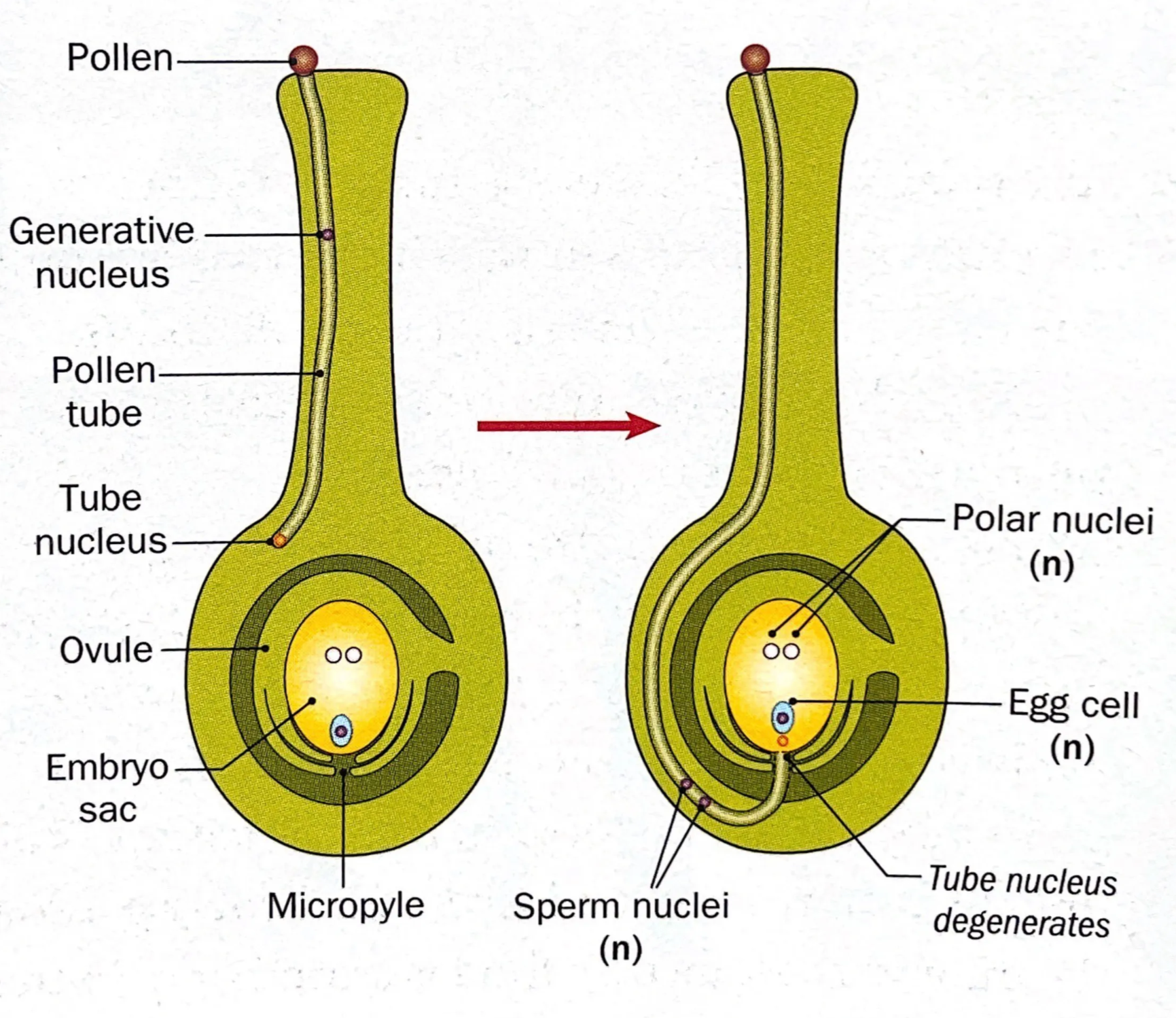
Growth of a pollen tube
- A pollen grain lands on the stigma.
- It is stimulated to grow by sugars produced by the stigma.
- A pollen tube grows through the style and into the ovule at the micropyle.
- The pollen tube grows towards chemicals released from the ovule – chemotropism.
- The tube nucleus then dies.
- As the haploid generative nucleus moves down the pollen tube, it divides by mitosis to form 2 haploid sperm nuclei. These are the male gametes.
- The 2 haploid sperm nuclei move down through the pollen tube.
Double Fertilisation
- One of the male gamete nuclei joins with the egg nucleus to form a diploid zygote.
- The second male gamete joins with the polar nuclei to form a triploid endosperm.
- Because two fertilisations take place, this is known as double fertilisation.
Seed Formation
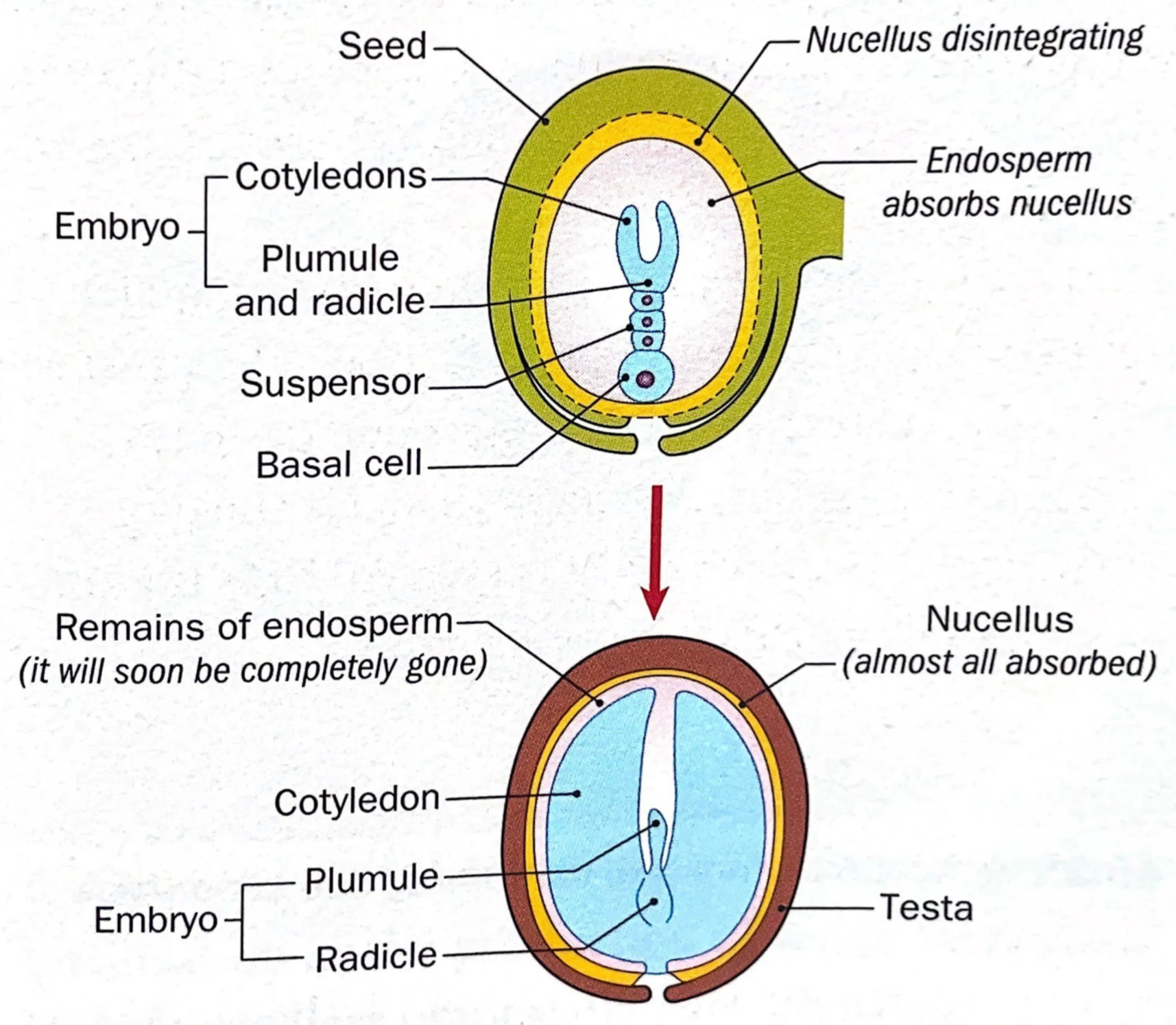
- After fertilisation, the ovule becomes the seed.
- The triploid endosperm grows rapidly by absorbing the inner layer of the ovule, called the nucellus.
- The zygote grows by mitosis to form the embryo (which is the new plant).
- The embryo is made up of the;
- Plumule (which will become the shoot) and
- The radicle (which will become the roots).
- As the embryo grows inside the seed, it produces one or two seed leaves called cotyledons.
- The cotyledons are diploid and are a food store in the seed.
- The testa is a protective cover that forms around the seed.
Note
The ovule becomes the seed**.** The ovary becomes the fruit**.**
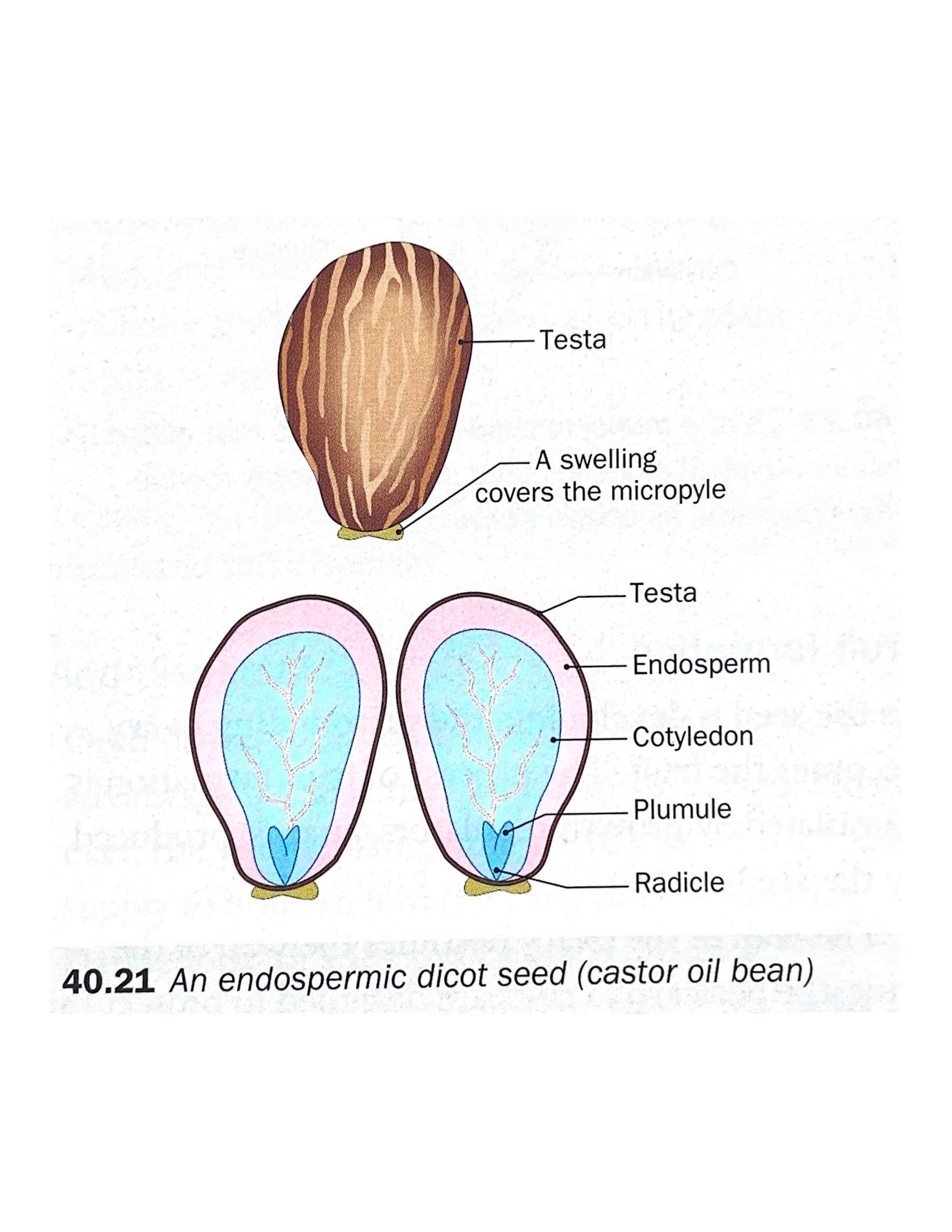
Types of Seeds
Monocots
- Plants that form a seed with a single cotyledon are called monocots.
- In monocots, the cotyledon absorbs a small amount of the endosperm to form an endospermic seed (e.g., grass, cereals).
Dicots
- Plants that form a seed with two cotyledons are called dicots.
- In dicots, the cotyledons absorb all the endosperm to form a non-endospermic seed (e.g., carrot, oak tree).
| Seed Features | Monocots | Dicots |
|---|---|---|
| Cotyledons | 1 cotyledon | 2 cotyledons |
| Endosperm | Present (endospermic seed) | None (non-endospermic seed) |
| Examples | Grass, cereals | Carrot, oak tree |
Note
Food stores in seeds:
- Cotyledon
- Endosperm
Note
Summary
Fertilisation
Fertilisation is the union of the male and female gametes to form a diploid zygote.
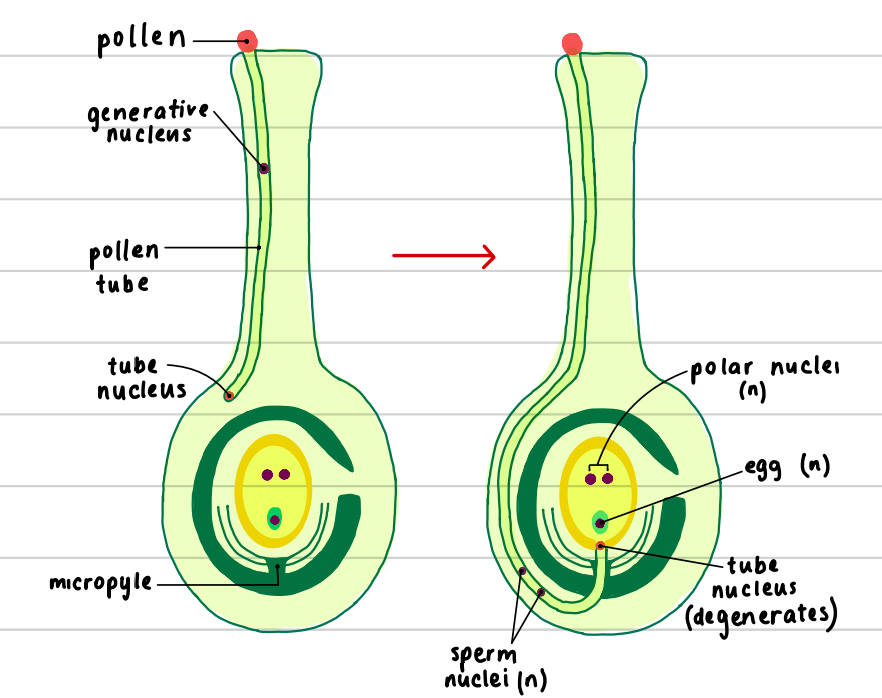
- A pollen grain lands on the stigma.
- The tube nucleus controls growth of a pollen tube, which grows down through the style towards the micropyle (guided by chemotropism).
- The generative nucleus moves down the pollen tube and divides by mitosis, forming two haploid male gametes (sperm nuclei).
- Double fertilisation occurs:
- 1st sperm nucleus (n) + egg nucleus (n) —> zygote (2n)
- 2nd sperm nucleus (n) + 2 polar nuclei (n) —> triploid endosperm (3n)
:::