How Transport Works (Leaving Cert Biology): Revision Notes
📚Revision Notes
How Transport Works
Plants need efficient transport systems to move water, nutrients, gases, and food throughout their structure. Understanding how these transport mechanisms work is essential for grasping plant biology.
Water transport
Movement into xylem
Water begins its journey through plants at the roots. Root hair cells absorb water from the soil, and this water then moves across the ground tissue until it reaches the xylem vessels in the centre of the root. The xylem forms a continuous hollow pipeline that extends from the roots to all parts of the plant, including the stem, leaves, and flowers.
Note
The continuous nature of the xylem pipeline is crucial for maintaining water supply throughout the plant. Think of it like a network of pipes that connects every part of the plant to the water source at the roots.
This system allows water to flow efficiently from the roots upwards through the stem, into the leaf stalks, and finally into the leaves themselves. The continuous nature of this pipeline is crucial for maintaining water supply throughout the plant.
Transpiration process
Transpiration is the process by which plants lose water through evaporation, primarily from their leaves. Water evaporates from cells in the leaves into the air spaces, then diffuses through the stomata (leaf pores) into the atmosphere. As each water molecule is 'pulled' from the xylem vessels, it creates a pulling force that draws the next water molecule upward.
This pulling force travels all the way down the stem to the roots, creating what scientists call the transpiration stream. The continuous flow of water from roots to leaves through transpiration is one of the main driving forces for water transport in plants.
Plants lose water through transpiration via the stomata, but also through small openings called lenticels found on stems and bark.

Gas transport
Carbon dioxide transport
Plants require carbon dioxide for photosynthesis, and this gas primarily enters through the stomata in leaves. The carbon dioxide diffuses into the air spaces within the leaf structure, then moves to the photosynthesising cells in the ground tissue.
Important
Understanding True Photosynthesis Rate
The true rate of photosynthesis must account for respiration occurring simultaneously:
This is because plants are both consuming CO₂ (photosynthesis) and producing CO₂ (respiration) at the same time.
During daylight hours when photosynthesis occurs, the rate of carbon dioxide uptake usually exceeds the rate of carbon dioxide production from respiration. However, in dark conditions, photosynthesis stops and only respiration continues, leading to carbon dioxide production and oxygen consumption.
Gas exchange in stems
Tree stems and branches also participate in gas exchange through specialised openings called lenticels. These structures allow oxygen to enter for respiration and carbon dioxide to exit. Unlike stomata, lenticels remain open most of the time and provide a pathway for gases to move in and out of woody plant tissues.
Food transport
Movement of photosynthetic products
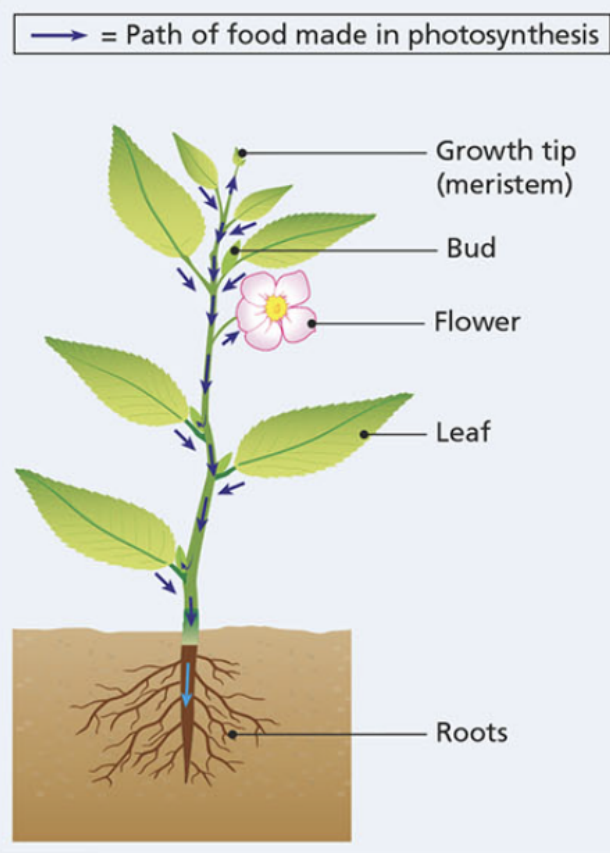
The products of photosynthesis, primarily glucose and oxygen, need to be transported throughout the plant. Food transport occurs through the phloem tissue, which forms a separate transport system from the water-carrying xylem.
Note
Phloem vs Xylem Transport
While xylem carries water upward from roots to leaves, phloem can transport food in multiple directions - up, down, and sideways - depending on where the plant needs nutrients most.
Phloem carries dissolved food substances to all parts of the plant, including growth areas such as buds, developing leaves, stems, roots, and flowers. This food can then be used for respiration, to build new plant structures, or converted into storage compounds like starch.
Fate of glucose
Glucose produced during photosynthesis has several possible destinations within the plant:
- Immediate use: Some glucose is used directly for respiration in leaf cells
- Storage conversion: Glucose may be converted to starch for storage, particularly in leaves, stems, and storage organs
- Transport: Glucose is often converted to sucrose (a transport sugar) before being moved through the phloem system
- Structural building: The transported sugars provide raw materials for building new plant tissues and structures
The precise mechanisms controlling food movement through phloem are not fully understood, but the system efficiently distributes nutrients where they are needed most.
Control of transport
Transpiration regulation
Plants must balance their need for carbon dioxide uptake with water conservation. Excessive water loss through transpiration can be harmful, especially during hot or dry conditions. Plants have developed several strategies to control water loss:
Important
Key Water Conservation Strategies
Plants have evolved multiple mechanisms to prevent excessive water loss:
- Waxy cuticle coating on leaf surfaces
- Strategic stomatal positioning
- Active stomatal control through guard cells
Leaf structure adaptations: Leaves possess a waxy cuticle on their upper surface that prevents water loss. This cuticle is typically thicker on the upper surface where more water would evaporate due to direct sunlight exposure.
Stomatal positioning: Most stomata are located on the lower leaf surface where it's cooler and less exposed to direct sunlight, reducing evaporation rates compared to the upper surface.
Stomatal control
Each stoma is surrounded by two guard cells that can change shape to open or close the stomatal pore. This provides plants with active control over gas exchange and water loss.
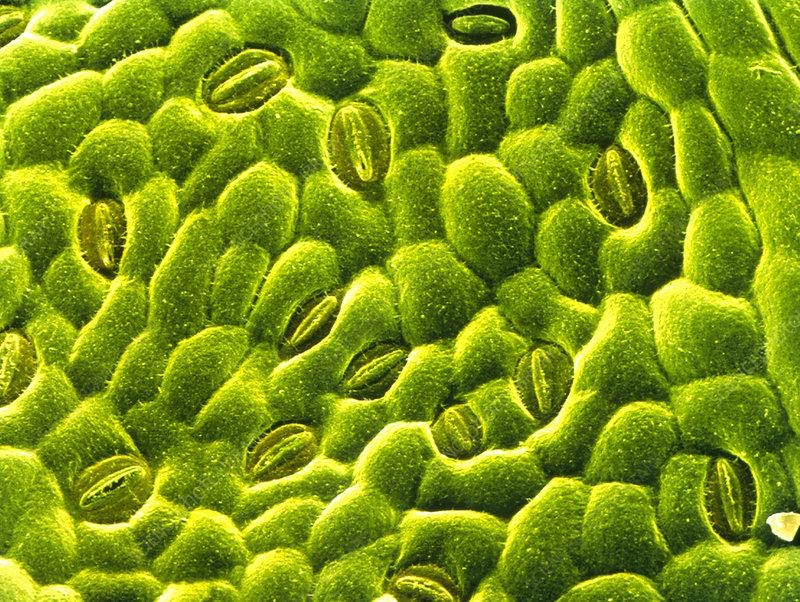
Daily rhythm: Stomata typically open during the day to allow carbon dioxide entry for photosynthesis. At night, when photosynthesis cannot occur, stomata generally close to reduce unnecessary water loss.
Environmental responses: Under stress conditions such as water shortage, high temperatures, or strong winds, stomata can close during the day to prevent excessive transpiration. While this reduces photosynthesis, it helps plants survive drought conditions.
Note
Guard Cell Mechanism
Guard cells control stomatal opening and closing by changing their shape. When conditions favour opening, guard cells take up water and become more curved, creating an opening between them. When closing is needed, guard cells lose water and straighten, sealing the stomatal pore.
This sophisticated control system allows plants to optimise their gas exchange while maintaining water balance, ensuring survival across varying environmental conditions.
Summary
Key Points to Remember:
- Water moves upwards through xylem vessels from roots to leaves, driven by transpiration
- Food moves in all directions through phloem tissue, carrying photosynthetic products to where they're needed
- Gases enter and exit primarily through stomata in leaves and lenticels in stems
- Stomata act like controllable doors - opening for photosynthesis during the day, closing to conserve water when necessary
- Transport systems work together - xylem, phloem, and gas exchange systems coordinate to meet plant survival needs