Calculating pH (Leaving Cert Chemistry): Revision Notes
📚Revision Notes
Calculating pH
Understanding how to calculate pH values is essential for working with acids and bases in chemistry. The pH scale provides a way to express how acidic or basic a solution is, and different types of acids and bases require different calculation approaches.
Note
Mastering pH calculations is fundamental to understanding acid-base chemistry. The methods you learn here will apply to everything from simple laboratory calculations to complex biochemical systems.
What is pH?
pH stands for "power of hydrogen" and measures the concentration of hydrogen ions (H⁺) in a solution. The fundamental formula for pH is:
Where represents the concentration of hydrogen ions in moles per litre (mol/L or M).
For bases, we often work with pOH, which measures hydroxide ion concentration:
Important
At 25°C, there's a crucial relationship between pH and pOH that you must remember:
This relationship is fundamental to all acid-base calculations and changes with temperature.
Calculating pH of strong acids
Strong acids completely dissociate (break apart) in water, making their pH calculations straightforward. This means we can directly relate the acid concentration to the hydrogen ion concentration.
Method for strong acids
- Determine the hydrogen ion concentration: For strong acids, equals the molarity of the acid multiplied by the number of hydrogen ions each molecule releases
- Apply the pH formula: Use
Examples of strong acid calculations
Example
Worked Example: Hydrochloric Acid (HCl)
For hydrochloric acid (HCl):
- (releases 1 H⁺ ion per molecule)
- If concentration is 0.01 M, then M
Example
Worked Example: Sulphuric Acid (H₂SO₄)
For sulphuric acid (H₂SO₄):
- (releases 2 H⁺ ions per molecule)
- If concentration is 0.204 M, then M
Calculating pH of strong bases
Strong bases completely dissociate to produce hydroxide ions (OH⁻). Since we need H⁺ concentration for pH, we calculate pOH first, then convert to pH.
Method for strong bases
- Calculate hydroxide ion concentration: molarity × number of OH⁻ ions per molecule
- Calculate pOH:
- Convert to pH:
Example
Worked Example: Sodium Hydroxide (NaOH)
For a 0.15 M NaOH solution:
- (releases 1 OH⁻ ion per molecule)
- M
Reference patterns for strong acids and bases
Note
Understanding the patterns in pH values helps you check your calculations and develop intuition for acid-base strength. Notice how systematic the relationships are between concentration and pH.
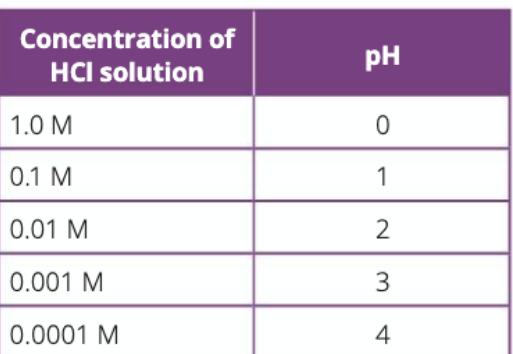
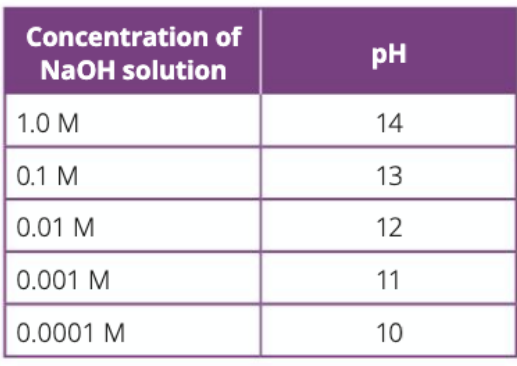
For strong acids like HCl, there's a clear pattern: as concentration decreases by a factor of 10, pH increases by 1 unit. Similarly, for strong bases like NaOH, as concentration decreases by a factor of 10, pH decreases by 1 unit.
Calculating pH of weak acids
Weak acids only partially dissociate in water, making their calculations more complex. You need to consider the equilibrium between the undissociated acid and the ions formed.
Understanding weak acid equilibrium
For a weak acid HA:
The dissociation constant Ka tells us how much the acid dissociates:
Simplified calculation method
Important
For weak acids, there's a useful approximation formula when the acid is not too weak and not too dilute:
Where is the concentration of the acid in moles per litre.
This formula saves time and works well for most practical calculations.
Worked examples of weak acid calculations
Example
Worked Example: Ethanoic Acid (CH₃COOH)
Ethanoic acid with at 0.1 M:
- M
Example
Worked Example: Methanoic Acid (HCOOH)
Methanoic acid with at 0.1 M:
- M
The key insight is that weak acids have higher pH values than strong acids of the same concentration because they don't fully dissociate.
Factors affecting pH calculations
Several factors can influence pH calculations and the behaviour of acid-base systems.
Concentration effects
The concentration of the acid or base directly affects the pH:
- Higher concentration of acid = lower pH (more acidic)
- Higher concentration of base = higher pH (more basic)
- For strong acids and bases, this relationship follows a logarithmic pattern
Temperature effects
Temperature affects pH calculations in several ways:
- The dissociation of water changes with temperature
- At 25°C, pH + pOH = 14, but this value changes at other temperatures
- Weak acid and base dissociation constants (Ka and Kb) are temperature dependent
Distinguishing between strong and weak acids using conductivity
Electrical conductivity provides a practical way to distinguish between strong and weak acids of the same concentration. Strong acids produce more ions in solution, leading to higher electrical conductivity.
This principle helps in laboratory identification:
- Strong acids: High conductivity due to complete ionisation
- Weak acids: Lower conductivity due to partial ionisation
- The difference is measurable even at the same molar concentrations
Limitations of pH calculations
Important
It's crucial to understand when pH calculations are valid and when they break down:
Key limitations:
- pH scale range: The traditional 0-14 pH scale applies at 25°C. Outside this range, pH can theoretically be negative or greater than 14
- Concentration limits: pH calculations work best for dilute solutions (usually < 1 M). Very concentrated solutions don't follow simple theoretical predictions
- Aqueous solutions only: pH calculations apply to water-based systems. Other solvents require different approaches
Practical considerations:
- For very dilute solutions, you may need to consider the contribution of water's own dissociation
- Very concentrated acid or base solutions may not behave as predicted by simple calculations
- Non-aqueous systems (like organic solvents) require different theoretical frameworks
Summary
Key Points to Remember:
- Strong acids and bases: Use direct calculation methods - for acids, calculate pOH first for bases
- Weak acids: Use the equilibrium approach with Ka values and the simplified formula
- Key relationship: (at 25°C) - essential for converting between pH and pOH
- Concentration matters: Higher acid concentration means lower pH; higher base concentration means higher pH
- Check your work: Use conductivity and reference tables to verify that your calculated pH values make sense for the type and strength of acid or base you're working with