Dipole-Dipole Forces (Leaving Cert Chemistry): Revision Notes
📚Revision Notes
Dipole-Dipole Forces
What are dipole-dipole forces?
Dipole-dipole forces are intermolecular forces of attraction that exist between polar molecules. These forces occur when the negative end () of one polar molecule attracts the positive end () of another polar molecule nearby.
Unlike temporary attractions that can occur between any molecules, dipole-dipole forces are permanent because they exist between molecules that have permanent dipoles. This means the molecules are always polar due to differences in electronegativity between their atoms.
Note
It's important to remember that these are intermolecular forces (between molecules) rather than intramolecular forces (within molecules). They affect how molecules interact with each other in liquids and solids.
How dipole-dipole forces work
When polar molecules come close to each other, they naturally arrange themselves so that opposite charges are as close as possible. The partially negative end of one molecule positions itself near the partially positive end of a neighbouring molecule, creating an attractive force.
These forces have several important characteristics:
- Directional nature - Molecules align themselves to maximise the attraction between opposite partial charges
- Distance dependence - The strength of dipole-dipole forces decreases rapidly as molecules move further apart
- Intermediate strength - They are much weaker than ionic bonds but stronger than London dispersion forces
- Only exist between polar molecules - Non-polar molecules cannot form dipole-dipole interactions
Note
The directional nature of dipole-dipole forces is what makes them different from London dispersion forces, which can occur between any molecules regardless of their orientation.
Examples and molecular behaviour
Common examples of molecules that experience dipole-dipole forces include hydrogen chloride (HCl) and propanone (acetone). In HCl, the chlorine atom is more electronegative than hydrogen, creating a permanent dipole with on hydrogen and on chlorine.
The presence of dipole-dipole forces significantly affects physical properties:
- Higher boiling points - More energy is needed to overcome the attractive forces between molecules
- Different solubility patterns - Polar substances tend to dissolve well in other polar substances
- Molecular alignment - Substances may show ordered arrangements even in liquid state
Hydrogen bonding - a special type of dipole-dipole force
Definition and requirements
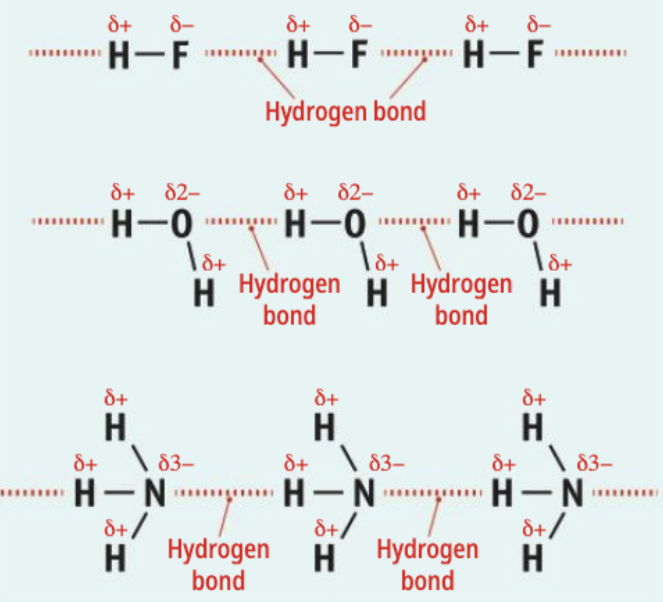
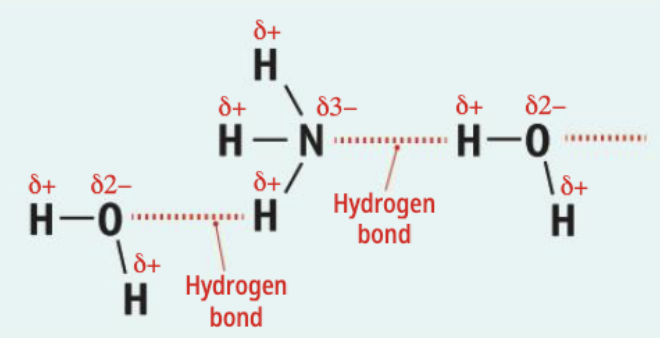
Hydrogen bonding is an exceptionally strong type of dipole-dipole force that occurs under very specific conditions. It forms when a hydrogen atom is bonded to one of the three most electronegative elements: nitrogen (N), oxygen (O), or fluorine (F).
Important
The NOF Rule for Hydrogen Bonding
Remember this as NOF - these are the only elements electronegative enough to create hydrogen bonds:
- Nitrogen
- Oxygen
- Fluorine
Only when hydrogen is bonded to these elements can hydrogen bonding occur.
Why hydrogen bonding is special
Hydrogen bonding is much stronger than regular dipole-dipole forces because:
- The hydrogen atom is very small, allowing close approach between molecules
- Nitrogen, oxygen, and fluorine are highly electronegative, creating strong partial charges
- The combination creates unusually strong intermolecular attractions
The strength of a hydrogen bond is approximately 10% of a covalent bond - much stronger than other intermolecular forces but still much weaker than bonds within molecules.
Evidence from boiling points
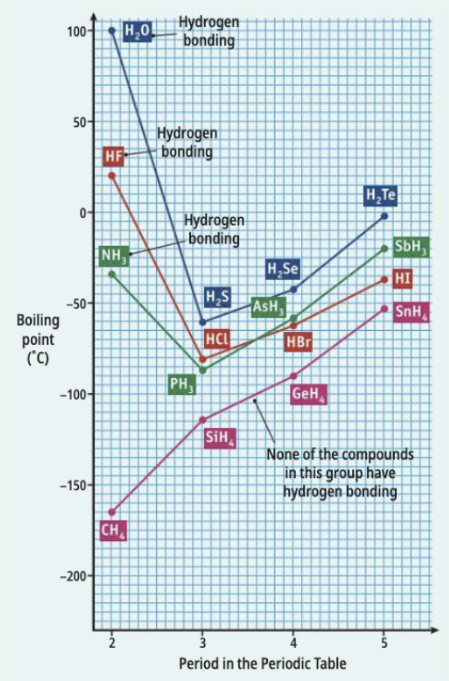
The existence of hydrogen bonding is clearly demonstrated by examining boiling points of similar compounds. Water (H₂O), ammonia (NH₃), and hydrogen fluoride (HF) all have much higher boiling points than would be expected based on their molecular masses.
Example
Boiling Point Comparison: Evidence for Hydrogen Bonding
Compare these boiling points to see the dramatic effect of hydrogen bonding:
With hydrogen bonding:
- Water (H₂O): 100°C
- Ammonia (NH₃): -33°C
- Hydrogen fluoride (HF): 20°C
Without hydrogen bonding:
- Hydrogen sulphide (H₂S): -61°C
- Phosphine (PH₃): -88°C
- Hydrogen chloride (HCl): -85°C
The compounds with hydrogen bonding have boiling points that are 50-100°C higher than their non-hydrogen-bonding equivalents!
This pattern shows that the extra energy needed to break hydrogen bonds results in dramatically higher boiling points.
Examples in everyday life
Hydrogen bonding affects many aspects of our daily lives:
Water's unique properties - Hydrogen bonding explains why water has such a high boiling point, why ice floats, and why water is such an excellent solvent for many substances.
Biological systems - Proteins maintain their shapes partly through hydrogen bonding, and DNA's double helix structure relies on hydrogen bonds between base pairs.
Materials science - Kevlar, used in bulletproof vests and protective equipment, gets its incredible strength from extensive hydrogen bonding between polymer chains.
Solubility and intermolecular forces
The "like dissolves like" rule
One of the most important practical applications of understanding dipole-dipole forces is predicting solubility. The general rule is that "like dissolves like":
- Polar substances dissolve well in polar solvents (like water)
- Non-polar substances dissolve well in non-polar solvents (like hexane)
- Polar and non-polar substances generally do not mix well
Understanding the mechanism
This occurs because:
Polar substances in water - Water molecules can form hydrogen bonds or dipole-dipole interactions with other polar molecules, helping to separate them from each other.
Non-polar substances - These have no permanent dipoles, so they cannot form strong interactions with polar water molecules. Instead, they dissolve in non-polar solvents where only weak London dispersion forces are involved.
Example
Solubility in Action: Methane vs Water
Methane (CH₄) has a very low boiling point because it is non-polar and can only experience weak London dispersion forces.
In contrast, even though water has a lower molecular mass than methane, it has a much higher boiling point due to hydrogen bonding.
This explains why methane doesn't dissolve in water - the polar water molecules are too strongly attracted to each other through hydrogen bonding to accommodate the non-polar methane molecules.
Summary
Key Points to Remember:
-
Dipole-dipole forces occur between polar molecules with permanent dipoles - they're stronger than London forces but weaker than ionic bonds
-
Hydrogen bonding is a special, extra-strong type of dipole-dipole force that only occurs with H-N, H-O, or H-F bonds (remember NOF!)
-
Boiling points are much higher for substances with hydrogen bonding - this is clear evidence that these forces exist
-
"Like dissolves like" - polar substances dissolve in polar solvents, non-polar substances dissolve in non-polar solvents
-
Applications are everywhere - from water's unique properties to the strength of materials like Kevlar, hydrogen bonding affects our daily lives