Physical Properties of Ionic and Covalent Compounds (Leaving Cert Chemistry): Revision Notes
📚Revision Notes
Physical Properties of Ionic and Covalent Compounds
Understanding the physical properties of different types of compounds helps us predict how they will behave in various conditions. The key differences between ionic and covalent compounds arise from their different bonding structures and the forces holding them together.
State of matter at room temperature
The structure of ionic and covalent compounds determines what state they exist in at room temperature.
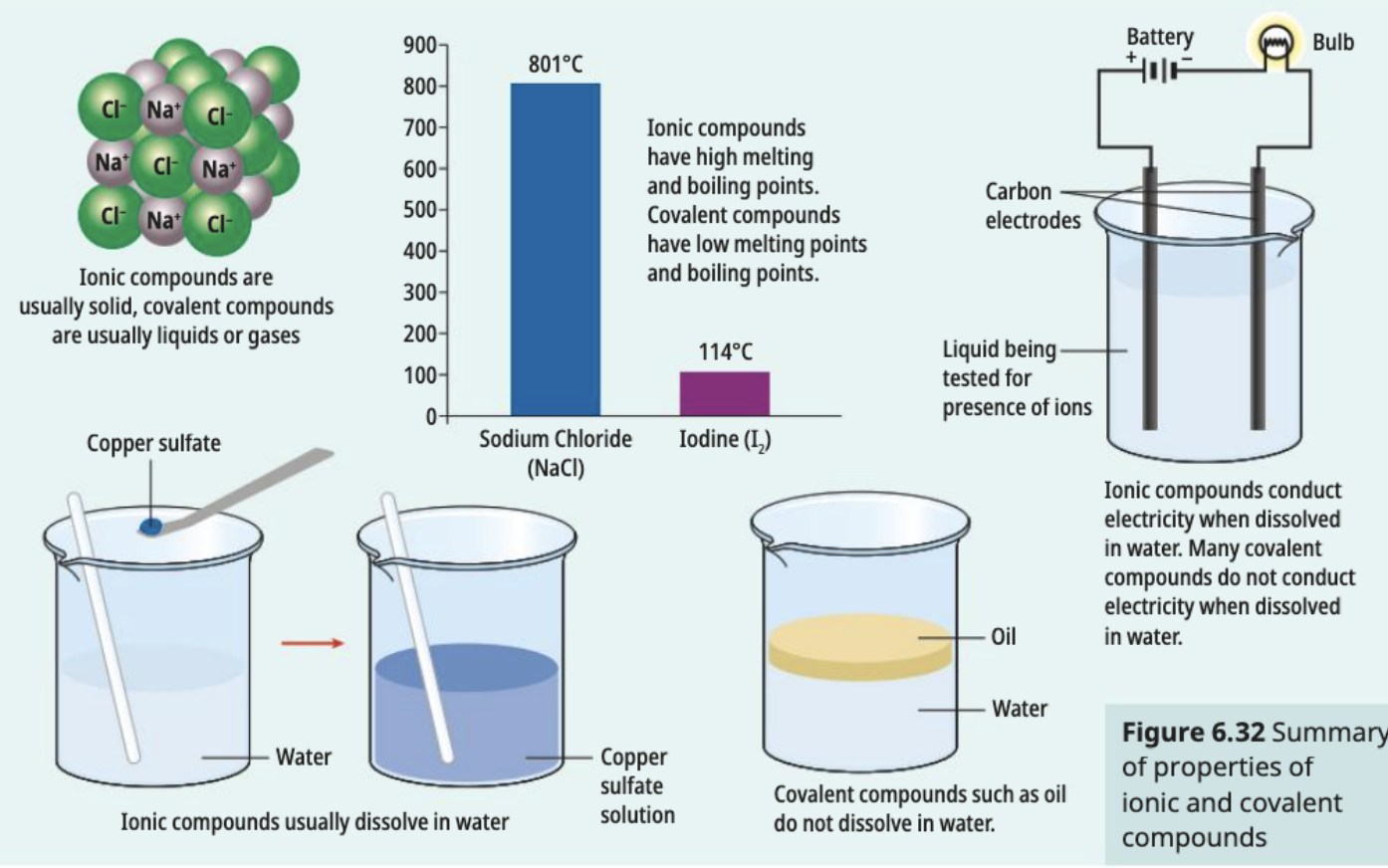
Ionic compounds are typically solid at room temperature. This happens because they form strong crystal lattice structures where oppositely charged ions are held together by powerful electrostatic forces of attraction. These forces require significant energy to break, keeping the compound in a solid state under normal conditions.
Examples include sodium chloride () and limestone (), which both remain solid at room temperature.
Note
The crystal lattice structure in ionic compounds creates a three-dimensional network where each ion is surrounded by ions of opposite charge. This arrangement maximises attractive forces and minimises repulsive forces, creating very stable structures.
Covalent compounds show much more variety in their room temperature states. They can exist as liquids, gases, or soft solids because the forces between individual molecules are generally weaker than those in ionic crystal lattices.
Examples include oxygen () and carbon dioxide () as gases, and water () as a liquid.
Melting and boiling points
The strength of forces within compounds directly affects how much energy is needed to change their state.
Ionic compounds typically have high melting and boiling points because the ions are held together by strong electrostatic forces throughout the crystal lattice. Breaking these bonds requires considerable energy, meaning the ions must vibrate intensely before they can overcome the attractive forces.
Example
Temperature Comparison Example:
Sodium chloride ():
- Melting point: 801°C
- Boiling point: 1413°C
Compare this to iodine (), a covalent compound:
- Melting point: 114°C
- Boiling point: 184°C
The ionic compound requires much more thermal energy to change state.
Covalent compounds generally have much lower melting and boiling points. While the covalent bonds within molecules are strong, the forces between separate molecules (intermolecular forces) are relatively weak. This means less energy is needed to separate the molecules from each other.
Some covalent substances have even lower melting and boiling points, with many existing as liquids or gases at room temperature.
Electrical conductivity
The ability to conduct electricity depends on whether a substance contains mobile charged particles.
Important
Key Concept: For electrical conductivity to occur, there must be charged particles (ions or electrons) that are free to move and carry electric current through the material.
Ionic compounds do not conduct electricity in their solid state because the ions are locked in fixed positions within the crystal lattice. However, when an ionic substance is melted or dissolved in water, the ions become mobile and can carry electric current through the solution or molten material.
When dissolved, ionic compounds form electrolytes. For example, hydrogen chloride dissolves in water to produce ions:
The presence of these mobile ions allows the solution to conduct electricity, which can be demonstrated when a light bulb glows in a simple conductivity test circuit.
Covalent compounds generally do not conduct electricity as solids, liquids, or gases because they don't contain mobile ions to carry electric current. The electrons are localised in covalent bonds between atoms rather than being free to move throughout the structure.
Solubility in water
The solubility of compounds in water depends on the interactions between the compound and water molecules.
Ionic compounds are usually soluble in water. When they dissolve, water molecules surround the individual ions and help separate them from the crystal lattice. The polar water molecules attract the charged ions, allowing the compound to dissolve completely.
However, the extent of solubility varies between different ionic compounds — some dissolve readily while others are only slightly soluble.
Note
When ionic compounds dissolve, the process involves water molecules surrounding and separating individual ions from the crystal structure. This process is called dissociation and requires polar water molecules to overcome the electrostatic attractions holding the crystal together.
Covalent compounds show varying solubility depending on whether they are polar or non-polar:
- Polar covalent compounds (like and ) are often highly soluble in water because they can form attractions with polar water molecules
- Non-polar covalent compounds (like and ) are generally only sparingly soluble in water
The principle "like dissolves like" applies here — polar substances dissolve well in polar solvents like water, while non-polar substances dissolve better in non-polar solvents.
For example, only small amounts of oxygen gas dissolve in water, but this small solubility is crucial for aquatic life. In contrast, compounds like oils and fats are largely insoluble in water.
Property comparison summary
Here are the key differences between ionic and covalent compounds:
- Structure: Ionic compounds form networks of ions; covalent compounds exist as individual molecules
- Physical state: Ionic compounds are usually hard and brittle solids; covalent compounds are typically soft solids, liquids, or gases at room temperature
- Melting/boiling points: High for ionic compounds; low for covalent compounds
- Electrical conductivity: Ionic compounds conduct when molten or dissolved; covalent compounds generally don't conduct
- Water solubility: Ionic compounds are usually soluble; covalent solubility depends on polarity
Summary
Key Points to Remember:
- Ionic compounds have strong electrostatic forces holding ions together, resulting in high melting points, solid state at room temperature, and electrical conductivity when dissolved or molten
- Covalent compounds have weaker intermolecular forces, leading to lower melting points, varied states at room temperature, and generally no electrical conductivity
- Water solubility follows the "like dissolves like" rule — ionic and polar covalent compounds dissolve well in water, while non-polar covalent compounds don't
- The crystal lattice structure in ionic compounds creates their characteristic properties of hardness, brittleness, and high melting points
- Electrical conductivity testing can help identify whether a compound is ionic (conducts when dissolved) or covalent (doesn't conduct)