Avogadro's Law (Leaving Cert Chemistry): Revision Notes
📚Revision Notes
Avogadro's Law
What is Avogadro's law?
Avogadro's Law is one of the fundamental gas laws in chemistry. It describes a simple but important relationship between the volume of a gas and the number of gas particles (molecules or atoms) present.
The law tells us that when we compare different gases under the same conditions of temperature and pressure, equal volumes will always contain the same number of particles, regardless of what type of gas we're looking at.
Historical background
The story of Avogadro's Law begins with Gay-Lussac, who discovered that when gases react together, they do so in simple whole number ratios. For example, when hydrogen gas reacts with chlorine gas to make hydrogen chloride, the volumes follow a 1:1:2 pattern.
Note
Scientists at the time, including Dalton, struggled to explain this observation using the atomic theory available then. The problem was that Dalton thought gases were made up of individual atoms, which couldn't properly explain Gay-Lussac's results.
It was Amedeo Avogadro who came up with the correct explanation. He suggested that gases are actually made up of molecules (not just atoms), and that equal volumes of gases contain equal numbers of these molecules. This brilliant insight solved the puzzle and became known as Avogadro's Law.
The statement of Avogadro's law
Important
Avogadro's Law states that equal volumes of gases contain equal numbers of molecules under the same conditions of temperature and pressure.
This means that if you have two containers of the same size, at the same temperature and pressure, they will contain the same number of gas molecules - whether one container holds oxygen and the other holds carbon dioxide.
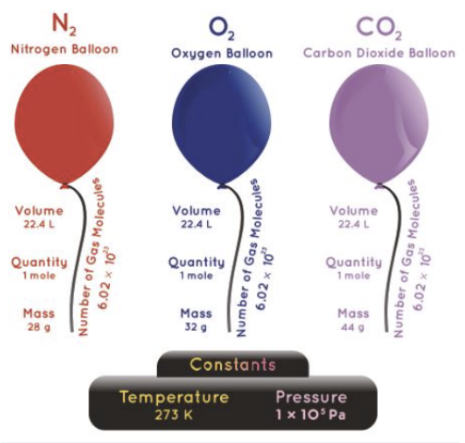
The diagram above shows this beautifully. Each balloon contains exactly 1 mole of gas (that's molecules), and each occupies the same volume of 22.4 litres. Notice how the masses are different (nitrogen is 28g, oxygen is 32g, carbon dioxide is 44g), but the number of molecules and the volume are identical.
How Avogadro's law works
Example
Worked Example: Hydrogen and Chlorine Reaction
Hydrogen + Chlorine → Hydrogen chloride 1 volume + 1 volume → 2 volumes
At the molecular level, this means:
- 1 molecule of hydrogen () + 1 molecule of chlorine () → 2 molecules of hydrogen chlorine ()
Because equal volumes contain equal numbers of molecules, we can predict the volumes of products formed in gas reactions. This makes Avogadro's Law incredibly useful for understanding chemical equations involving gases.
Kinetic theory explanation
Note
The Kinetic Theory of Matter helps us understand why Avogadro's Law works through three key principles:
-
Same temperature means same energy: When gases are at the same temperature, their particles have the same average kinetic energy, regardless of the type of gas.
-
Pressure depends on collisions: The pressure a gas exerts depends on how often its particles hit the container walls, not on what type of particles they are.
-
Volume depends on particle number: If gases have the same temperature and pressure, the volume they occupy depends only on how many particles are present.
This explains why equal volumes of different gases at the same temperature and pressure must contain equal numbers of particles.
Molar volume concept
One of the most practical applications of Avogadro's Law is the concept of molar volume.
Important
Key fact: The volume occupied by one mole of any gas is called its molar volume.
- At standard temperature and pressure (s.t.p.): 22.4 litres
- At room temperature and pressure: 24.0 litres
This is incredibly useful for calculations. Since one mole of any gas occupies the same volume under the same conditions, we can easily convert between:
- Number of moles and volume
- Mass and volume (if we know the molecular mass)
- Number of molecules and volume
Practical applications and calculations
Avogadro's Law is essential for many chemistry calculations:
Volume calculations: If you know how many moles of gas you have, you can find the volume it occupies.
Density calculations: You can calculate the density of gases using the relationship between molar mass and molar volume.
Molecular mass determination: By measuring the density of a gas, you can work out its molecular mass.
Note
Exam tip: Always check whether the question gives you conditions at s.t.p. (22.4 L) or room temperature and pressure (24.0 L). Using the wrong molar volume is a common mistake!
Remember!
Summary
Key Points to Remember:
-
Avogadro's Law: Equal volumes of gases contain equal numbers of molecules at the same temperature and pressure
-
Molar volume: One mole of any gas occupies 22.4 L at s.t.p. or 24.0 L at room temperature and pressure
-
Same conditions, same energy: Gases at the same temperature have particles with the same average kinetic energy
-
Practical applications: Use Avogadro's Law for volume calculations, density problems, and understanding chemical equations involving gases
-
Exam success: Always identify whether you're working at s.t.p. or room conditions before using molar volume values