Boyle's Law (Leaving Cert Chemistry): Revision Notes
📚Revision Notes
Boyle's Law
Historical background
In 1662, an Irish chemist named Robert Boyle made groundbreaking discoveries about how gases behave. Using an air pump that he designed, Boyle investigated the relationship between the pressure and volume of gases. His careful experiments led to one of the most important gas laws in chemistry.
What is Boyle's Law?
Note
Boyle's Law states that at constant temperature, the volume of a fixed mass of gas is inversely proportional to its pressure.
This means that when you increase the pressure on a gas, its volume decreases proportionally. Conversely, when you decrease the pressure, the volume increases. Think of squeezing a balloon - as you apply more pressure, the balloon gets smaller.
Important
Boyle's Law only applies when temperature remains constant. Any change in temperature will affect the pressure-volume relationship.
Mathematical expression
Boyle's Law can be expressed mathematically as:
This means volume is inversely proportional to pressure. We can also write this as:
Where is a constant value that depends on the amount of gas and temperature.
Rearranging this equation gives us:
This is the most useful form of Boyle's Law for calculations.
Experimental demonstration
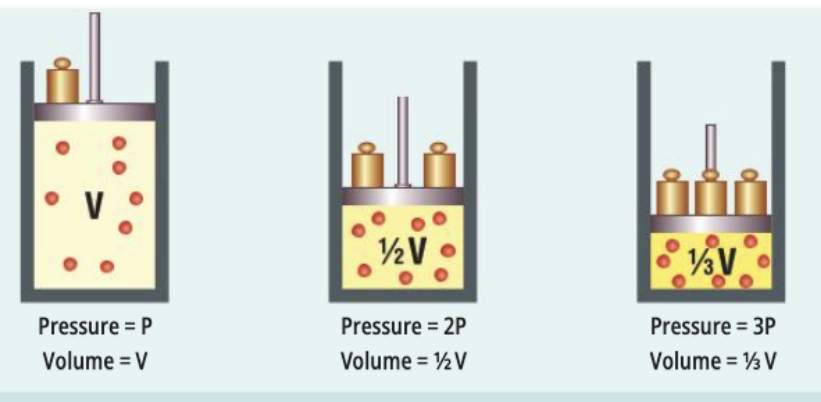
The diagram above shows three containers with the same gas at different pressures. Notice how:
- At pressure , the volume is
- At double the pressure , the volume halves
- At triple the pressure , the volume becomes one-third
This clearly demonstrates the inverse relationship between pressure and volume.
Modern experimental verification

Today, we can verify Boyle's Law using modern equipment like digital pressure sensors connected to syringes. As shown in the image, precise pressure measurements can be taken while the volume is changed by moving the plunger.
Understanding through kinetic theory
Note
Boyle's Law can be explained using the Kinetic Theory of Matter:
- Gas particles are constantly moving: Gas molecules move randomly and collide with the walls of their container
- Pressure comes from collisions: When gas particles hit the container walls, they create pressure
- Decreasing volume increases collision frequency: When you compress a gas into a smaller space, the same number of molecules now collide with the walls more frequently
- More collisions mean higher pressure: The increased collision frequency results in greater pressure
- The reverse is also true: Expanding the volume gives molecules more space, reducing collision frequency and decreasing pressure
Data analysis and graphs
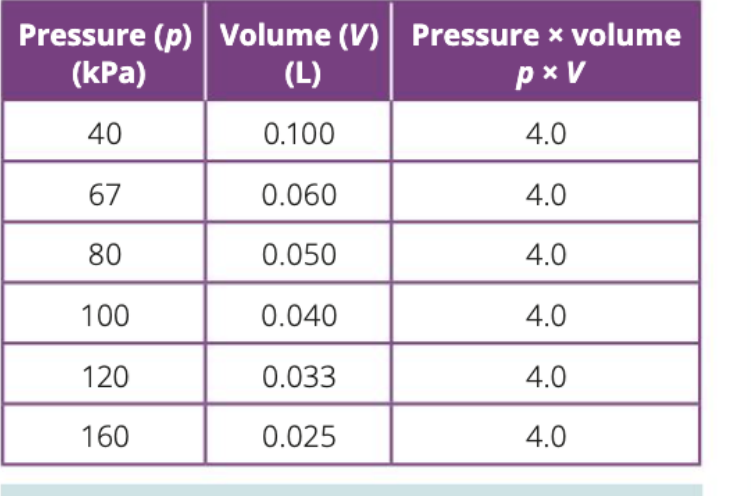
The table shows experimental data that proves Boyle's Law. Notice how the pressure × volume (p × V) values remain constant at 4.0, regardless of the individual pressure and volume measurements.
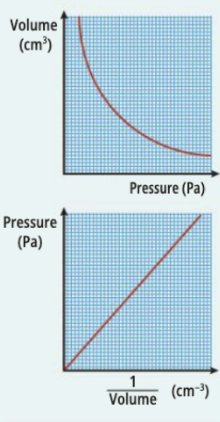
The graphs show two important relationships:
- Top graph: Volume vs Pressure produces a curved (hyperbolic) line showing the inverse relationship
- Bottom graph: When we plot vs , we get a straight horizontal line, proving that remains constant
Example
Worked Example: Using Boyle's Law
A gas sample has a volume of 2.0 L at a pressure of 1.5 atm. What will be the volume if the pressure is increased to 3.0 atm at constant temperature?
Step 1: Identify the known values
- ,
- ,
Step 2: Apply Boyle's Law
Step 3: Solve for
The volume decreases to half when pressure doubles, confirming the inverse relationship.
Key applications
Understanding Boyle's Law helps explain many everyday phenomena:
- How syringes work
- Why your ears "pop" when climbing mountains
- How breathing works (diaphragm movement changes lung volume and pressure)
- How pneumatic systems operate
Summary
Key Points to Remember:
- Boyle's Law applies only at constant temperature - temperature changes will affect the relationship
- The relationship is inverse - as pressure increases, volume decreases (and vice versa)
- The mathematical expression is - this constant relationship is key for calculations
- It explains gas behaviour through molecular collisions - more compression means more frequent collisions with container walls
- Real experimental data confirms the theory - the product remains constant across different pressure and volume measurements