Evidence for the Kinetic Theory of Matter (Leaving Cert Chemistry): Revision Notes
📚Revision Notes
Evidence for the Kinetic Theory of Matter
The Kinetic Theory of Matter states that all matter is made up of tiny particles that are in constant, random motion. But how do we know this theory is correct? Scientists have gathered observable evidence that supports this fundamental concept through careful experiments and observations.
Brownian motion
The discovery
In 1827, a Scottish botanist named Robert Brown made a fascinating observation that would later become crucial evidence for the kinetic theory. While studying pollen grains suspended in water under a microscope, Brown noticed something unexpected - the tiny pollen particles were moving about in a completely random, zig-zag pattern.
This strange movement puzzled Brown at first. The pollen grains weren't being pushed by any visible force, yet they danced around continuously in an unpredictable way. This phenomenon became known as Brownian motion.
What causes Brownian motion?
The explanation for Brownian motion lies in the kinetic theory itself. The water surrounding the pollen grains is made up of countless tiny water molecules that are constantly moving and colliding with each other. These water molecules are far too small to see, even under Brown's microscope.
Note
The water molecules are invisible under even powerful microscopes, but their effects can be observed through the movement of larger particles like pollen grains. This demonstrates how we can study the invisible world of atoms and molecules through their observable effects.
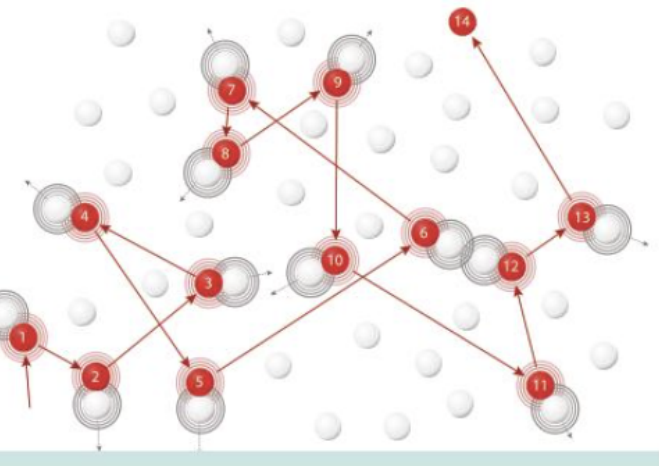
When these invisible water molecules bump into the much larger pollen grains from all sides, they cause the grains to move in random directions. Since the collisions happen randomly and from different angles, the pollen grains appear to "dance" in an irregular, unpredictable way.
Important
Why Brownian motion supports the kinetic theory:
- It shows that invisible particles (water molecules) are constantly moving
- The random nature of the movement matches what we'd expect from particle collisions
- The motion is continuous, suggesting that molecular movement never stops
- Even when there's no external force, particles still move due to their own kinetic energy
Diffusion of gases
What is diffusion?
Diffusion is the process where particles naturally spread out from areas where they're concentrated to areas where they're less concentrated. Think of it like perfume spreading through a room - the scent molecules move from the bottle (high concentration) throughout the space (lower concentration).
The ammonia and hydrogen chloride experiment
Example
Demonstration: Gas Diffusion Experiment
A classic experiment demonstrates diffusion using two gases: ammonia (NH₃) and hydrogen chloride (HCl). When these gases meet, they react to form a white solid called ammonium chloride (NH₄Cl).
Experimental setup:
- Ammonia gas is introduced at one end of a tube
- Hydrogen chloride gas is introduced at the other end
- Both gases diffuse towards each other through the air in the tube
- Where they meet, a white ring of ammonium chloride forms
Chemical reaction:
Key observations
The white ring doesn't form exactly in the middle of the tube. Instead, it appears closer to the hydrogen chloride end. This happens because ammonia molecules are lighter than hydrogen chloride molecules, so they move faster and travel further in the same time.
Note
This uneven positioning of the white ring provides additional evidence that different molecules have different speeds based on their mass - exactly what the kinetic theory predicts.
Important
How diffusion supports the kinetic theory:
- Particles move spontaneously without any external force pushing them
- Lighter particles move faster than heavier ones, as predicted by kinetic theory
- The process happens continuously as long as there's a concentration difference
- Gases can mix completely through random particle motion
Connecting the evidence to kinetic theory
Both Brownian motion and diffusion demonstrate the same fundamental principle: all matter consists of particles in constant, random motion. This motion:
- Happens at the molecular level, even when we can't see it directly
- Continues constantly, providing kinetic energy to all particles
- Causes observable effects like mixing, spreading, and random movement
- Explains many everyday phenomena, from why sugar dissolves in tea to how smells travel
These pieces of evidence were crucial in establishing the kinetic theory as a cornerstone of modern chemistry and physics.
Summary
Key Points to Remember:
- Brownian motion shows tiny, invisible particles constantly colliding with larger, visible particles
- Robert Brown discovered this random movement of pollen grains in water in 1827
- Diffusion demonstrates how particles naturally spread from high to low concentration areas
- Lighter gas molecules move faster than heavier ones during diffusion
- Both phenomena provide observable evidence that all matter consists of particles in constant motion