The Ideal Gas Equation (Leaving Cert Chemistry): Revision Notes
📚Revision Notes
The Ideal Gas Equation
The ideal gas equation is one of the most important relationships in chemistry, combining three fundamental gas laws into a single mathematical expression. This equation allows us to predict and calculate the behaviour of gases under different conditions, making it essential for solving many chemistry problems.
Note
The ideal gas equation is considered one of the most versatile tools in chemistry because it connects multiple physical properties of gases in a single, elegant mathematical relationship.
What is the ideal gas equation?
The ideal gas equation brings together Boyle's Law, Charles' Law, and Avogadro's Law into one comprehensive formula. When we combine these three relationships, we get a powerful tool for understanding how gases behave.
The equation connects five important variables:
- P = pressure (measured in Pascals, Pa)
- V = volume (measured in cubic metres, m³)
- n = amount of substance (measured in moles, mol)
- R = universal gas constant (always )
- T = temperature (measured in Kelvin, K)
The individual gas laws
Understanding how the ideal gas equation was developed helps us appreciate its power and usefulness.
Boyle's Law tells us that volume is inversely proportional to pressure when temperature stays constant. This means that as pressure increases, volume decreases proportionally.
Charles' Law shows us that volume is directly proportional to temperature when pressure remains constant. As temperature increases, volume increases proportionally.
Avogadro's Law demonstrates that volume is directly proportional to the number of moles when both temperature and pressure stay constant. More gas molecules means more volume.
Note
The beauty of the ideal gas equation lies in how it mathematically combines these three separate relationships. Each individual law describes how one variable affects another, but together they create a complete picture of gas behaviour.
When we combine these three relationships mathematically, we arrive at the ideal gas equation: .
The universal gas constant
The value is called the universal gas constant because it has the same value for all gases under ideal conditions. This constant was determined through careful experimental measurements and allows us to make quantitative predictions about gas behaviour.
Important
The universal gas constant R is truly universal - it has exactly the same value regardless of which gas you're working with, as long as the gas behaves ideally.
Important unit conversions
Getting the units right is crucial when using the ideal gas equation. Here are the key conversions you need to remember:
Note
Essential Unit Conversions for Gas Calculations:
- Volume: 1000 litres = 1 cubic metre (1000 L = 1 m³)
- Temperature: Celsius to Kelvin by adding 273:
- Pressure: Make sure to use Pascals (Pa) for consistency
Important
The most common mistake students make is forgetting to convert volume from litres to cubic metres or temperature from Celsius to Kelvin. Always check your units before calculating!
Working with standard conditions
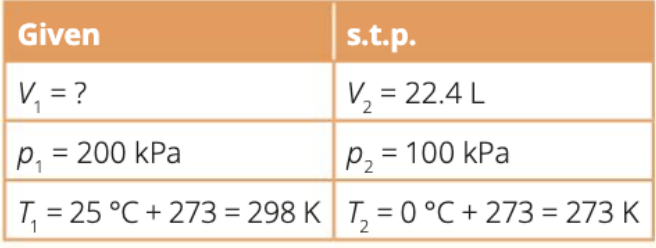
At standard temperature and pressure (s.t.p.), we have specific reference values:
- Temperature: 0°C = 273 K
- Pressure: 100 kPa = 1.0 × 10⁵ Pa
- One mole of any gas occupies 22.4 litres = 0.0224 m³
Note
These standard conditions provide a useful reference point for gas calculations and help us verify our answers. The value of 22.4 L per mole at s.t.p. is particularly useful for quick checks.
Solving gas problems step by step
When tackling ideal gas equation problems, follow this systematic approach:
Example
Worked Example: Systematic Problem-Solving Approach
Step 1: Identify what you're given - List all known values
Step 2: Identify what you need to find - Clearly state the unknown
Step 3: Convert units - Ensure all values use the correct SI units
Step 4: Substitute into - Rearrange if necessary
Step 5: Calculate - Work through the mathematics carefully
Step 6: Check your answer - Does it make sense?
For example, when calculating the volume occupied by oxygen gas at specific conditions, remember that you may need to first find the number of moles from the given mass, then apply the ideal gas equation.
Alternative calculation methods
Sometimes you can solve gas problems using the combined gas law approach, especially when comparing two different sets of conditions. This method can be particularly useful when the amount of gas (n) remains constant.
Note
The key is to identify which approach will be most straightforward for the specific problem you're solving. Consider whether you have all five variables (P, V, n, R, T) or whether you're comparing two different states of the same gas sample.
Exam tips
Important
Critical Exam Success Tips:
- Always check your units before substituting values
- Remember that R is always constant at
- Convert temperatures to Kelvin and volumes to cubic metres
- Show your working clearly to gain maximum marks
- Double-check that your final answer makes physical sense
Remember!
Summary
Key Points to Remember:
- The ideal gas equation combines three fundamental gas laws into one powerful tool
- The universal gas constant is always the same for all ideal gases
- Unit conversions are critical - temperature must be in Kelvin and volume in cubic metres
- At s.t.p., one mole of gas occupies 22.4 litres, which is a useful reference value
- Show your working step by step in exams to demonstrate your understanding and gain full marks