Acid-Base Reactions of Organic Compounds (Leaving Cert Chemistry): Revision Notes
📚Revision Notes
Acid-Base Reactions of Organic Compounds
This section explores how certain organic compounds can behave as acids in chemical reactions. We'll focus on two main types of organic compounds that show acidic properties: alcohols and carboxylic acids.
Alcohols as weak acids
Alcohols are organic compounds containing the hydroxyl group (-OH). While they can exhibit acidic behaviour, they are significantly weaker acids compared to water and most inorganic acids.
Reaction with sodium metal
When a piece of sodium metal is added to ethanol, you'll observe that a gas is produced, though the reaction is much less vigorous than sodium's reaction with water. The gas produced is hydrogen gas, which can be tested with a lighted splint to confirm its identity.
Example
Chemical Reaction: Sodium with Ethanol
In this reaction:
- Sodium (Na) reacts with ethanol ()
- Sodium ethoxide () is formed as a salt
- Hydrogen gas () is released
Why the reaction occurs
During this reaction, the hydrogen atom from the -OH group in ethanol is replaced by a sodium atom. This happens because the sodium atom effectively "takes" the hydrogen's electron, causing the hydrogen to be released as ions, which then combine to form hydrogen gas.
Note
The key observation is that alcohols are much weaker acids than water. This explains why:
- The reaction with sodium is far less vigorous than sodium with water
- Alcohols only react with very reactive metals like sodium
- They do not react with bases such as sodium hydroxide or sodium carbonate
Carboxylic acids and their acidic nature
Carboxylic acids are organic compounds that contain the carboxyl functional group and exhibit much stronger acidic properties than alcohols.
The carboxylic acid functional group
Carboxylic acids contain the -COOH group, which gives them their acidic properties. Unlike alcohols, carboxylic acids are strong enough to show typical acid behaviour in various reactions.
Why carboxylic acids act as acids
Carboxylic acids can donate protons ( ions) because when they lose a proton, the resulting carboxylate ion is particularly stable. This stability comes from two important factors that we'll explore in detail.
Stability of the carboxylate ion
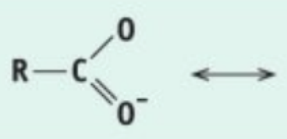
When a carboxylic acid loses a proton, it forms a carboxylate ion (). This ion is much more stable than other organic anions due to its unique structural characteristics.
Important
Resonance stabilisation: The negative charge is not localised on one oxygen atom but is spread over three atoms. The structure exists as a resonance hybrid of two possible structures, giving it extra stability.
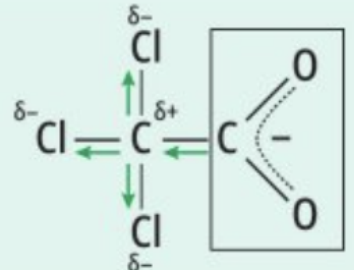
The carboxylate ion is stabilised because the negative charge is spread across the entire group rather than being concentrated on a single atom.
Inductive effect
The stability of the carboxylate ion is also affected by the nature of the R group attached to it. If the R group contains atoms or groups that can pull electron density towards themselves (called electron-withdrawing groups), they help stabilise the negative charge on the carboxylate ion by spreading the charge over a greater number of atoms.
Note
Examples of electron-withdrawing groups include:
- Chlorine atoms (Cl)
- Other electronegative atoms
This inductive effect explains why some carboxylic acids are stronger than others.
Typical acid reactions of carboxylic acids
Carboxylic acids demonstrate classic acid behaviour through several characteristic reactions that can be easily observed and tested in laboratory settings.
Neutralisation reactions
Carboxylic acids react with bases to form salts and water, just like inorganic acids. A common example is the reaction between ethanoic acid and sodium hydroxide:
Example
Neutralisation Reaction: Ethanoic Acid with Sodium Hydroxide
- Ethanoic acid + Sodium hydroxide → Sodium ethanoate + Water
This is a classic neutralisation reaction that produces a salt (sodium ethanoate) and water.
Reaction with carbonates
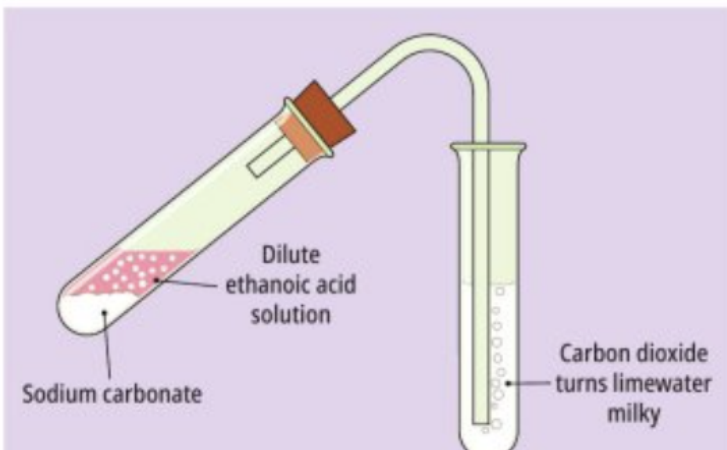
Carboxylic acids react with metal carbonates to produce carbon dioxide gas, which can be detected using limewater. When ethanoic acid reacts with sodium carbonate:
Example
Gas Evolution Reaction: Ethanoic Acid with Sodium Carbonate
The carbon dioxide gas produced will turn limewater milky, providing a clear test for the presence of an acid.
Reaction with metals
Like other acids, carboxylic acids can react with metals to produce hydrogen gas. For example, ethanoic acid reacts with magnesium:
Example
Metal-Acid Reaction: Ethanoic Acid with Magnesium
- Ethanoic acid + Magnesium → Magnesium ethanoate + Hydrogen gas
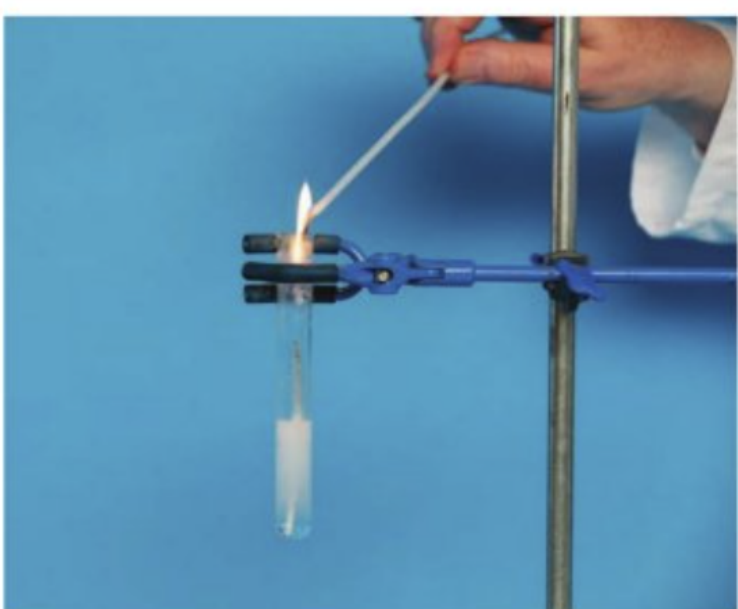
The hydrogen gas produced forms an explosive mixture with air and can be tested by bringing a lighted taper near the mouth of the test tube - it will produce a characteristic 'pop' sound.
Comparing organic acids
Ethanoic acid is much weaker than common inorganic acids such as sulfuric acid, hydrochloric acid, and nitric acid. However, it is still strong enough to show typical acidic properties and can be used to demonstrate classic acid reactions in laboratory experiments.
Note
The strength of a carboxylic acid depends on how stable its conjugate base (the carboxylate ion) is. The more stable the carboxylate ion, the more readily the acid will donate its proton, making it a stronger acid.
Summary
Key Points to Remember:
-
Alcohols are weak acids that only react with very reactive metals like sodium to produce alkoxides and hydrogen gas
-
Carboxylic acids are much stronger acids than alcohols due to the stability of the carboxylate ion formed when they lose a proton
-
The carboxylate ion is stabilised by resonance, where the negative charge is spread over three atoms rather than localised on one
-
Inductive effects from electron-withdrawing groups can further stabilise carboxylate ions, making some carboxylic acids stronger than others
-
Carboxylic acids undergo typical acid reactions including neutralisation with bases, gas evolution with carbonates, and hydrogen production with metals