Addition Reactions (Leaving Cert Chemistry): Revision Notes
📚Revision Notes
Addition Reactions
What are addition reactions?
Addition reactions are fundamental organic chemistry processes where two molecules combine to form a single product. In these reactions, atoms or groups are added across a double bond without any atoms being removed. This makes addition reactions particularly important when working with alkenes, which contain C=C double bonds.
The most common addition reactions you'll encounter involve adding halogens (like chlorine or bromine) or hydrogen halides (like HCl or HBr) to alkenes such as ethene.
Addition of halogens to alkenes
When halogens react with alkenes, they add across the double bond to form dihalogenated products. Let's examine this using ethene and chlorine as an example.
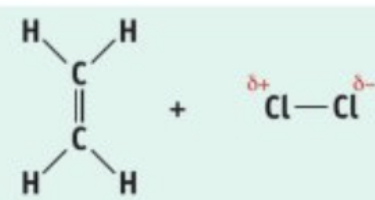
The reaction begins when chlorine approaches the ethene molecule. The chlorine molecule becomes polarised, with one end slightly positive (δ+) and the other slightly negative (δ-).
Note
The polarisation of the halogen molecule is crucial for the reaction to proceed. Without this polarisation, the halogen would not be attracted to the electron-rich double bond of the alkene.
Mechanism of addition reactions
The addition of chlorine to ethene follows a step-by-step mechanism involving several key stages:
Step 1: Electrophilic attack
The π electrons in the C=C double bond act as a nucleophile and attack the partially positive chlorine atom. This causes the chlorine molecule to undergo heterolytic fission, where the bonding electrons end up on one atom rather than being shared equally.
Step 2: Intermediate formation
This attack can lead to two possible intermediates:
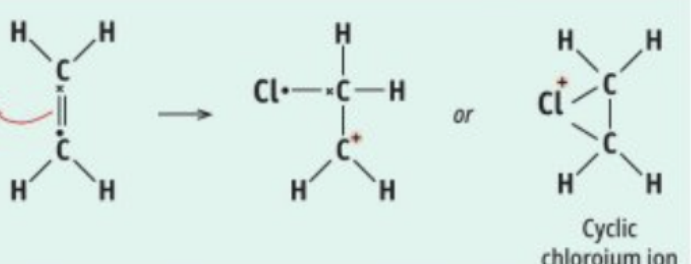
- A carbocation (open structure with a positive charge on carbon)
- A cyclic chloronium ion (bridged structure where chlorine forms a three-membered ring)
Important
Current evidence suggests that the cyclic chloronium ion is the more likely intermediate, particularly with symmetrical alkenes like ethene. This intermediate explains the stereochemistry observed in many addition reactions.
Step 3: Nucleophilic attack
The chloride ion (Cl⁻) formed in step 1 then attacks the positively charged intermediate, leading to the final product.
Products formed
When ethene reacts with chlorine, the main product is 1,2-dichloroethane. However, if water is present, a mixture of products can form:
Example
Worked Example: Products with Water Present
When ethene reacts with in the presence of water:
Main reaction: (1,2-dichloroethane)
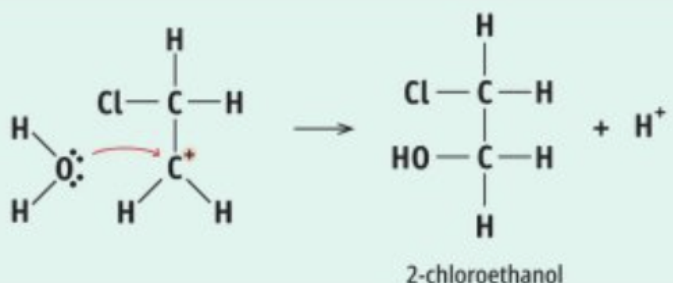
Side reaction: (2-chloroethanol)
The presence of water can lead to nucleophilic substitution, where water molecules attack the intermediate to form 2-chloroethanol alongside the expected dichloroethane product.
Addition of hydrogen halides
Hydrogen halides (HF, HCl, HBr, HI) also undergo addition reactions with alkenes. The rate of these reactions depends on the bond strength of the hydrogen halide.
Bond strength and reaction rates
The bond enthalpies show a clear trend: as we move down the halogen group, the H-X bond becomes weaker. This affects the reaction rate significantly:
- HF has the strongest bond () → slowest reaction
- HI has the weakest bond () → fastest reaction
Important
This occurs because weaker bonds are easier to break during the initial step of the mechanism. The breaking of the H-X bond is often the rate-determining step in these addition reactions.
The reactivity order is: HI > HBr > HCl > HF
Evidence for the mechanism
Several pieces of evidence support the proposed mechanisms:
Note
Supporting Evidence for Addition Mechanisms:
- Reaction rates: The order of reactivity (HI > HBr > HCl > HF) matches the bond strength data perfectly
- Polarity effects: The polar nature of both the alkene double bond and the approaching halogen explains the initial electrophilic attack
- Product analysis: When reactions are carried out in the presence of water, the formation of alcohol products supports the intermediate carbocation/chloronium ion pathway
- Stereochemistry: The observed stereochemical outcomes are consistent with the proposed cyclic intermediate structures
Key factors affecting addition reactions
1. Bond polarity
The more polar the approaching molecule (like HCl), the faster the initial electrophilic attack occurs.
2. Bond strength
Weaker bonds in the addendum molecule lead to faster reactions because less energy is required for bond breaking.
3. Stability of intermediates
More stable carbocations or bridged ions form more readily, affecting the reaction pathway and rate.
Note
Tips for Exam Success:
- Always draw out the step-by-step mechanism when asked
- Remember that addition reactions involve no loss of atoms - everything adds on
- Use curly arrows to show electron movement in mechanisms
- Include partial charges (δ+ and δ-) when showing polarisation
- Be able to explain why reaction rates vary with different hydrogen halides
- Practice drawing both carbocation and cyclic intermediate structures
Summary
Key Points to Remember:
- Addition reactions add atoms across double bonds without removing anything from the molecule
- The mechanism involves electrophilic attack on the π electrons, followed by nucleophilic attack on the resulting positive intermediate
- Two possible intermediates can form: carbocations or cyclic halonium ions, with evidence favouring the cyclic structure
- Reaction rates depend on bond strengths - weaker H-X bonds lead to faster reactions (HI > HBr > HCl > HF)
- The presence of water or other nucleophiles can lead to alternative products through competing reactions
- Understanding bond polarity and intermediate stability is crucial for predicting reaction outcomes