Balancing Chemical Equations and Applying the Mole Concept (Leaving Cert Chemistry): Revision Notes
📚Revision Notes
Balancing Chemical Equations and Applying the Mole Concept
Understanding the law of conservation of mass
The Law of Conservation of Mass explains why chemical equations must be balanced. This fundamental principle states that atoms cannot be created or destroyed during a chemical reaction - they can only be rearranged to form new substances.
Important
When a chemical equation is unbalanced, it incorrectly suggests that some atoms have vanished or appeared from nowhere. This violates the basic laws of chemistry. To represent chemical reactions accurately, we must ensure that the same number of each type of atom appears on both sides of the equation.
The step-by-step process for balancing equations
Step 1: Count the atoms of each element
Begin by systematically counting the number of atoms of each element on both the left-hand side (reactants) and right-hand side (products) of the equation.
Example
Worked Example: Analysing an Unbalanced Equation
Let's examine the unbalanced equation: CH₄ + O₂ → CO₂ + H₂O
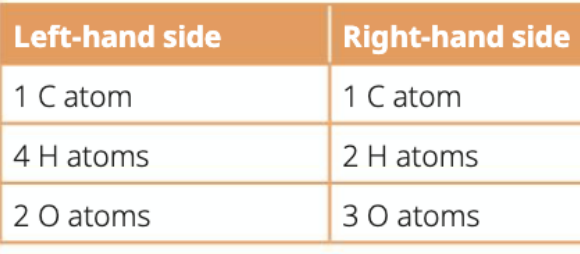
As the table shows, we have:
- Left-hand side: 1 carbon atom, 4 hydrogen atoms, 2 oxygen atoms
- Right-hand side: 1 carbon atom, 2 hydrogen atoms, 3 oxygen atoms
The equation is clearly unbalanced because the hydrogen and oxygen atoms don't match on both sides.
Step 2: Adjust the coefficients
Important
Important rule: When balancing equations, you can only change the numbers in front of the formulas (coefficients). You must never change the chemical formulas themselves, as this would create entirely different compounds.
To balance the hydrogen atoms, we need 4 hydrogen atoms on the right side. Since each H₂O molecule contains 2 hydrogen atoms, we need 2 molecules of water:
CH₄ + O₂ → CO₂ + 2H₂O
Now let's check our atom count:
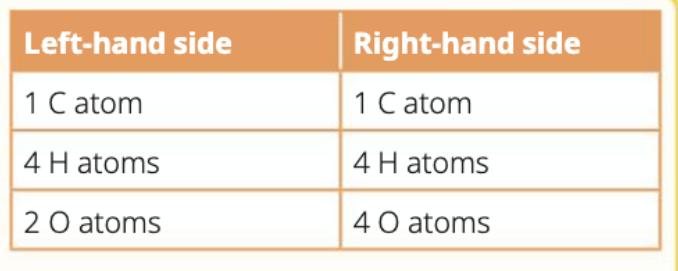
We now have equal hydrogen atoms (4 on each side), but the oxygen atoms are still unbalanced - 2 on the left versus 4 on the right.
To balance the oxygen atoms, we need 4 oxygen atoms on the left side. Since each O₂ molecule contains 2 oxygen atoms, we need 2 molecules of oxygen:
CH₄ + 2O₂ → CO₂ + 2H₂O
Step 3: Verify the balance
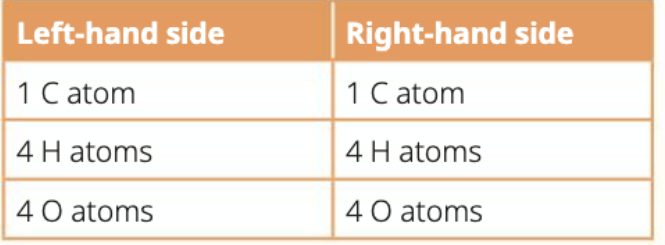
Let's check our final balanced equation by counting atoms again:
Note
Perfect! We now have:
- Carbon: 1 atom on each side
- Hydrogen: 4 atoms on each side
- Oxygen: 4 atoms on each side
The equation is now balanced, satisfying the Law of Conservation of Mass.
Applying the mole concept to balanced equations
Once we have a balanced chemical equation, we can interpret it in several meaningful ways that help us understand the quantitative relationships in chemical reactions.
Molecular interpretation
Consider the balanced equation for water formation:

This equation tells us that 2 molecules of hydrogen gas react with 1 molecule of oxygen gas to produce 2 molecules of water.
Using Avogadro's number
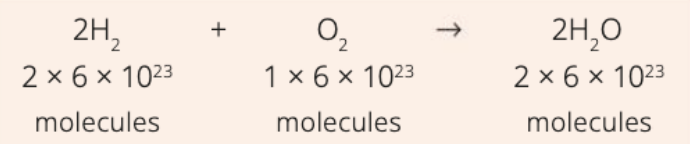
We can scale this up using Avogadro's constant (), which represents the number of particles in one mole:
Example
Worked Example: Scaling with Avogadro's Number
This shows us that:
- molecules of H₂
- React with molecules of O₂
- To produce molecules of H₂O
Mole relationships
Since one mole contains Avogadro's number of particles, we can express the same reaction in terms of moles:

This tells us that 2 moles of hydrogen gas react with 1 mole of oxygen gas to produce 2 moles of water.
Mass calculations
Finally, we can convert moles to masses using molar masses:
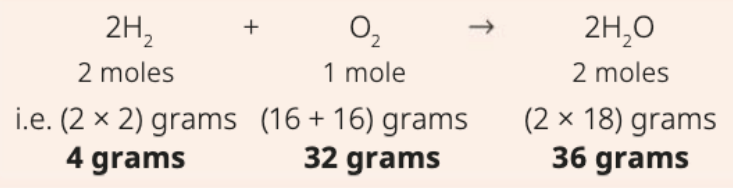
The mass relationships show us that:
- 4 grammes of hydrogen gas
- Plus 32 grammes of oxygen gas
- Produces 36 grammes of water
Note
Notice that the total mass is conserved: 4 + 32 = 36 grammes, confirming the Law of Conservation of Mass.
Introduction to stoicheiometry
Stoicheiometry is the branch of chemistry that studies the quantitative relationships between the amounts of reactants and products in balanced chemical equations.
The word 'stoicheiometry' comes from two Greek words:
- Stoicheion meaning 'element'
- Metron meaning 'measure'
Stoicheiometry enables chemists to:
- Calculate how much product can be formed from given amounts of reactants
- Determine how much reactant is needed to produce a specific amount of product
- Understand the exact proportions in which substances react
This mathematical approach to chemistry is essential for practical applications, from industrial manufacturing to laboratory experiments.
Important exam tips
Important
Essential Exam Guidelines:
- Always start by balancing the equation before attempting any calculations
- Use tables to systematically count atoms - this prevents mistakes
- Remember that coefficients can be changed, but chemical formulas cannot
- The trial and error method is acceptable for balancing equations
- In exams, whole-number ratios are usually expected rather than fractions
- Double-check your balanced equation by counting atoms of each element
Summary
Key Points to Remember:
- The Law of Conservation of Mass requires that chemical equations be balanced - the same number of each type of atom must appear on both sides
- When balancing equations, only coefficients can be changed, never the chemical formulas themselves
- Balanced equations can be interpreted at the molecular level, mole level, and mass level
- Stoicheiometry is the quantitative study of chemical reactions, telling us the exact relationships between reactants and products
- Always count atoms systematically using tables to avoid errors when balancing equations