The Law of Conservation of Mass (Leaving Cert Chemistry): Revision Notes
📚Revision Notes
The Law of Conservation of Mass
Introduction to Antoine Lavoisier
Antoine Lavoisier (1743-1794) is recognised as one of the founders of modern analytical chemistry. His groundbreaking work in 18th-century France revolutionised our understanding of chemical reactions through precise measurements and careful observations.
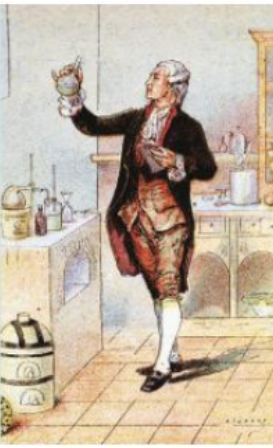
Lavoisier understood that accurate measurements were essential for advancing chemistry as a science. He invested in hundreds of different measuring instruments for his laboratory, recognising that precise data would lead to important discoveries about the nature of chemical reactions.
Note
Lavoisier's emphasis on quantitative measurement was revolutionary for chemistry in the 1700s. Before his work, chemistry was largely descriptive rather than mathematical, making it difficult to establish universal laws.
The historic mercury experiment
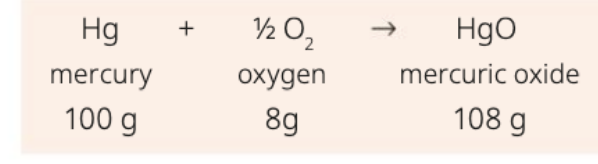
In 1774, Lavoisier conducted a crucial experiment that would change chemistry forever. He heated a known mass of mercury in a sealed glass container that contained a limited supply of air.
Example
Lavoisier's Historic Mercury Experiment (1774)
During this experiment, Lavoisier observed that the silvery mercury changed into a red powder called mercuric oxide (HgO). The chemical reaction can be written as:
What made this experiment revolutionary was Lavoisier's meticulous approach to measuring mass. He carefully weighed the entire sealed container and its contents both before and after heating. Despite the dramatic change in appearance from silvery mercury to red powder, the total mass of the container remained exactly the same.
The key discovery
Lavoisier made several important observations:
- The mercuric oxide formed was heavier than the original mercury
- The mercury had gained mass by combining with oxygen from the air inside the container
- The loss in mass of oxygen in the container exactly equalled the gain in mass of the mercury
- The total mass of all substances remained constant throughout the reaction
This led him to a fundamental principle that governs all chemical reactions.
Statement of the law
Based on his careful experiments, Lavoisier formulated what we now know as the Law of Conservation of Mass:
Important
The Law of Conservation of Mass
"When a chemical reaction occurs, the total mass of the reactants is always equal to the total mass of the products."
This can be expressed mathematically as:
Understanding the law with examples
The law means that atoms cannot simply disappear during chemical reactions. All atoms present in the reactants must also be present in the products, just arranged differently.
Example
Mass Conservation in Carbon Combustion
When 12 grammes of carbon combine with 32 grammes of oxygen to form carbon dioxide:
- Reactants: 12g carbon + 32g oxygen = 44g total
- Products: 44g carbon dioxide
- Mass conservation: 44g = 44g ✓
Experimental verification
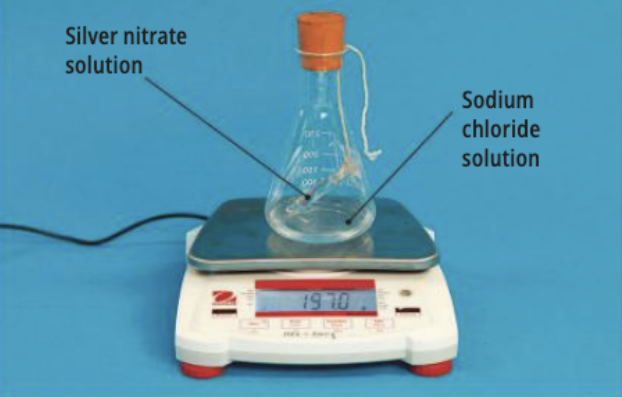
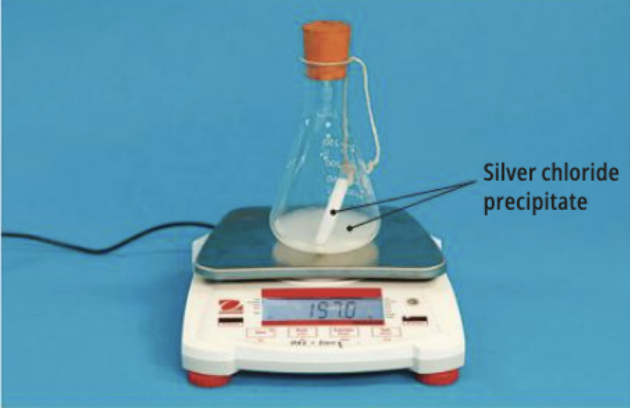
Modern chemistry students can verify this law through practical experiments. A common demonstration involves the reaction between silver nitrate and sodium chloride solutions:
Example
Silver Chloride Precipitation Experiment
Before mixing the solutions, the total mass of reactants and containers measures 197.0g. After the reaction forms white silver chloride precipitate, the total mass remains 197.0g, confirming that mass is conserved.
This demonstrates that even when a visible precipitate forms and the appearance changes dramatically, no mass is lost or gained in the process.
The importance of closed systems
For the Law of Conservation of Mass to be verified experimentally, reactions must be carried out in a closed system. This means nothing can enter or escape during the reaction.
Note
Understanding Closed Systems
A simple closed system can be created using a flask with a tightly-fitting rubber stopper. This prevents gases from escaping or entering, ensuring accurate mass measurements. Without a closed system, gases produced or consumed in reactions could escape, making it appear that mass is not conserved.
Important
Common Experimental Error
Many students incorrectly conclude that mass is not conserved when they observe reactions in open containers where gases can escape. Always ensure your experimental setup prevents material loss!
Practical applications and exam tips
Understanding the Law of Conservation of Mass is fundamental to:
Note
Key Applications
- Balancing chemical equations - ensuring equal numbers of each type of atom on both sides
- Stoichiometric calculations - working out quantities of reactants and products
- Predicting reaction outcomes - understanding what masses of products to expect
Exam tip: Always remember that in any chemical equation, the total mass of reactants equals the total mass of products. Use this principle to check your balanced equations and calculations.
Summary
Key Points to Remember:
- The Law of Conservation of Mass states that mass cannot be created or destroyed in chemical reactions
- Antoine Lavoisier discovered this law through careful measurement of the mercury-oxygen reaction in 1774
- Total mass of reactants always equals total mass of products
- Experiments must be conducted in closed systems to verify the law accurately
- This law is the foundation for balancing chemical equations and stoichiometric calculations