Volumetric Analysis: Acid-Base (LC 2027) (Leaving Cert Chemistry): Revision Notes
📚Revision Notes
Accuracy and Precision in Volumetric Analysis
Understanding accuracy and precision
When working with volumetric analysis, two fundamental concepts determine the quality of your measurements: accuracy and precision. These terms are often confused, but understanding their differences is crucial for successful laboratory work.
Note
Key Definitions:
Accuracy refers to how close your measurement is to the correct or true value of what you're measuring. Think of it as hitting the bullseye on a target - the closer you get to the centre, the more accurate your measurement.
Precision refers to how close repeated measurements are to each other, regardless of whether they're correct. This is about consistency and repeatability in your results.
Key differences between accuracy and precision
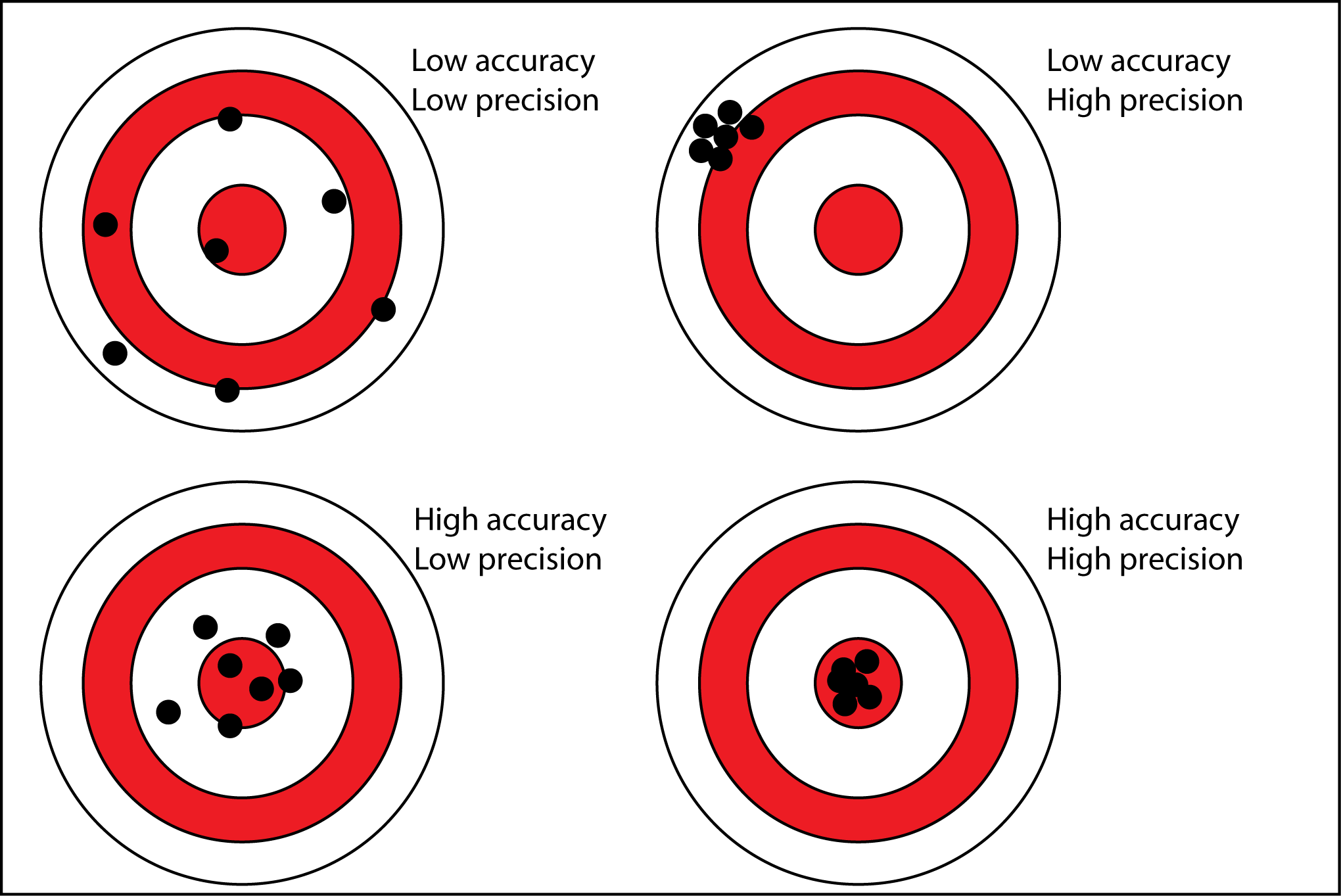
The relationship between these concepts can be understood through practical examples:
Important
Understanding the Bullseye Analogy:
Using the bullseye analogy helps visualise these concepts:
- High accuracy, high precision: All shots hit near the centre and are grouped together
- High accuracy, low precision: Shots are scattered but average near the centre
- Low accuracy, high precision: Shots are grouped together but away from the centre
- Low accuracy, low precision: Shots are scattered and away from the centre
Importance in volumetric analysis
Both accuracy and precision play vital roles when carrying out titrations and other volumetric procedures:
Why accuracy matters
- Ensures you obtain the correct concentration values for unknown solutions
- Prevents systematic errors that could affect all your calculations
- Essential for reliable quantitative analysis results
Why precision matters
- Indicates the reliability and consistency of your experimental technique
- Helps identify random errors in your measurements
- Builds confidence in your results through repeatability

When scientists follow detailed procedures carefully, they can achieve both accurate and precise results consistently.
Practical precautions for accurate measurements
To ensure your volumetric analysis results are both accurate and precise, it's essential to follow proper laboratory procedures and maintain consistent technique throughout your work.
Important
Essential Precautions for Accurate Measurements:
-
Use properly calibrated equipment - Only use burettes, pipettes and volumetric flasks that have been accurately calibrated
-
Take readings at eye level - Prevent parallax errors by ensuring the bottom of the meniscus aligns with the calibration mark at eye level
-
Rinse glassware correctly - Rinse burettes and pipettes with the solution they will contain, not just with deionised water
-
Control the endpoint carefully - Add solution drop-by-drop near the endpoint to avoid overshooting
-
Use standard solutions - Always use solutions with accurately known concentrations for your calculations
Common errors and their effects
Understanding how different errors affect your results helps improve your technique and identify areas for improvement in your experimental procedure.
Note
Types of Errors and Their Sources:
Accuracy errors typically result from:
- Using incorrectly calibrated equipment
- Systematic procedural mistakes
- Using solutions with incorrect concentrations
Precision errors usually stem from:
- Inconsistent technique between measurements
- Environmental factors affecting readings
- Difficulty in determining exact endpoints
Industrial applications
The principles of accuracy and precision are crucial in industrial chemistry, particularly in pharmaceutical manufacturing. Companies must follow strict quality control procedures to ensure every batch of medication contains exactly the right concentration of active ingredients.
Worked examples
Example
Worked Example 1: Evaluating Measurement Quality
A student measures a solution volume three times and records 23.5 cm³, 23.6 cm³, and 23.7 cm³. The correct volume is 23.0 cm³.
Analysis: The results show good precision (close to each other) but poor accuracy (different from the true value).
Example
Worked Example 2: Identifying Procedural Errors
When measuring ethanoic acid concentration in vinegar, a student forgets to rinse the burette with the solution.
Effect: This affects accuracy because water remaining in the burette dilutes the solution, giving an incorrect concentration reading. However, precision may remain good if the error is consistent.
Example
Worked Example 3: Ensuring Accurate Results
To ensure accurate results when measuring ethanoic acid concentration, what precautions should be taken?
Answer: Use calibrated equipment, read at eye level, rinse glassware properly, control the endpoint carefully, and use standard solutions with known concentrations.
Summary
Key Points to Remember:
- Accuracy means getting close to the true or correct value
- Precision means getting consistent, repeatable results
- Both are essential for reliable volumetric analysis
- Proper technique and calibrated equipment ensure accurate measurements
- Consistent methodology ensures precise results