Exam-Style Volumetric Problems (Leaving Cert Chemistry): Revision Notes
📚Revision Notes
Exam-Style Volumetric Problems
Introduction
Volumetric analysis problems can be approached using two different methods, and mastering both approaches is essential for exam success. In previous chapters, you learned how problems could be solved starting with basic definitions without needing formulas. However, when facing time pressure in exams, using key formulas can be much faster and more effective, provided you show all your calculations clearly.
Learning to solve problems using first principles helps you understand the underlying concepts in volumetric analysis. However, this approach can be time-consuming during exams. Therefore, this chapter introduces key formulas that will help you solve volumetric problems more efficiently whilst maintaining accuracy and precision in your practical work.
Problem-solving approaches
First principles method
This approach starts with basic definitions and works through each step systematically. You begin with fundamental concepts and build up your solution step by step. This method helps develop a deep understanding of volumetric analysis principles but can be time-consuming in exam conditions.
Formula method
This approach starts with an appropriate formula and substitutes known values directly. This method is faster and very effective when you're confident with the formulas, making it ideal for exam situations where time management is crucial.
Note
When to use each method:
- Use the first principles method when learning new concepts or when you need to demonstrate understanding
- Use the formula method during exams when time efficiency is critical
Key formulas for volumetric analysis
Understanding these essential formulas will help you tackle different types of volumetric problems efficiently:
Formula 1: Moles calculation
- This formula can be rearranged to find mass or molecular mass when needed
Formula 2: Molarity relationship
- Useful for calculating moles when given volume and molarity of solutions
Formula 3: Titration equation
- Essential for determining unknown concentrations from titration data
Formula 4: Density relationship
- Helpful when dealing with liquid samples where density is provided
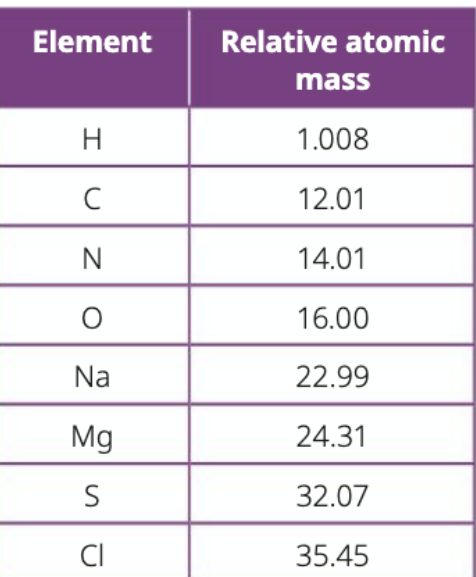
Important
The relative atomic masses shown above are commonly used in acid-base volumetric calculations and should be memorised or readily available during calculations.
Worked examples
Example
Worked Example: Vinegar analysis
This example demonstrates how to determine the concentration of ethanoic acid in vinegar using titration data.
Problem setup: A sample of vinegar was diluted and titrated against standardised sodium hydroxide solution. The titration data needs to be analysed to find the concentration of ethanoic acid.
Solution approach: Using the titration formula , where:
- cm³ (volume of acid)
- (unknown molarity of acid)
- (from balanced equation)
- cm³ (volume of base)
- mol/L (molarity of base)
- (from balanced equation)
Step-by-step calculation:
- Substitute values into the formula:
- Solve for : mol/L
Example
Worked Example: Dilution calculations
This example shows how to handle dilution problems and calculate concentrations in original solutions.
Key steps in dilution problems:
- Calculate the molarity of the diluted solution using titration data
- Use the dilution factor to find the concentration in the original solution
- Convert between different concentration units as required
Important dilution relationship:
Practical exam tips
Equipment and procedures
Note
Apparatus selection:
- Use a pipette to measure accurate volumes of the original solution
- Rinse apparatus with deionised water, then with the solution to be used
Dilution technique:
- Place measured volume of original solution in a volumetric flask
- Add deionised water carefully
- Ensure the bottom of the meniscus aligns with the graduation mark
Indicator selection:
- Phenolphthalein is suitable for acid-base titrations
- The colour change is from pink to colourless at the endpoint
- Always state both colours when describing colour changes
Accuracy considerations
Dilution benefits: If vinegar is not diluted, a much smaller volume of the more concentrated solution would be required to neutralise the sodium hydroxide solution. This smaller volume increases the percentage error, making the results less accurate. Diluting the vinegar increases the volume needed for neutralisation, which reduces percentage error and leads to more accurate titration results.
Important
Caustic substance safety: Since sodium hydroxide is a caustic substance, it's safer to use a less concentrated solution to minimise the risk of chemical burns or other safety hazards.
Summary
Key Points to Remember:
- Two approaches exist: First principles method for understanding, formula method for exam efficiency
- Key formula: is essential for titration calculations
- Dilution reduces error: Diluting concentrated solutions improves accuracy by reducing percentage error
- Show all working: Always demonstrate your calculation steps clearly in exam answers
- Safety first: Use appropriate concentrations and equipment to ensure safe practical work