Potassium Permanganate and Redox Titration 1 (Leaving Cert Chemistry): Revision Notes
📚Revision Notes
Potassium Permanganate and Redox Titration 1
Introduction to potassium permanganate
Potassium permanganate is a powerful chemical compound that plays a crucial role in redox titrations. Understanding its properties and behaviour is essential for mastering volumetric analysis techniques.
What is potassium permanganate?
- Chemical formula:
- Appearance: Distinctive purple-coloured solid
- Function: Acts as a strong oxidising agent
- Special property: Self-indicating (changes colour during reactions)
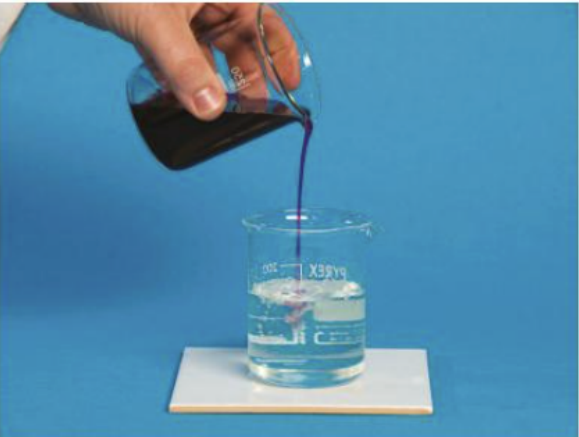
The compound is widely used in analytical chemistry because it can accept electrons from other substances, making it an effective oxidising agent. Unlike many other titrants, potassium permanganate doesn't require a separate indicator because it provides its own visual cue through colour changes.
Note
The self-indicating property of potassium permanganate makes it particularly valuable in analytical chemistry, as it eliminates the need for additional indicators and simplifies the titration process.
Key properties of potassium permanganate
Physical characteristics:
- Intense purple colour when dissolved in water
- Not a primary standard due to purity limitations
- Unstable and decomposes in sunlight and heat
- Concentration varies over time in solution
Important
Why isn't it a primary standard?
Potassium permanganate cannot be used as a primary standard because:
- It cannot be obtained in a state of very high purity
- It's unstable and decomposes in the presence of sunlight and heat
- The concentration of solutions varies over time
- Solutions must be standardised by titration against a primary standard solution
The permanganate reaction in acidic solution
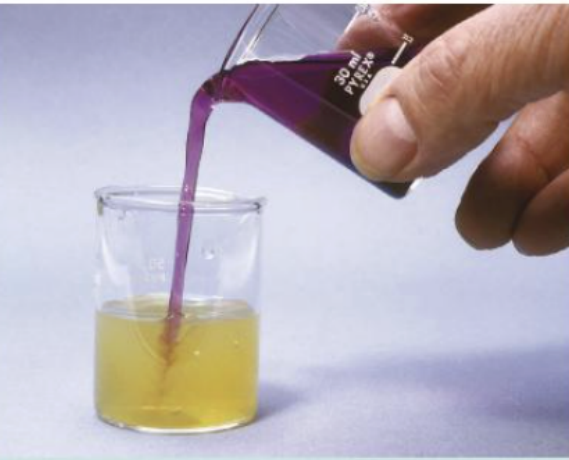
The fundamental reaction: When potassium permanganate reacts with iron(II) ions in acidic conditions, a characteristic colour change occurs from purple to colourless.
Half equations:
- Reduction (permanganate):
- Oxidation (iron):
Overall balanced equation:
Key stoicheiometry:
- One ion reacts with five ions
- Ratio is 1:5 (permanganate to iron)
- This ratio is crucial for accurate calculations
Example
Worked Example: Stoichiometric Calculations
If 25.0 mL of 0.020 M is used in a titration:
Step 1: Calculate moles of Moles = 0.025 L × 0.020 mol/L = 5.0 × 10⁻⁴ mol
Step 2: Use 1:5 ratio to find moles of Moles of = 5.0 × 10⁻⁴ × 5 = 2.5 × 10⁻³ mol
Understanding the self-indicating nature
What does self-indicating mean? Potassium permanganate acts as its own indicator because:
- The permanganate ion () is purple in colour
- When reduced to ions, the solution becomes colourless
- The colour change signals the end point of the titration
- No additional indicator is needed
During titration:
- Start: Purple permanganate solution in the burette
- During: Purple colour disappears as permanganate is reduced
- End point: Faint pink colour persists (excess permanganate)
Important
The self-indicating property is one of the most significant advantages of using potassium permanganate in redox titrations. The dramatic colour change from intense purple to colourless provides a clear, unmistakable endpoint that doesn't require additional indicators.
Iron(II) as a reducing agent and primary standards
The Fe²⁺ reducing agent: Iron(II) ions serve as the reducing agent in these titrations. However, simple iron(II) sulphate () cannot be used directly as a primary standard.
Important
Problems with iron(II) sulphate:
- It's not possible to use iron crystals of iron(II) sulphate as a primary standard
- The crystals tend to lose their water of crystallisation when exposed to air
- Spontaneous loss of water (efflorescence) occurs
- This makes accurate weighing difficult
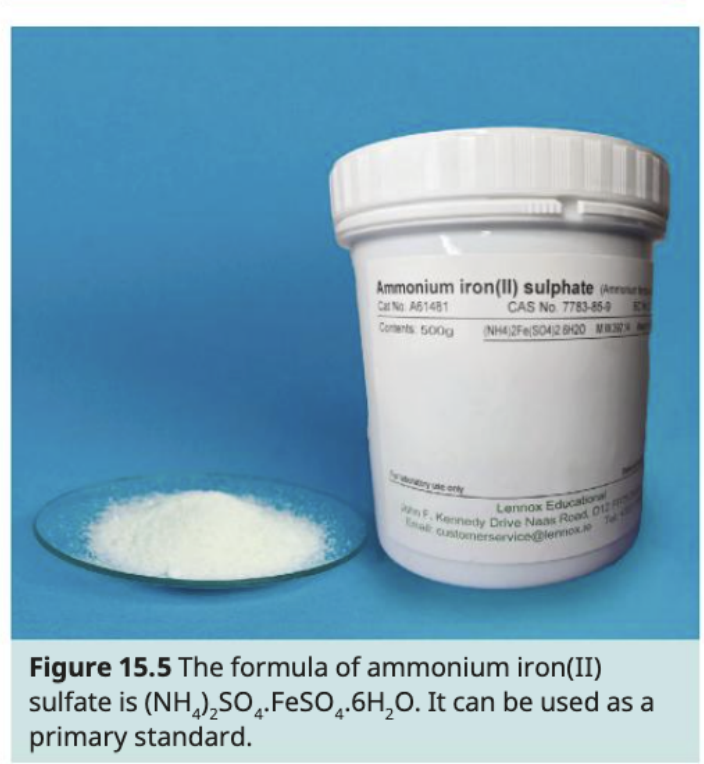
Solution: Ammonium iron(II) sulfate Instead, we use ammonium iron(II) sulphate as the source of ions:
- Formula:
- Also known as ferrous ammonium sulphate
- Can be obtained in high purity
- Does not suffer from efflorescence
- Acts as a reliable primary standard
Key advantages:
- Very stable and doesn't spontaneously lose water
- High degree of purity available
- Not affected by air exposure
- Provides a consistent source of ions
Note
Ammonium iron(II) sulphate is classified as a double salt, consisting of two different simple salts crystallised together in a fixed ratio within the same crystal structure. This structure contributes to its stability compared to simple iron(II) sulphate.
Practical considerations for titrations
Acid conditions:
- The reaction must occur in acidic solution
- Usually dilute sulfuric acid is added
- This provides the ions needed for the reaction
- Prevents side reactions
Note
Dilute solutions:
- Fairly dilute solutions of are typically used
- Usually around 0.02 M solutions for redox titrations
- This ensures better control and accuracy
Note
Colour observation:
- Read from the top of the meniscus rather than the bottom
- The intense purple colour makes the bottom difficult to read
- Take readings from the top for better accuracy
Reactions in different conditions
In neutral or basic solution: The reaction changes when conditions are not acidic:
- Permanganate doesn't change to colourless
- Instead, it forms a brown solid precipitate
- The manganese changes from oxidation state +7 (purple) to +4 (brown)
Alternative reaction:
Important
This is why acidic conditions are essential for the standard permanganate titrations used in analysis. Without proper acidification, you won't get the characteristic colour change from purple to colourless, making endpoint detection impossible.
Important definitions
Efflorescence: The spontaneous loss of water of crystallisation by a hydrated salt when exposed to air.
Hygroscopic: A substance that absorbs moisture from the surrounding air without dissolving into a liquid solution.
Deliquescence: The spontaneous process by which a substance absorbs moisture from the atmosphere to the extent that it dissolves into a liquid solution.
Double salt: A salt that consists of two different simple salts crystallised together in a fixed ratio within the same crystal structure.
Summary
Key Points to Remember:
- Potassium permanganate is self-indicating - it changes from purple to colourless, eliminating the need for separate indicators
- The stoichiometric ratio is crucial - one ion reacts with five ions (1:5 ratio)
- Acidic conditions are essential - the reaction requires ions and produces different products in basic conditions
- Use ammonium iron(II) sulphate as the primary standard - it's more stable than simple iron(II) sulphate and doesn't lose water spontaneously
- Read the meniscus from the top - the intense purple colour makes bottom readings difficult and inaccurate