Random and Systematic Errors (Leaving Cert Chemistry): Revision Notes
📚Revision Notes
Random and Systematic Errors
When carrying out chemistry practical work, especially volumetric analysis, there is always a possibility of experimental error. Understanding the different types of errors and how to minimise them is crucial for obtaining accurate and reliable results.
Note
What is Experimental Error?
Experimental error refers to the difference between the measured value and the true value of a particular quantity. In chemistry, we need to be aware of sources of error and know how to minimise them to ensure our results are as accurate as possible.
There are two main categories of experimental error that you need to understand: systematic error and random error. Each behaves differently and requires different approaches to minimise their impact on your results.
Systematic error
A systematic error is a consistent, repeating error that always occurs in the same direction. This means that if a systematic error is present, it will always cause your measured values to be either consistently higher or consistently lower than the true value.
Key characteristics of systematic errors
Understanding the key characteristics of systematic errors is essential for identifying them in your practical work:
- Consistent direction: Systematic errors always shift measurements in the same direction (always too high or always too low)
- Repeatable: The same error occurs every time the measurement is taken
- Affects accuracy: Systematic errors reduce the accuracy of results but do not affect precision
- Can be eliminated: Once identified, systematic errors can often be completely eliminated through proper procedures
Common examples of systematic errors
Equipment-related systematic errors:
- A faulty pH probe that always gives readings that are consistently higher than the true pH value
- A pipette with a damaged tip that always delivers a consistently lower volume than stated on the bulb
- An electronic balance that has not been correctly calibrated, causing all mass readings to be consistently off by the same amount
Procedural systematic errors:
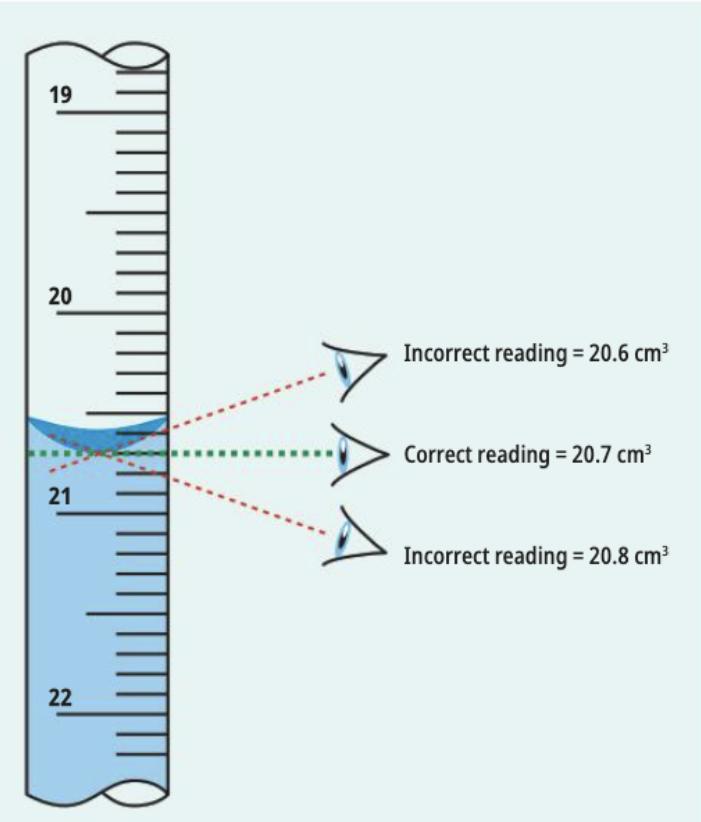
- Reading the meniscus from the wrong angle, known as parallax error
- Using the wrong indicator for a particular titration, causing the end point to be detected too early or too late consistently
- Consistently overshooting the end point in titrations
Technique-related systematic errors:
- Always reading liquid volumes from the top of the meniscus instead of at eye level
- Consistently holding a burette at an incorrect angle when taking readings
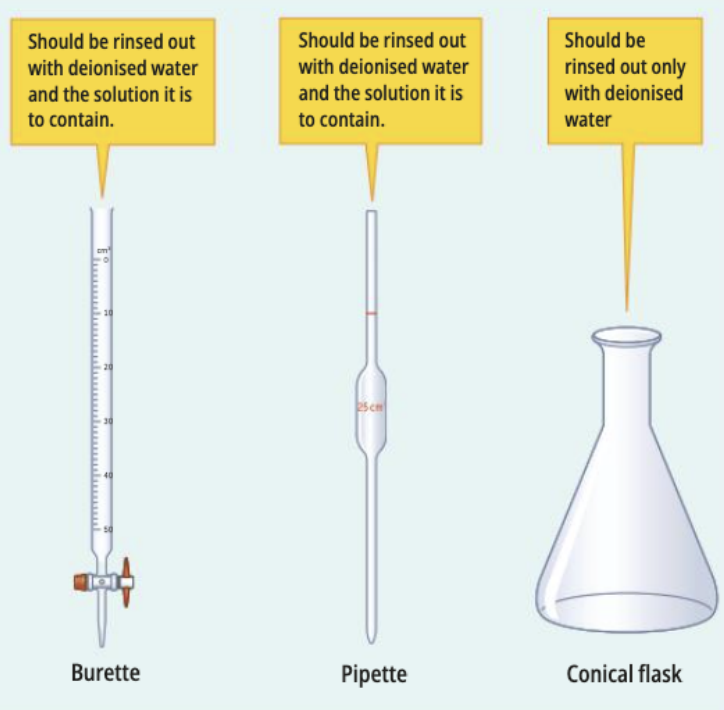
- Not following correct rinsing procedures for glassware
Important
Critical Point About Parallax Error
Parallax error is one of the most common systematic errors in volumetric analysis. Always ensure you read the meniscus at eye level to avoid this error. Even experienced students can fall into this trap if they're not careful!
How to minimise systematic errors
Systematic errors can be minimised or eliminated by:
- Ensuring proper calibration of all instruments before use
- Using correct indicators for each specific type of titration
- Reading volumes at eye level to avoid parallax errors
- Following correct laboratory procedures as outlined in practical manuals
- Using properly maintained equipment and replacing faulty apparatus
Random error
A random error is an unpredictable fluctuation in measurements that can occur in both directions around the true value. Unlike systematic errors, which always shift results in the same direction, random errors cause measurements to vary unpredictably from trial to trial.
Key characteristics of random errors
Random errors behave very differently from systematic errors, making them challenging to identify and manage:
- Unpredictable direction: Random errors can cause measurements to be either higher or lower than the true value
- Inconsistent: The size and direction of the error changes randomly between measurements
- Affects precision: Random errors reduce precision but can be minimised through repeated measurements
- Cannot be completely eliminated: Random errors can only be reduced, not eliminated entirely
Common examples of random errors
Environmental factors:
- Temperature fluctuations during the experiment affecting reaction rates or equipment calibration
- Air currents affecting electronic balance readings
- Variations in room lighting that could affect colour change detection during titrations
Human factors:
- Reaction time variations when stopping a titration at the end point
- Inconsistent technique in swirling solutions during titrations
- Slight variations in the number of drops of indicator added between trials
Equipment-related factors:
- Uneven mixing of solutions in volumetric flasks, leading to concentration variations
- Temperature variations affecting the volume of solutions
- Small inconsistencies in reading the meniscus, even when using correct technique
Note
Understanding Random Error Impact
Random errors are particularly frustrating because they're unpredictable. However, their random nature means that with enough measurements, positive and negative errors will tend to cancel each other out when you calculate an average.
How to minimise random errors
Random errors can be minimised by:
- Taking multiple measurements and calculating an average result
- Maintaining constant environmental conditions throughout the experiment
- Using consistent technique for all trials
- Ensuring thorough mixing of all solutions
- Keeping room conditions stable (temperature, lighting, air currents)
Practical examples
Understanding how to identify different types of errors in real experimental data is crucial for improving your practical skills.
Example
Worked Example: Identifying Systematic Error
If a student performs three titrations and obtains results of 22.4 cm³, 22.2 cm³, and 22.1 cm³, with a true end point of 22.5 cm³, this shows evidence of systematic error because all values are consistently lower than the true value.
Analysis: All measurements are consistently below the true value, indicating a systematic error rather than random variation.
Example
Worked Example: Identifying Random Error
If different samples in a titration have slightly different concentrations due to incomplete mixing, this introduces random error because the concentration varies unpredictably between samples, causing titration results to fluctuate randomly around the true value.
Analysis: The error direction and magnitude change unpredictably between trials, which is characteristic of random error.
Key differences between error types
Understanding the fundamental differences between systematic and random errors will help you identify and address them effectively in your practical work.
| Systematic Error | Random Error |
|---|---|
| Consistent direction (always high or low) | Unpredictable direction (can be high or low) |
| Affects accuracy | Affects precision |
| Can be eliminated completely | Can only be minimised |
| Same error repeats in each trial | Error varies between trials |
| Caused by faulty equipment or incorrect procedures | Caused by uncontrolled variables |
Important
Remember the Key Distinction
The most important difference to remember is that systematic errors are consistent and predictable, while random errors are inconsistent and unpredictable. This fundamental difference determines how you approach minimising each type of error.
Summary
Key Points to Remember:
- Systematic errors are consistent and always shift results in the same direction - they can be eliminated through proper calibration and correct procedures
- Random errors are unpredictable fluctuations that can occur in either direction - they can be minimised by taking multiple measurements and averaging results
- Parallax error is a common systematic error caused by reading measurements from the wrong angle - always read at eye level
- Environmental factors like temperature and air currents are major sources of random error in chemistry practicals
- Both types of errors can significantly affect the reliability of your experimental results, so understanding how to identify and minimise them is essential for success in chemistry practicals