Medea (Leaving Cert Classical Studies): Revision Notes
📚Revision Notes
Literary Techniques
Euripides employs a rich variety of literary techniques throughout Medea to create dramatic tension, engage the audience emotionally, and explore complex themes. Understanding these techniques is essential for appreciating how the tragedy achieves its powerful effects and communicates its central messages.
Note
Mastering these literary techniques will help you analyse not just Medea, but any classical Greek tragedy. Pay attention to how each technique serves multiple purposes within the same work.
Tragic conventions
Euripides follows several classical Greek dramatic conventions that shape the structure and presentation of Medea. The unity of place ensures all action occurs in front of Jason and Medea's house, creating a focused setting that intensifies the domestic conflict. This single location emphasises how the breakdown of marriage and family lies at the heart of the tragedy.
The playwright employs offstage violence to maintain dramatic propriety whilst still conveying the horror of Medea's revenge. The deaths of Glauce, Creon, and Medea's children all occur away from the audience's direct view, with messengers reporting these events. This technique allows Euripides to describe the gruesome details whilst preserving the dignity of the theatrical performance.
Example
Worked Example: Deus Ex Machina
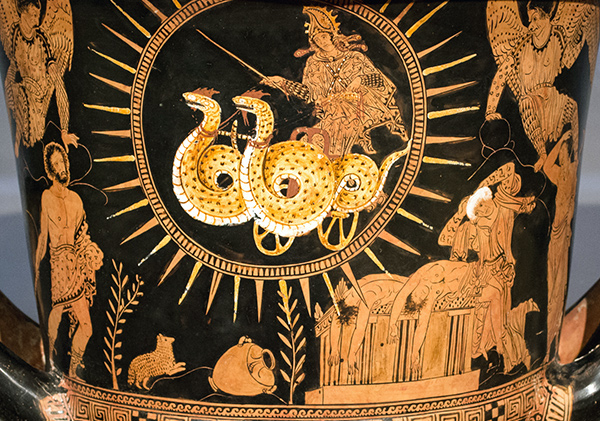
The most significant convention is the deus ex machina - literally "god from the machine."
Evidence: "Medea is carried aloft by the Sun God's chariot."
Effect: This divine intervention provides resolution whilst emphasising Medea's supernatural connections and ultimate triumph over her enemies, elevating her from mortal victim to divine agent of justice.
Speeches and rhetoric
The play features extended rhetorical speeches that allow characters to present their perspectives and engage in complex arguments. These lengthy passages serve multiple dramatic purposes: they reveal character motivations, advance the plot, and highlight the fundamental conflicts between different worldviews.
Note
The contrast between characters' rhetorical styles is particularly effective in revealing their true natures and values. Pay attention to how speech patterns reflect character psychology.
The contrast between characters' rhetorical styles proves particularly effective. Medea delivers emotionally charged speeches that often win audience sympathy through their eloquence and passion. Her famous feminist declaration exemplifies this: "Of all creatures that can feel and think, we women are the worst treated things alive." Meanwhile, Jason employs cold, rational arguments that reveal his pragmatic but heartless nature, as when he claims: "It was not for desire of a new bride, but to secure your prosperity."
These opposing rhetorical approaches emphasise the clash between emotion and logic, female experience and male privilege, that drives the tragedy's central conflict.
Irony
Euripides masterfully employs multiple forms of irony to create dramatic tension and highlight the tragedy's themes. Dramatic irony occurs when the audience possesses knowledge that characters lack, particularly regarding Medea's secret plans for revenge. Whilst Jason believes Medea has accepted their situation, the audience knows she is plotting his destruction, creating sustained tension throughout the play.
Situational irony pervades Jason's story arc. He enters into his new marriage believing it will secure his future prosperity and success, but this decision ultimately leads to his complete ruin and loss of everything he values. The irony extends to other characters as well - the Chorus initially sympathises with Medea's plight but becomes horrified when they witness the full extent of her vengeance.
Example
Worked Example: Verbal Irony in Action
Medea employs irony as a weapon when speaking deceptively to Creon:
Quote: "Do not be afraid of me... I will yield to your request."
Reality: She is planning his daughter's murder at this very moment.
Effect: This false reassurance demonstrates how irony functions as both a literary technique and a character trait, showing Medea's cunning intelligence.
Imagery and symbolism
The play's imagery creates powerful visual and emotional associations that reinforce its central themes. Fire and poison imagery dominates Medea's revenge against Glauce, with the magical crown and robe producing destructive flames that symbolise uncontrollable passion and divine retribution. The Messenger's vivid description captures this: "The crown of gold poured forth a stream of all-devouring fire."
Children function as complex symbols throughout the tragedy. They represent innocence, the future, and family continuity - all of which Medea destroys in her quest for revenge. Their silent presence on stage heightens the pathos of the final scenes, as the audience witnesses the destruction of the most vulnerable characters.
Helios' chariot symbolises divine power and Medea's connection to supernatural forces. Her escape in this vehicle demonstrates that she possesses resources beyond mortal reach, elevating her from abandoned wife to divine agent of justice and vengeance.
Important
The symbolic elements work together to create layers of meaning. Fire represents both destructive passion and purifying justice, while children symbolise both innocent victims and the future that revenge destroys.
Chorus and choral odes
The Chorus of Corinthian women serves multiple dramatic functions, providing lyrical commentary on the action whilst exploring broader themes of justice, gender relations, and divine order. Their songs offer moments of reflexion between intense dramatic episodes, allowing the audience to process complex emotional and moral questions.
The Chorus's shifting sympathies mirror the audience's own conflicted response to Medea's actions. Initially, they express understanding for her situation and anger at Jason's betrayal, but their horror at her infanticide reveals the limits of their support. This evolution demonstrates how even those who understand Medea's grievances cannot condone her ultimate revenge.
Their commentary often addresses universal themes that extend beyond the specific story. The Chorus reflects: "Terrible is the anger and almost beyond cure when strife severs the bond of marriage." Such observations connect Medea's particular situation to broader patterns of human experience and divine justice.
Stychomythia (rapid dialogue)
This technique involves fast exchanges of single lines between characters, creating intense dramatic moments that highlight conflict and build tension. Euripides uses stychomythia particularly effectively during confrontations between Jason and Medea, where their rapid verbal sparring reflects the breakdown of communication and the intensity of their mutual hostility.
The technique proves especially powerful during scenes where Jason attempts to justify his betrayal. The short, sharp exchanges prevent either character from delivering lengthy explanations, forcing them to confront each other directly without rhetorical flourishes. This creates moments of raw emotional truth that reveal character motivations more clearly than extended speeches might achieve.
Foreshadowing
Throughout the early scenes, Euripides plants hints about the tragic events to come, building anticipation and dread that intensify the drama's emotional impact. Medea's early laments and expressions of rage suggest the violence that will eventually unfold, whilst other characters' warnings prove prophetic.
Example
Worked Example: Early Warning Signs
The Nurse's observation: "Her temper is dangerous... she will not put up with this treatment."
Creon's instinctive fear: Despite Medea's apparent submission, he senses danger.
Effect: These early warnings prove entirely justified when Medea's revenge unfolds, creating a sense of inevitable tragedy while maintaining suspense about exactly how events will develop.
Pathos (emotional power)
The play achieves its devastating emotional impact through carefully crafted scenes that evoke both sympathy and horror. Euripides presents Medea as simultaneously victim and perpetrator, creating complex emotional responses that resist simple moral judgements.
The most powerful pathetic moment occurs when Medea struggles between maternal love and the desire for revenge. Her internal conflict, expressed in the anguished line "My heart dissolves, women, when I see the shining faces of my children," demonstrates the terrible cost of her chosen path whilst maintaining audience sympathy for her impossible situation.
The children's silent presence throughout the final scenes heightens the emotional impact, as their innocence contrasts sharply with the adult world's corruption and violence. This technique ensures that the tragedy's conclusion achieves maximum emotional effect whilst raising profound questions about justice, revenge, and the price of honour.
Important
Exam Strategy: Analysing Literary Techniques
When analysing literary techniques in Medea, always:
- Identify specific techniques and explain their dramatic effects
- Use specific episodes to support your analysis
- Connect techniques to broader themes
- Support arguments with brief, well-chosen quotations
Remember that these techniques work together to create the play's overall effect. Consider how foreshadowing builds to the climax, how irony creates tension, and how pathos ensures emotional engagement with morally complex characters.
For example, deus ex machina creates divine ambiguity by suggesting both justice and escape from consequences, whilst irony builds tension by creating gaps between appearance and reality. Reference Medea's speeches to demonstrate rhetoric, the Messenger scene to show offstage violence, and the final chariot escape to illustrate divine intervention.
Contrast Jason's cold logic with Medea's emotional appeals to show how rhetorical styles reveal character. Always connect techniques to broader themes: link fire imagery to passion and destruction, relate the Chorus's commentary to social issues, and consider how stychomythia reflects communication breakdown.
Summary
Key Points to Remember:
-
Tragic conventions structure the drama using unity of place, offstage violence, and deus ex machina to maintain classical form whilst exploring contemporary themes
-
Irony and foreshadowing build dramatic tension by creating gaps between knowledge and ignorance, expectation and reality
-
Rhetorical speeches reveal character motivations whilst highlighting conflicts between different worldviews and values
-
Imagery and symbolism reinforce themes through powerful visual associations, particularly fire representing passion and destruction
-
Chorus and pathos guide audience response whilst exploring universal themes of justice, revenge, and human nature