Characters (Leaving Cert Classical Studies): Revision Notes
📚Revision Notes
Characters
Philoctetes - The suffering hero
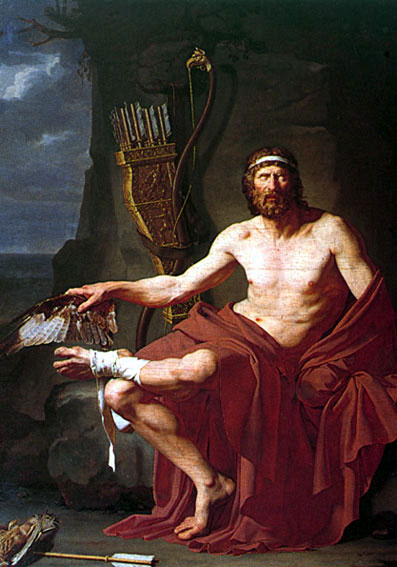
Philoctetes is the central tragic figure of Sophocles' play, representing the consequences of abandonment and the power of unwavering principles. This Greek warrior was left stranded on the remote island of Lemnos by his own comrades due to his festering snake wound, which produced an unbearable stench and constant cries of agony.
Note
The infected wound serves as a powerful symbol in the play, representing both Philoctetes' physical agony and his complete social isolation from the Greek community that once embraced him as a hero.
Key characteristics of Philoctetes:
- Physical and emotional suffering: His infected wound serves as a powerful symbol of both his physical pain and his social isolation from the Greek community
- Possessor of Heracles' sacred bow: This divine weapon is essential for Greek victory at Troy, making Philoctetes both valuable and vulnerable
- Stubborn honour: Despite his suffering, he refuses to compromise his principles or forgive those who wronged him
- Bitter resentment: Years of solitude have hardened his heart against his former allies
The wounded hero's isolation has shaped his worldview, making him deeply suspicious of others' motives. His famous declaration reveals his pain: "They left me, abandoned, alone, with this incurable wound." This abandonment has created an almost insurmountable barrier between Philoctetes and any Greek who seeks his aid.
Odysseus - The pragmatic strategist
Odysseus appears as the master manipulator who prioritises victory over moral concerns. As the architect of the mission to retrieve both Philoctetes and his bow, he represents a pragmatic worldview that justifies deception when it serves the greater good.
Odysseus embodies several key traits:
- Strategic thinking: He carefully plans how to obtain the bow through trickery rather than honest persuasion
- Moral flexibility: Unlike Philoctetes' rigid principles, Odysseus adapts his ethics to suit his goals
- Leadership responsibility: He feels the weight of Greek expectations and the need for victory at Troy
- Willingness to sacrifice individual morality: He believes the war effort justifies personal ethical compromises
His philosophy becomes clear when he tells Neoptolemus: "Deceit is a weapon we must use, if it brings us victory." This utilitarian approach puts him in direct conflict with both Philoctetes' honour-bound nature and Neoptolemus' emerging moral consciousness.
Important
Odysseus represents a critical moral perspective in the play - the idea that the ends can justify the means when the stakes are high enough. This creates the central ethical tension that drives the entire drama.
Neoptolemus - The conflicted young warrior
Neoptolemus, son of the great Achilles, serves as the play's most complex character development. His moral journey from willing participant in deception to champion of truth forms the emotional heart of the drama.
Neoptolemus' character development includes:
- Initial naivety: As a young, inexperienced warrior, he initially trusts Odysseus' guidance without question
- Growing moral awareness: Contact with Philoctetes awakens his sense of right and wrong
- Internal conflict: He struggles between loyalty to his mission and sympathy for the suffering hero
- Moral courage: Eventually, he chooses honesty over expediency, returning the bow to its rightful owner
His transformation is captured in powerful statements that reveal his changing values. He declares: "Better to fail with honour than win by deceit" and "My nature is to do no wrong, not by deceit nor by compulsion." These quotes demonstrate his growth from confused youth to principled young man.
Example
Character Arc: Neoptolemus' Moral Transformation
Stage 1: Naive obedience - follows Odysseus without question
Stage 2: Developing doubt - begins to question the deception
Stage 3: Internal conflict - struggles between duty and conscience
Stage 4: Moral awakening - chooses truth over tactical advantage
Stage 5: Principled action - returns the bow despite consequences
Heracles - The divine solution
Heracles appears as a deus ex machina (literally "god from the machine"), providing supernatural resolution to the seemingly impossible human conflict. As Philoctetes' former friend and the original owner of the sacred bow, he carries unique authority to end the standoff.
Heracles' role encompasses:
- Divine intervention: He represents the gods' will overriding human stubbornness and conflict
- Resolution of fate: His appearance ensures that prophetic destiny will be fulfilled
- Healing promise: He offers Philoctetes both physical cure and heroic glory at Troy
- Moral authority: As a figure who has suffered and achieved immortality, he can speak to Philoctetes' situation
His commanding words provide the play's resolution: "Follow now the will of Zeus, and go to Troy; there you will be healed, and win everlasting honour." This divine command transcends human arguments and personal grievances.
Note
The appearance of Heracles as a divine figure represents Sophocles' solution to an otherwise irresolvable human conflict. When human reason and emotion reach an impasse, divine intervention provides the path forwards.
The Chorus - Voices of the common people
The Chorus, composed of Neoptolemus' sailors, serves as both observer and moral commentator throughout the drama. They represent the perspective of ordinary people caught between competing loyalties and ethical demands.
The Chorus functions include:
- Emotional response: They express genuine sympathy for Philoctetes' terrible suffering
- Moral complexity: They understand both the hero's pain and their duty to their leaders
- Audience guide: Their reactions help shape how the audience should respond to events
- Social commentary: They represent how common people view the actions of their leaders
Their conflicted feelings emerge in the line: "We pity your suffering, Philoctetes, yet fear the power of the Atreidae." This captures the tension between human compassion and political necessity that runs throughout the play.
Character relationships and contrasts
Understanding how these characters interact reveals Sophocles' deeper themes about human nature, moral choice, and the tension between individual and collective needs.
Important
Key Thematic Contrasts:
- Philoctetes vs Odysseus: This represents the fundamental conflict between personal honour and political pragmatism
- Neoptolemus as mediator: The young warrior bridges these opposing worldviews through his moral development
- Divine vs human will: Heracles' intervention shows how fate ultimately transcends human choices
- Individual vs community: Each character struggles with balancing personal desires against collective needs
The interplay between these characters creates a rich tapestry of moral dilemmas that remain relevant to contemporary audiences, demonstrating Sophocles' timeless insight into human nature and ethical decision-making.
Summary
Key Character Insights:
-
Philoctetes embodies suffering and honour, representing the consequences of abandonment - his wound symbolises both physical pain and social exclusion
-
Odysseus represents cunning pragmatism and the willingness to sacrifice individual morality for collective victory
-
Neoptolemus undergoes crucial character development from naive youth to morally aware young man, torn between competing influences
-
Heracles provides divine resolution through deus ex machina, representing fate and the gods' ultimate authority
-
The Chorus offers the common people's perspective, showing the moral complexity ordinary citizens face when leaders conflict