Summary (Leaving Cert Classical Studies): Revision Notes
📚Revision Notes
Summary
Structure and plot overview
Aeschylus's Prometheus Bound follows a clear dramatic structure that builds tension through Prometheus's unwavering defiance against Zeus's tyrannical rule. The play unfolds through a series of encounters that reveal different perspectives on power, justice, and resistance.
Note
Unlike many Greek tragedies that rely on physical action and multiple scene changes, Prometheus Bound creates dramatic tension through dialogue and revelation while the protagonist remains physically static throughout the entire play.
Prologue - The chaining of Prometheus
The drama opens with a powerful scene of divine punishment. Kratos (representing Power) and Bia (representing Force) drag the Titan Prometheus to a remote mountainous location. They are accompanied by Hephaestus, the god of fire and metalworking, who reluctantly carries out Zeus's orders to chain Prometheus to the rock.
This opening immediately establishes the central conflict between authoritarian power and individual conscience. Hephaestus expresses moral discomfort with his task, stating "I must obey Zeus, though my heart grieves", whilst Kratos shows no sympathy, declaring Prometheus "foolish to resist the will of Zeus". The scene introduces the play's core theme of tyranny versus resistance.
Important
This opening scene is crucial because it immediately presents the moral complexity of the situation - even the gods themselves are conflicted about Zeus's harsh punishment, setting up audience sympathy for Prometheus from the very beginning.
Parodos - The chorus enters
The Chorus of Oceanids (sea nymphs) arrives and immediately demonstrates sympathy for Prometheus's plight. Their entrance serves multiple dramatic purposes:
- They represent the audience's emotional response to injustice
- They provide a moral voice questioning divine cruelty
- They allow Prometheus to explain his situation to newcomers
The Chorus expresses their distress, saying "We see your suffering, Prometheus, and our hearts are troubled". This reaction guides the audience towards viewing Prometheus as a sympathetic figure rather than a criminal.
First episode - Prometheus explains his gifts
In this crucial scene, Prometheus reveals why he faces punishment. He describes how he gave humanity essential knowledge and skills, including fire, agriculture, medicine, and various crafts. This explanation transforms our understanding of his 'crime' - rather than simple disobedience, Prometheus acted as humanity's benefactor.
Prometheus proudly declares "All human arts are from Prometheus", emphasising his role in human civilisation. The Chorus responds with admiration, which increases audience sympathy and positions Prometheus as a hero rather than a villain.
Example
Dramatic Technique: Revelation and Sympathy Building
Notice how Aeschylus structures this revelation:
- First, we see the punishment (prologue)
- Then, we learn why Prometheus is being punished (first episode)
- Finally, we understand that his "crime" was actually helping humanity
This sequence deliberately builds sympathy by showing the punishment before revealing the "crime."
Second episode - Oceanus advises compromise
Oceanus, an older Titan, arrives to counsel Prometheus towards submission. This episode creates a fascinating contrast between pragmatic survival and principled resistance. Oceanus represents the voice of caution, advising "Yield to Zeus... harsh words help not at all".
However, Prometheus refuses this practical advice, maintaining his moral stance. He criticises Zeus as "new to power and harsh to those he rules", suggesting that the current regime lacks legitimacy and experience. This exchange highlights the difficult choice between safety and integrity.
Third episode - Io's parallel suffering
The arrival of Io, a mortal woman transformed into a cow-like creature, provides a parallel to Prometheus's torment. Cursed by Zeus's lust and Hera's jealousy, Io wanders the earth driven by a gadfly, crying "I wander, driven by a gadfly, tormented by gods".
This encounter serves several purposes:
- It demonstrates that Zeus's cruelty extends beyond divine punishment to innocent mortals
- It connects Prometheus's suffering to human suffering more broadly
- It allows Prometheus to prophecy about Io's future descendants, including Heracles, who will eventually free him
Note
The Io episode serves as a crucial structural element that connects the mythological past (Prometheus's punishment) with the mythological future (his eventual liberation through Heracles). This gives the audience hope despite the play's dark ending.
Fourth episode - The secret prophecy
Prometheus reveals his most powerful weapon against Zeus: knowledge of a secret prophecy that threatens Zeus's rule. He knows of a future marriage that will produce a son stronger than Zeus, potentially overthrowing him.
Crucially, Prometheus refuses to reveal the details, even under threat, because "Fate is stronger than Zeus". This knowledge becomes his only bargaining power, creating tension between divine authority and the power of fate itself.
Important
The secret prophecy is Prometheus's only source of power in the play. Without this knowledge, he would be completely helpless against Zeus's punishment. This creates dramatic tension because the audience knows Prometheus holds a crucial secret but doesn't know what it is.
Exodos - The final confrontation
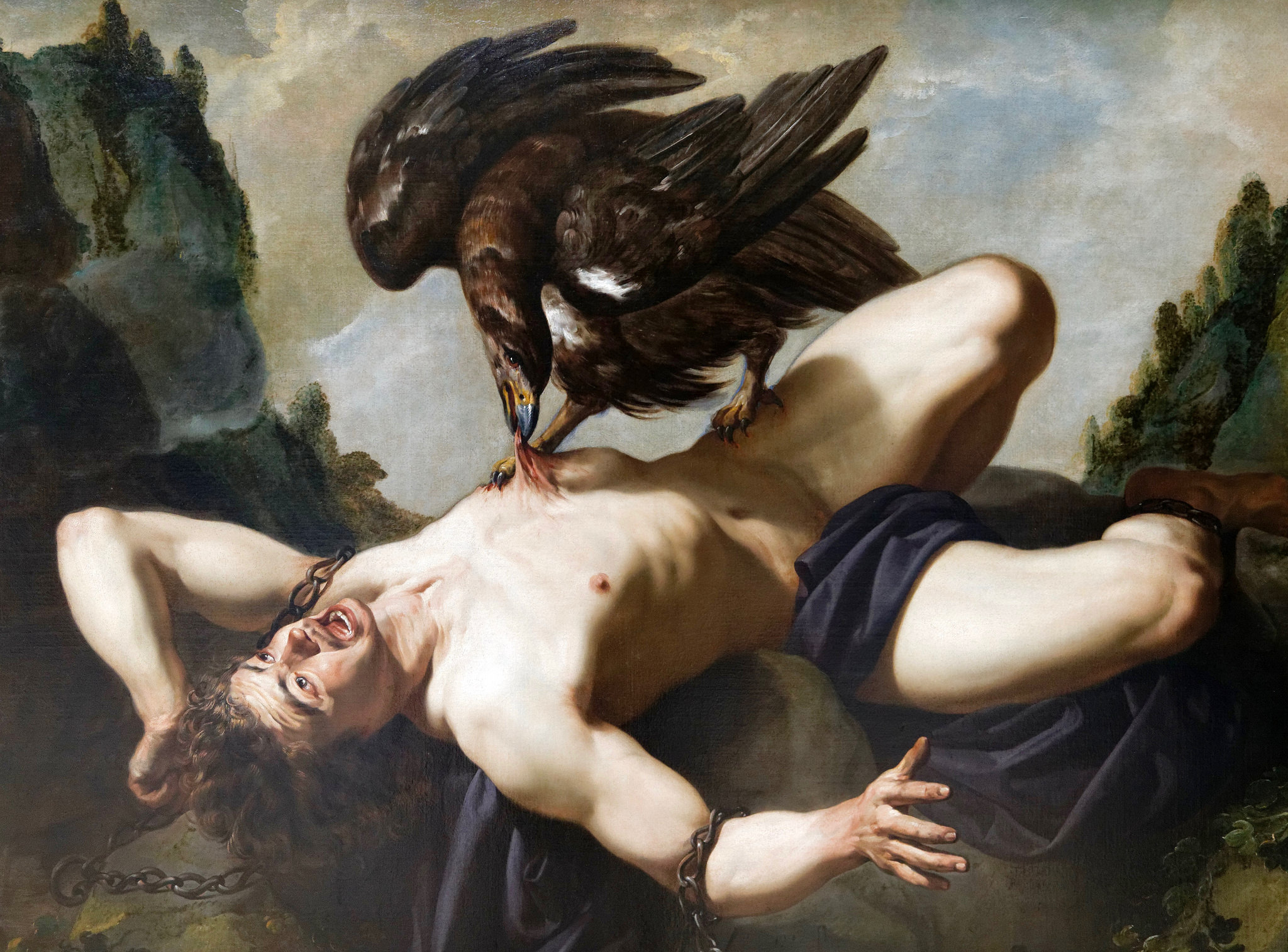
Hermes, Zeus's messenger, arrives to demand that Prometheus reveal the prophecy. When Prometheus defiantly refuses, Hermes threatens escalated punishment: Zeus will send an eagle to eat Prometheus's liver daily, with the organ regenerating each night for eternal torment.
The play reaches its climax as Prometheus maintains his defiance, declaring "Let the sky be shaken... I will not yield". The earth trembles, and Prometheus is swallowed into the abyss, creating a dramatic and unresolved ending that emphasises the ongoing nature of his resistance.
Key themes and dramatic techniques
Tyranny versus resistance
The play explores the moral complexities of challenging authority. Prometheus represents principled resistance to injustice, even when the cost is enormous personal suffering. His defiance raises questions about when obedience becomes complicity and whether justice justifies rebellion.
Important
This theme was particularly relevant to Aeschylus's Athenian audience, who had recently established democracy and overthrown tyrannical rulers. The play questions the legitimacy of absolute power, even when that power is divine.
Static staging and dramatic tension
Despite Prometheus being chained throughout the play, Aeschylus maintains dramatic interest through:
- A series of visitors who bring different perspectives
- Revelations about past events and future prophecies
- Emotional development in the Chorus's responses
- Escalating threats and Prometheus's growing defiance
Divine justice versus human values
The play questions whether divine power automatically creates divine right. Zeus's actions appear cruel and arbitrary, whilst Prometheus's gifts to humanity seem beneficial and compassionate.
Example
Dramatic Technique: Character Foils
Aeschylus uses different characters to represent different responses to authority:
- Hephaestus: Reluctant obedience with guilt
- Oceanus: Practical submission for survival
- Kratos: Blind loyalty to power
- Prometheus: Principled resistance at any cost
Each character's response helps illuminate different aspects of the central moral dilemma.
Exam techniques
Structural analysis
When discussing the play's structure, trace the stages of defiance: initial punishment → explanation of 'crimes' → refusal of advice → prophetic knowledge → final refusal. This progression shows how Prometheus's resistance intensifies rather than weakens.
Character contrasts
Compare different approaches to Zeus's authority:
- Hephaestus: reluctant obedience with moral discomfort
- Oceanus: practical submission for survival
- Prometheus: principled resistance regardless of consequences
Example
Sample Essay Structure: Character Analysis
When comparing characters' responses to authority:
- Introduction: State your thesis about different responses to tyranny
- Hephaestus paragraph: Analyse reluctant compliance and moral conflict
- Oceanus paragraph: Examine pragmatic submission and survival instincts
- Prometheus paragraph: Explore principled resistance and its consequences
- Conclusion: Evaluate which response Aeschylus presents most favourably
Using quotations effectively
Select brief, powerful quotes that capture character positions:
- "All human arts are from Prometheus" (demonstrates his gifts to humanity)
- "Zeus is new to power and harsh to those he rules" (criticises tyrannical authority)
- "Fate is stronger than Zeus" (suggests limits to divine power)
Important
When using quotations in exams, always explain how the quote supports your argument. Don't just insert quotes without analysis - show how the language choices reveal character motivations or thematic concerns.
Debate preparation
Be ready to argue both sides: Is Prometheus a noble martyr for justice, or dangerously reckless in resisting divine authority? Consider how ancient and modern audiences might view his actions differently.
Summary
Key Points to Remember:
- Prometheus represents principled resistance to tyrannical authority, choosing suffering over submission
- The Chorus guides audience sympathy from initial shock through pity to horror at divine cruelty
- Static staging creates tension through visitor dialogues rather than physical action
- The secret prophecy provides Prometheus's only power against Zeus's overwhelming force
- The play explores whether divine power equals divine justice through contrasting characters and moral perspectives