Stratum thickness (Leaving Cert DCG): Revision Notes
📚Revision Notes
Stratum Thickness
Understanding how to calculate stratum thickness is essential for geological mapping and construction projects. This process involves finding the perpendicular distance between the top and bottom surfaces of a geological layer, known as the headwall and footwall respectively.
What is stratum thickness?
Stratum thickness refers to the perpendicular distance between the upper surface (headwall) and lower surface (footwall) of a geological layer or rock formation. Unlike measuring the distance along the surface, true thickness must be measured at right angles to the bedding planes.
Note
The distinction between surface distance and true thickness is crucial - measuring along a sloped surface will always give a larger value than the actual geological thickness of the layer.
Locating outcrop points
The first step in determining stratum thickness is to identify where the geological layer intersects with the ground surface. This creates what we call outcrop points.
To find these points:
- Use ground contour lines at specific elevation intervals
- Identify where the geological formation crosses these contours
- Mark points A, B, and C where the edge view crosses the levels
- Project these points back to give coordinates on the contour map
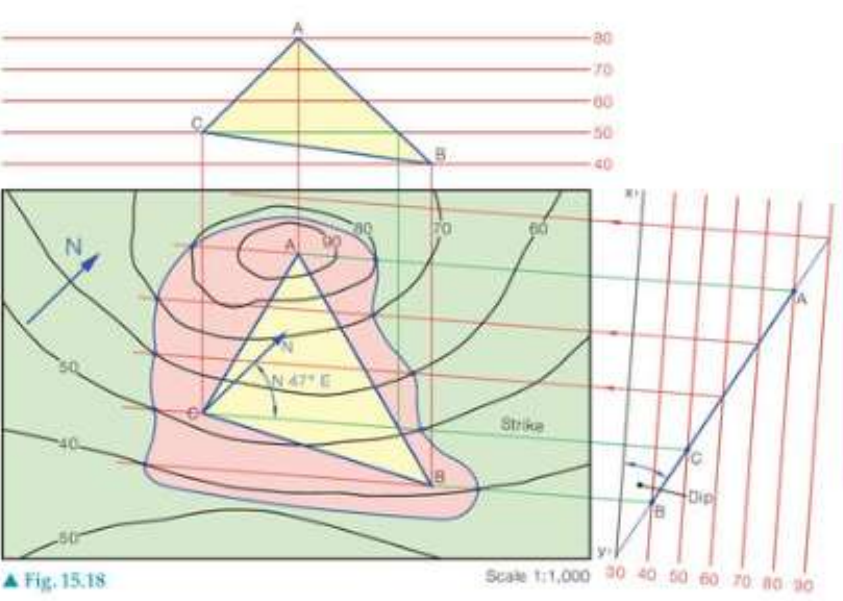
The diagram shows how outcrop points are located using ground contours at 10-metre vertical intervals. Points A, B and C mark where the stratum of ore intersects with the 80m and 90m contour lines respectively.
Important
Critical Step: Always use regular vertical intervals (typically 10m) when working with ground contours to ensure accurate location of outcrop points. Irregular intervals can lead to significant errors in thickness calculations.
Determining strike and dip
Once you have located the outcrop points, you can establish the strike and dip of the stratum:
- Strike: The horizontal direction of the rock layer
- Dip: The angle at which the rock layer tilts from horizontal
These measurements help you understand the three-dimensional orientation of the geological formation, which is crucial for calculating true thickness.
Calculating true thickness
The key principle is that stratum thickness must be measured perpendicular to the bedding planes, not along the ground surface or at any other angle.
Example
Worked Example: Step-by-step Thickness Calculation
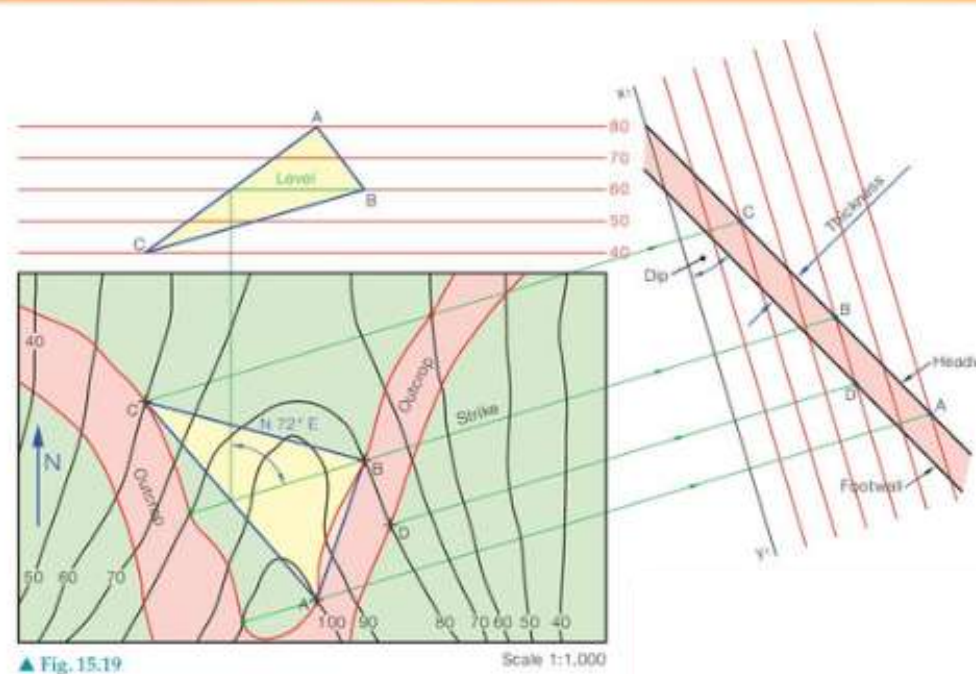
- Join the outcrop points on the headwall to form a triangle
- Find the strike and dip of the stratum using standard geological methods
- Project the footwall onto the auxiliary view to show the true orientation
- Draw the footwall parallel to the headwall in the auxiliary view
- Mark the perpendicular distance between headwall and footwall - this gives the true thickness
Practical applications
Earthworks and construction
When planning construction projects, accurate thickness measurements are vital for:
- Determining how much material needs to be excavated
- Calculating the volume of rock or soil in different areas
- Planning road construction through geological formations
- Assessing the stability of foundations
The thickness calculation helps engineers understand the topography of the land and plan construction routes that minimise cutting and filling requirements.
Note
In large construction projects, even small errors in thickness calculations can result in significant cost overruns due to unexpected volumes of material requiring excavation or removal.
Key techniques to remember
- Always use perpendicular measurements - never measure thickness along sloped surfaces
- Auxiliary views help show the true thickness when the stratum is inclined
- Ground contours at regular vertical intervals (typically 10m) help locate outcrop points accurately
- The headwall and footwall represent the upper and lower boundaries of the geological layer
Important
Common Mistake to Avoid: Many students incorrectly measure thickness vertically or along the ground surface. Remember that true geological thickness is always measured perpendicular to the bedding planes, regardless of the stratum's orientation.
Exam tips
- Practice identifying outcrop points where geological boundaries cross contour lines
- Remember to show your construction lines clearly when calculating thickness
- Label your headwall and footwall clearly in diagrams
- Always measure thickness perpendicular to the bedding planes, not vertically
Summary
Key Points to Remember:
- Stratum thickness is the perpendicular distance between the headwall (top) and footwall (bottom) of a geological layer
- Outcrop points are found where the formation crosses ground contour lines at specific elevations
- Strike and dip must be determined before calculating true thickness
- Auxiliary views help show the true thickness when dealing with inclined strata
- Practical applications include earthworks calculations and construction planning where accurate volume estimates are essential