Terminology (Leaving Cert DCG): Revision Notes
📚Revision Notes
Terminology
Geologic geometry involves understanding the fundamental terms used to describe rock formations and their characteristics. These terms are essential for interpreting geological maps, understanding rock structures, and solving practical problems in geological surveying.
Basic stratum characteristics
A stratum forms the foundation of geological terminology. It refers to a layer, seam, or vein of ore that geologists generally treat as an inclined plane with uniform thickness.
Note
Think of a stratum like a tilted sheet of rock within the Earth's crust. This visualisation helps you understand how these geological layers exist in three-dimensional space.
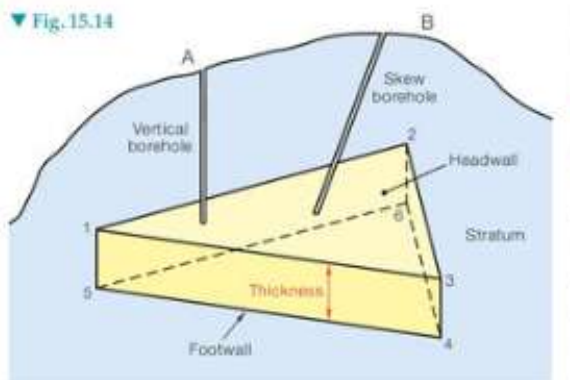
Understanding a stratum requires knowledge of its key surfaces and measurements:
Headwall represents the top surface of the stratum - essentially the upper boundary of the rock layer. Remember this as "head up" - it's always the higher surface when looking at the stratum's orientation.
Footwall forms the lower surface of the stratum - the bottom boundary of the rock layer. Using the memory aid "foot down," this is always the lower surface relative to the headwall.
Thickness measures the perpendicular distance between the headwall and footwall. This is crucial because thickness is always measured at right angles to the surfaces, not along the slope. It represents the true width of the geological layer.
Outcrop describes the portion of the stratum that reaches the Earth's surface and becomes visible. This is where geologists can directly observe and study the rock formation without drilling or excavation.
Strike and dip fundamentals
Two critical concepts describe how geological strata are oriented in space:
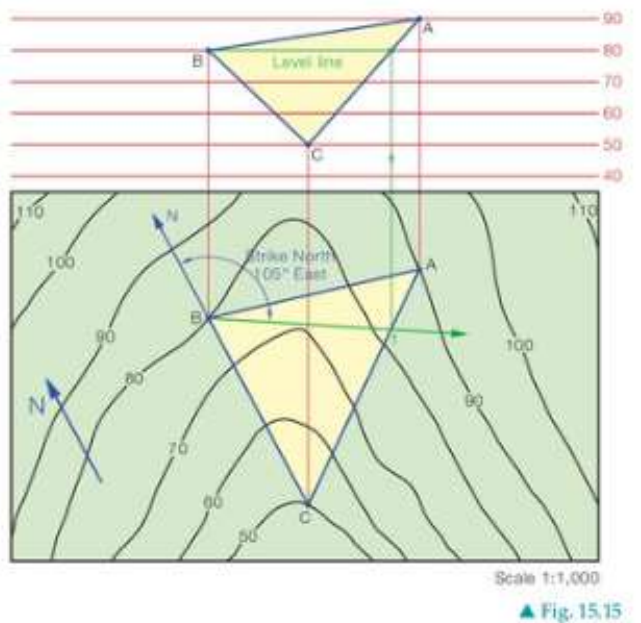
Strike indicates the bearing of a level line drawn on the surface of the stratum. This measurement tells you the horizontal direction of the rock layer and is always related to compass directions. The strike line remains perfectly horizontal, making it essential for mapping purposes.
Dip measures the angle that a stratum makes with the horizontal plane, essentially describing the slope or inclination of the rock layer. The dip angle tells you how steeply the stratum tilts from horizontal.
Important
These measurements work together to completely describe a stratum's three-dimensional orientation. The strike gives the horizontal direction, while the dip provides the vertical angle information. You cannot fully understand a stratum's position without both measurements.
Measurement techniques
Borehole drilling provides a practical method for investigating subsurface geology. A borehole is a hole drilled from the Earth's surface down through a stratum of ore or rock.
Note
This technique allows geologists to determine the position, thickness, and characteristics of underground rock formations without extensive excavation. Boreholes can be drilled vertically or at angles, depending on the geological investigation requirements.
They provide crucial data for understanding stratum geometry and planning mining or construction projects.
Practical applications
These geological terms form the vocabulary necessary for:
- Reading and interpreting geological maps
- Planning excavation and mining operations
- Understanding rock structure stability
- Conducting geological surveys
- Solving problems involving subsurface formations
Each term represents a specific aspect of how rock layers exist in three-dimensional space, and mastering these definitions enables you to tackle more complex geological geometry problems.
Important
Common Mistakes to Avoid:
- Never measure thickness along the slope - it must always be perpendicular
- Don't confuse strike (horizontal) with dip (angle)
- Remember that headwall is always above footwall, regardless of the stratum's orientation
- Practice identifying these features in cross-sectional diagrams to build your visual understanding
Summary
Key Terms to Remember:
- Stratum: A rock layer treated as an inclined plane with uniform thickness
- Headwall and footwall: Top and bottom surfaces of the stratum respectively
- Thickness: Perpendicular distance between headwall and footwall surfaces
- Strike: Horizontal bearing direction of the stratum surface
- Dip: Angle of inclination that the stratum makes with horizontal
- Outcrop: Visible portion of the stratum at Earth's surface
- Borehole: Drilled hole used to investigate subsurface geology