Categories of Polymers (Leaving Cert Engineering): Revision Notes
📚Revision Notes
Thermosetting Polymers (Thermosets)
What are thermosetting polymers?
Thermosetting polymers (also called thermosets) are fully synthetic polymers that behave very differently from thermoplastics. Common examples include Bakelite and epoxy resins. These materials undergo a permanent chemical change during their formation, which gives them unique and irreversible properties.
The key distinguishing feature of thermosets is that once they are formed and set, they cannot be reheated and remoulded like thermoplastics can. This makes them ideal for applications where permanent shape and heat resistance are essential.
Note
Unlike thermoplastics which can be repeatedly melted and reshaped, thermosets undergo an irreversible chemical change during formation. Once set, they maintain their shape permanently - this is why they're called "thermosetting" polymers.
How are thermosets manufactured?
Thermosets are produced through a process called condensation polymerisation. This name comes from the fact that during the reaction, a small molecule (usually water) is eliminated as a byproduct - this elimination is called condensation.
The manufacturing process differs significantly from thermoplastics because thermosets start with two distinctly different molecules rather than identical monomers joining together. This fundamental difference creates an entirely different type of polymer structure.
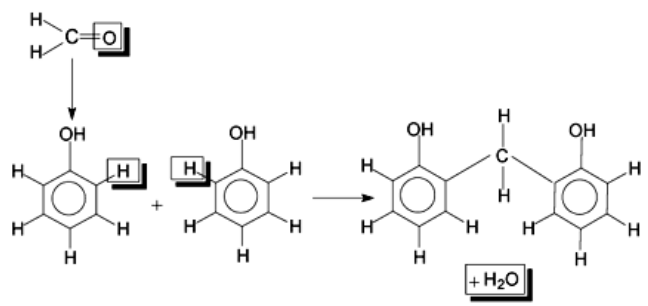
The chemical reaction above shows how phenol and formaldehyde molecules react together to form Bakelite, one of the first synthetic thermosets developed in the early 20th century. Notice how water () is eliminated during this condensation reaction, which is characteristic of thermosetting polymerisation.
Note
The elimination of water during condensation polymerisation is a key identifier of this process. This is different from addition polymerisation used for thermoplastics, where no small molecules are eliminated.
Structure and bonding in thermosets
The most important characteristic of thermosets is their cross-linked or networked structure. When the polymerisation reaction occurs, an irreversible chemical transformation takes place that creates a complex, interconnected three-dimensional network.
This structure has several critical features:
- No long polymer chains are created, unlike in thermoplastics
- Instead, a complex cross-linked network forms throughout the material
- Primary bonding exists throughout the entire structure
- Even secondary bonds are replaced by primary bonding cross-links between adjacent molecules
- This creates much stronger intermolecular forces than found in thermoplastics
Important
The cross-linked network structure is what makes thermosets irreversible. Once these primary bonds form during curing, they cannot be broken by reheating - this is fundamentally different from the secondary bonding in thermoplastics.
Key properties of thermosets
The cross-linked structure gives thermosets distinctive properties that make them suitable for specific applications:
Irreversible setting: Once the cross-linking reaction occurs during the initial moulding process, the final shape is permanently set. Thermosets cannot be reheated or remoulded because no secondary bonding exists in their structure.
Rigidity and brittleness: Thermosets tend to be quite rigid and brittle compared to the more flexible thermoplastics. This is due to the extensive primary bonding throughout the cross-linked network.
Heat resistance: The strong primary bonding network means thermosets maintain their shape and properties at higher temperatures than many thermoplastics.
Strength: The interconnected network of primary bonds creates materials with excellent structural strength.
Note
The rigidity and brittleness of thermosets can be both an advantage and a limitation. While they provide excellent structural strength and heat resistance, they lack the flexibility that makes thermoplastics useful for many applications.

Manufacturing and curing process
The production of thermosets involves a curing process where:
- Two different starting molecules are mixed together
- The mixture is heated and shaped in moulds
- An irreversible chemical reaction occurs, forming cross-links
- The material permanently sets into its final form
- Once cured, the shape cannot be changed by reheating
This curing process is fundamentally different from the reversible melting and solidifying that occurs with thermoplastics.
Note
The curing process is a one-way chemical transformation. Unlike thermoplastics that can be melted and reformed multiple times, thermosets can only be shaped once during the initial curing process.
Comparison with thermoplastics
Understanding the key differences helps distinguish between these polymer categories:
Structure: Thermosets have cross-linked networks while thermoplastics have long polymer chains held together by secondary bonding.
Reversibility: Thermoplastics can be repeatedly heated and reshaped, but thermosets undergo irreversible setting.
Flexibility: Thermoplastics are generally more flexible and can be described as "plastic", while thermosets are rigid and brittle.
Manufacturing: Thermosets use condensation polymerisation with two different starting molecules, while thermoplastics typically use addition polymerisation.
Important
Common Mistake to Avoid: Don't confuse the terms! "Thermoplastics" can be repeatedly heated and reshaped (think "plastic" flexibility), while "thermosets" set permanently once cured (they "set" like concrete).
Applications and uses
Thermosets are chosen for applications where their unique properties are advantageous:
- Electrical components - Bakelite was widely used for electrical switches and housings
- Heat-resistant parts - Components that must maintain shape at high temperatures
- Structural composites - Epoxy resins in fibreglass and carbon fibre materials
- Adhesives and coatings - Where permanent bonding is required
Example
Real-World Application: Bakelite Electrical Components
Early 20th century electrical switches and plugs were commonly made from Bakelite because:
- It provided excellent electrical insulation
- It maintained its shape under heat from electrical current
- Once moulded, it couldn't be accidentally deformed
- It was heat-resistant, preventing melting near hot electrical components
Summary
Key Points to Remember:
- Thermosets set permanently - they cannot be reheated and remoulded once the cross-linking reaction occurs
- Cross-linked structure - primary bonding creates a rigid, interconnected network throughout the material
- Condensation polymerisation - two different molecules react together, eliminating water as a byproduct
- Bakelite is a classic example made from phenol and formaldehyde reactions
- Rigid and brittle properties - very different from the flexible nature of thermoplastics