Extrusion Moulding (Leaving Cert Engineering): Revision Notes
📚Revision Notes
Extrusion Moulding
Introduction to plastic manufacturing processes
Manufacturing with plastics involves several different moulding techniques that allow engineers to shape thermoplastic materials into useful products. Two important processes are vacuum forming and extrusion moulding, each suited to different types of products and applications.
Note
These two processes represent fundamental approaches to plastic manufacturing - vacuum forming shapes flat sheets into 3D forms, while extrusion moulding creates continuous products with consistent cross-sections.
Extrusion moulding process
Extrusion moulding is a continuous manufacturing process used to produce polymer products with consistent length and uniform cross-sectional shapes.
How extrusion moulding works
The process starts with polymer material (usually in pellet form) being fed from a hopper into a heated barrel. Inside the barrel, a rotating screw mechanism mixes and moves the polymer pellets along the length of the chamber.
Heating elements attached to the barrel, combined with the friction generated by the screw action, gradually melt the polymer material. This creates a molten plastic called the melt.
Important
The screw mechanism serves two critical functions: it both mixes the polymer material to ensure uniform heating and creates the pressure needed to force the molten plastic through the die.
The molten material is then forced under pressure through a specially shaped extrusion die at the end of the machine. The die determines the final cross-sectional shape of the extruded product. As the continuous stream of plastic exits the die, it passes through a coolant system that solidifies the material.
The finished product moves along a conveyor belt where it can be cut to required lengths as it continues to cool.
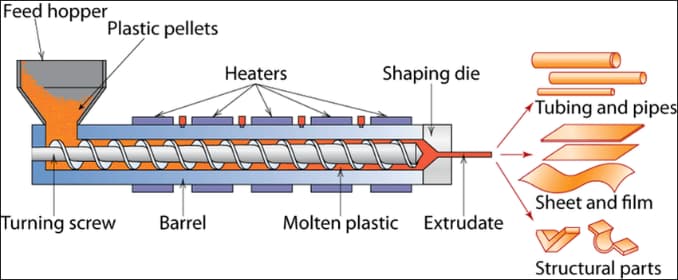
Products made by extrusion moulding
This process is ideal for creating products with uniform cross-sections, including:
- Round, square, and hexagonal bars
- Window frames and door frames
- Garden hoses and tubing
- Plastic pipes and conduits
- Weather stripping and seals
Key advantages of extrusion moulding
- Continuous operation: The process runs continuously, making it highly efficient for large production volumes
- Consistent quality: Products have uniform cross-sections along their entire length
- Versatile shapes: The die can be designed to create various cross-sectional profiles
- Cost-effective: Suitable for high-volume production runs
Summary
Key Points to Remember:
- Vacuum forming uses atmospheric pressure to shape heated plastic sheets over moulds - perfect for complex hollow shapes like bathtubs
- Extrusion moulding is a continuous process that pushes melted plastic through shaped dies to create long products with consistent cross-sections
- Thermoplastics are essential for both processes because they can be heated, shaped, and cooled repeatedly
- The screw mechanism in extrusion moulding both mixes the polymer and creates the pressure needed to force material through the die
- Both processes are widely used in manufacturing because they can produce high-quality products efficiently and cost-effectively