Injection Moulding (Leaving Cert Engineering): Revision Notes
📚Revision Notes
Injection Moulding
What is injection moulding?
Injection moulding is the most commonly used manufacturing process for creating plastic products today. This process works best with thermoplastics, though more sophisticated systems can handle thermosets using a double barrel setup.
The process creates finished products with fixed shapes by injecting molten plastic into a cavity mould. This differs from extrusion, which uses a die to create continuous shapes. Nearly every plastic item you encounter daily has likely been made using injection moulding.
Note
The key difference between injection moulding and extrusion is that injection moulding creates fixed-shape products using a cavity mould, while extrusion produces continuous shapes through a die. This makes injection moulding ideal for discrete items like phone cases, while extrusion is better for items like pipes or tubing.
How injection moulding works
The injection moulding process follows these key steps:
- Feeding: Plastic polymer pellets are loaded into the hopper at the top of the machine
- Melting: The pellets travel into the barrel where a rotating screw mixes and heats the material until it becomes molten
- Injection: The mould closes completely, then a hydraulic ram pushes the entire screw forwards inside the barrel
- Filling: This action injects a precise amount of molten plastic into the closed mould cavity
- Cooling: The screw retracts while the mould stays closed for several seconds, allowing the product to set and solidify
- Ejection: The mould opens and ejector pins push the finished product out of the cavity
The entire process is highly automated and requires minimal manual supervision, making it extremely efficient for mass production.
Important
The automation of injection moulding is one of its greatest advantages. Once the machine is set up and programmed, it can run continuously with minimal human intervention, producing thousands of identical parts with consistent quality.
Example
Typical Injection Moulding Cycle:
A simple plastic component like a bottle cap might follow this timing:
- Injection time: 2-3 seconds
- Cooling time: 10-15 seconds
- Ejection time: 1-2 seconds
- Total cycle time: 13-20 seconds
This means the machine can produce 180-270 bottle caps per hour!
Machine components
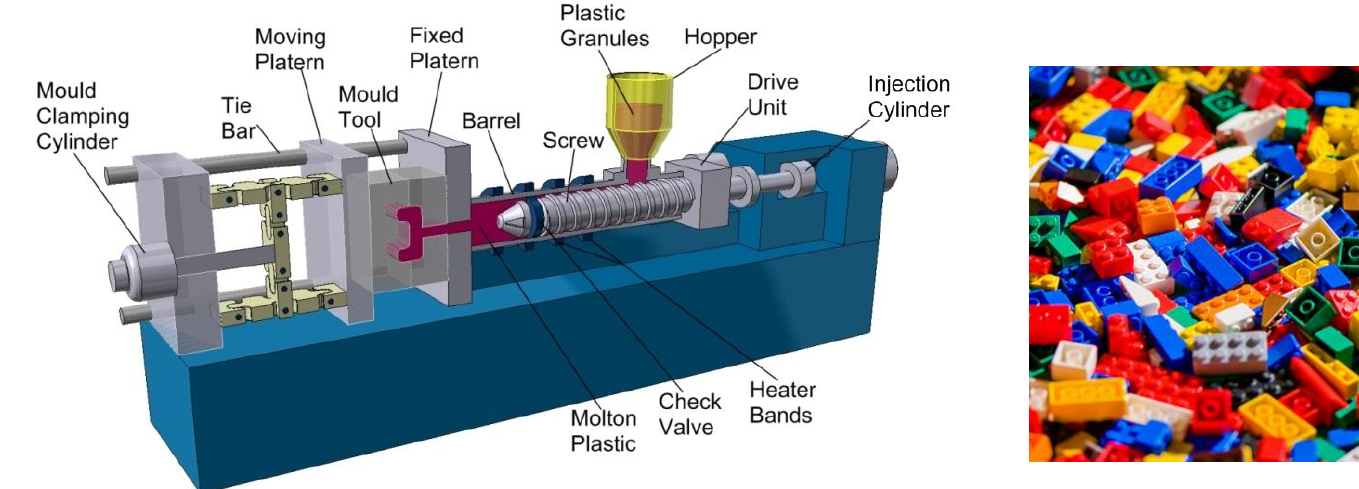
The injection moulding machine contains several critical components working together in a complex system. Understanding these components helps explain how the process achieves such precision and consistency.
Clamping system:
- Moving platen and fixed platen - hold the mould halves
- Tie bars - provide structural support
- Mould clamping cylinder - applies pressure to keep mould closed
Injection system:
- Hopper - stores plastic granules
- Barrel - contains the screw and heating elements
- Screw - mixes and transports molten plastic
- Heater bands - maintain correct temperature
- Check valve - prevents backflow of molten plastic
- Drive unit - powers the screw rotation
- Injection cylinder - provides hydraulic pressure
Mould system:
- Mould tool - creates the product shape
- Ejector system - removes finished products
Note
The injection moulding machine is essentially three systems working in perfect coordination: the clamping system holds everything together under enormous pressure, the injection system melts and delivers the plastic, and the mould system shapes the final product. Each system must be precisely controlled for successful production.
Applications and products
Injection moulding creates countless everyday items that demonstrate the versatility and precision of this manufacturing process:
- Pens and rulers
- Mobile phone covers
- Computer keyboards
- Lunch boxes and containers
- Toys like building blocks
- Chair components
- Automotive parts
The process excels at producing complex shapes with excellent surface finish and dimensional accuracy.
Note
Versatility in Action: From the tiny components inside your smartphone to large automotive bumpers, injection moulding can handle an incredible range of sizes and complexities. The same basic process that makes a LEGO brick can also produce intricate medical devices or precision electronic housings.
Key advantages
Note
Why Injection Moulding Dominates Manufacturing:
- High automation - minimal labour required once set up
- Precision - excellent dimensional accuracy and surface finish
- Speed - rapid cycle times for high-volume production
- Versatility - can produce complex geometries and thin walls
- Material efficiency - minimal waste compared to other processes
- Consistency - identical products in large quantities
These advantages explain why injection moulding has become the go-to process for mass-producing plastic products across virtually every industry.
Summary
Key Points to Remember:
- Injection moulding is the most widely used plastic manufacturing process
- The process uses a cavity mould to create fixed-shape products, unlike extrusion
- Thermoplastics work best, but thermosets can be processed with advanced systems
- The process is highly automated with precise control over temperature, pressure and timing
- Common products include phone covers, keyboards, toys and countless everyday plastic items
- Main advantages: automation, precision, speed, and material efficiency