Transfer Moulding (Leaving Cert Engineering): Revision Notes
📚Revision Notes
Transfer Moulding
What is transfer moulding?
Transfer moulding is a manufacturing process used to create plastic components, particularly those with complex shapes. This method works specifically with thermosets - plastics that cannot be reshaped once they have been formed and cured.
The process shares similarities with compression moulding but offers distinct advantages. Unlike compression moulding, transfer moulding eliminates the need to precisely measure the polymer charge, and the system can accommodate excess material more effectively.
Note
Thermosets vs Thermoplastics: Thermosets are polymers that undergo irreversible chemical changes when heated and cured. Once set, they cannot be remelted or reshaped, unlike thermoplastics which can be repeatedly heated and reformed.
How transfer moulding works
The transfer moulding process follows a systematic sequence that ensures consistent, high-quality results.
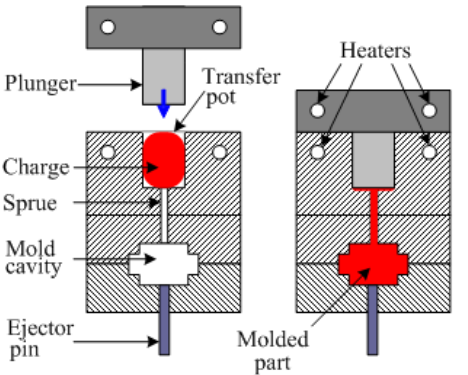
The process begins with the charge (raw polymer material) being placed into the transfer pot. A plunger then applies pressure to force the polymer material through a narrow channel called the sprue into the closed mould cavity.
Note
Key Components of Transfer Moulding System:
- Transfer pot - holds the raw polymer material
- Plunger - applies pressure to move material
- Sprue - narrow channel that guides polymer into mould
- Mould cavity - shapes the final product
- Ejector pin - removes the finished part
- Heaters - maintain proper temperature for curing
Once the polymer fills the mould cavity completely, heat is applied to cure the thermoset material. After the polymer has set and hardened, the mould opens and the ejector pin pushes the finished component out of the cavity.
Applications and advantages
Transfer moulding proves particularly valuable for manufacturing bushings and bearing units that combine plastic components with metal cores. The process allows manufacturers to place a metal core or base inside the mould cavity before injecting the polymer material.
This capability makes transfer moulding ideal for creating composite components where metal provides structural strength while plastic offers specific functional properties like reduced friction or electrical insulation.
Example
Practical Application: Metal-Insert Bearing
Step 1: Place metal bearing core in mould cavity Step 2: Close mould and inject polymer material around the core Step 3: Apply heat to cure the thermoset plastic Step 4: Remove finished composite bearing with metal core encased in plastic
Result: A bearing unit combining metal strength with plastic's friction-reducing properties.
The main advantages of transfer moulding include:
- Better control over material flow compared to compression moulding
- Ability to create complex shapes with consistent wall thickness
- Reduced material waste through excess polymer accommodation
- Excellent for insert moulding with metal components
- Produces parts with good surface finish and dimensional accuracy
Industrial equipment
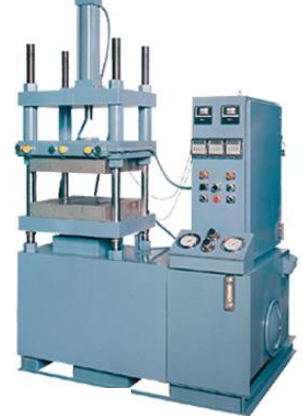
Transfer moulding typically requires substantial hydraulic press equipment to generate the high pressures needed for forcing polymer through the sprue system. Modern transfer moulding machines feature automated controls for precise pressure, temperature, and timing management.
Important
Equipment Requirements: Transfer moulding demands significant hydraulic pressure capabilities, often requiring industrial-grade presses that can generate pressures of several thousand PSI to effectively force polymer material through the sprue system.
Current industry trends
While transfer moulding remains useful for specific applications, injection moulding increasingly replaces it in many manufacturing scenarios. Injection moulding offers faster cycle times and greater automation possibilities, making it more cost-effective for high-volume production runs.
However, transfer moulding maintains its relevance for specialised applications requiring thermoset materials, particularly where complex geometries or insert moulding capabilities are essential.
Important
When to Choose Transfer Moulding:
- Thermoset materials are required
- Complex insert moulding with metal components
- Small to medium production volumes
- High-precision dimensional requirements
- Complex geometries that benefit from controlled material flow
Summary
Key Points to Remember:
- Transfer moulding uses thermosets to create complex shapes through a plunger and sprue system
- Metal cores can be placed in the mould before polymer injection for composite components
- The process offers better material flow control than compression moulding
- Hydraulic presses provide the high pressures required for effective material transfer
- Injection moulding increasingly replaces transfer moulding for many applications due to efficiency advantages