Liquid Penetrant Test (Leaving Cert Engineering): Revision Notes
📚Revision Notes
Liquid Penetrant Test
What is non-destructive testing?
Non-destructive testing (NDT) is a method used to find surface and internal flaws in engineered components without damaging them. These flaws might include cracks, voids, or inclusions that could cause parts to fail early.
NDT plays a crucial role in safety, particularly in the aerospace industry where components must have long service lives. Regular inspections help identify unsafe items before they cause accidents due to component failure.
Note
The aerospace industry relies heavily on NDT because aircraft components are subject to extreme stresses and must maintain their integrity over thousands of flight hours. A single undetected flaw could lead to catastrophic failure.
Liquid penetrant test process
The liquid penetrant test is used to highlight surface cracks on components that are difficult to identify with the naked eye. This process is widely used in aircraft maintenance, repair, and overhaul operations where detecting even the smallest surface defects is critical for safety.
This method works on the principle that liquid will penetrate into surface-breaking discontinuities through capillary action, making invisible cracks visible through enhanced contrast.
Example
Worked Example: Liquid Penetrant Test Process
The liquid penetrant test follows a systematic five-step approach:
Step 1: Cleaning - The material being tested must first be cleaned to ensure it is free of oil, grease, and dirt particles
Step 2: Application - A liquid dye is sprayed over the material surface. This liquid penetrates into any surface cracks present on the component
Step 3: Removal - The excess liquid is lightly wiped away, leaving dye only in the cracks
Step 4: Development - A developer spray is applied over the component. The developer draws the colour dye from the cracks, creating greater contrast between the penetrant dye and the component surface
Step 5: Inspection - If flaws are identified, engineers can decide whether to repair, replace, or leave the component in service
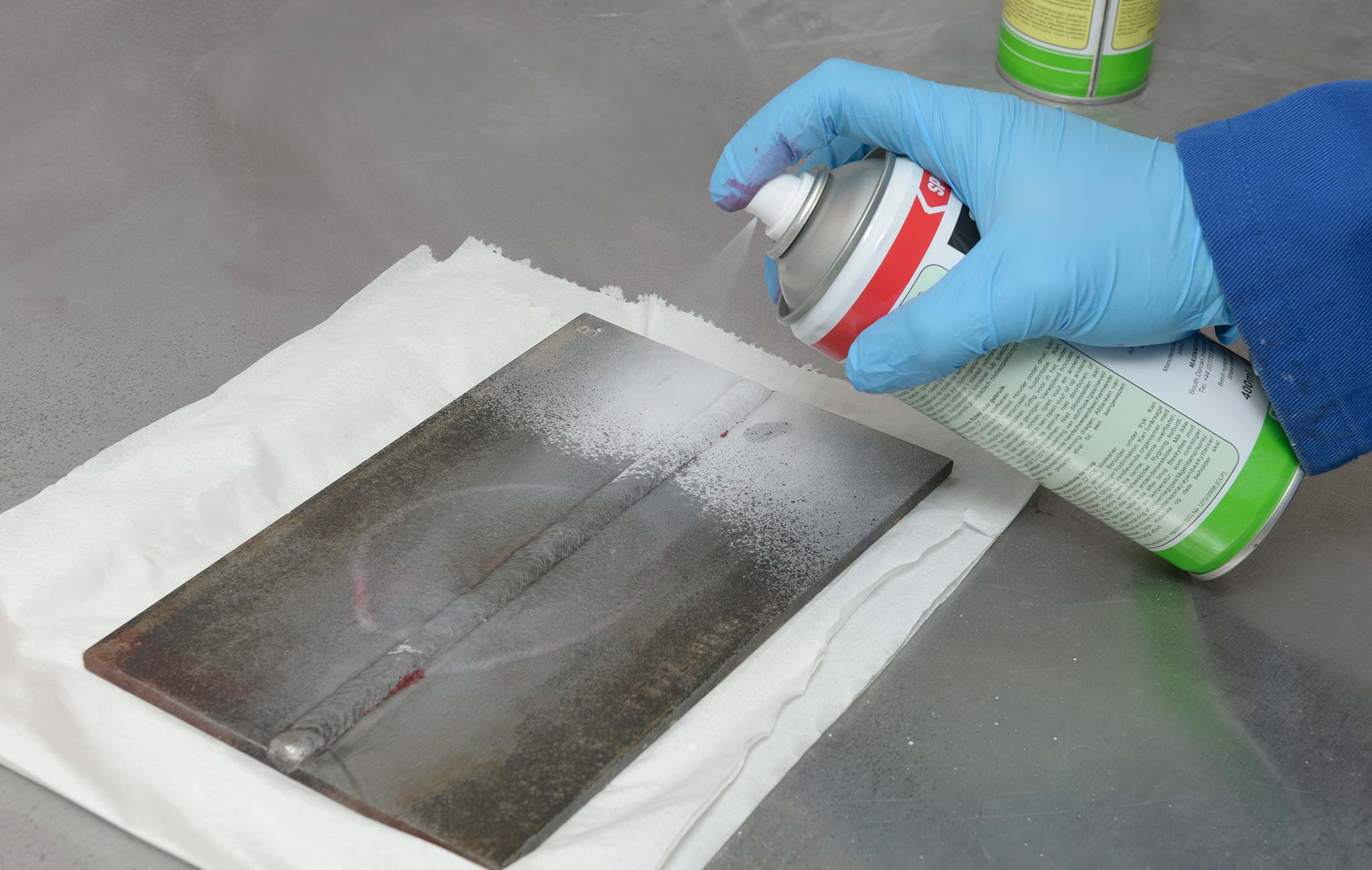
Alternative method
An alternative approach uses ultra violet sensitive liquid penetrant. This penetrant shows up brightly in a darkened room when illuminated with an ultraviolet lamp (blacklight). This method can provide better visibility of small defects and is particularly useful for detailed inspections.
Note
UV penetrant testing is especially valuable in production environments where high sensitivity is required. The fluorescent indication under UV light provides excellent contrast and can reveal defects that might be missed with visible dye penetrants.
Summary
Key Points to Remember:
- NDT prevents component failure by identifying flaws before they cause safety issues
- Visual inspection comes in two types: macroscopic (naked eye) and microscopic (magnified)
- Liquid penetrant testing uses a five-step process: clean, apply, wipe, develop, inspect
- Quality control is essential in manufacturing to prevent faulty products reaching customers
- UV penetrant offers an alternative method for enhanced flaw visibility