Formation of Clouds (Leaving Cert Geography): Revision Notes
📚Revision Notes
Formation of clouds
What are clouds and how do they form?
Clouds are fascinating results of natural atmospheric processes. Understanding cloud formation requires knowledge of condensation, which is a crucial step in the water cycle.
The formation of clouds follows a clear sequence of events that transforms invisible water vapour into the visible cloud structures we see in the sky.
Note
Cloud formation is a complex atmospheric process that demonstrates the dynamic relationship between temperature, humidity, and atmospheric particles. This process is fundamental to understanding weather patterns and precipitation.
The cloud formation process
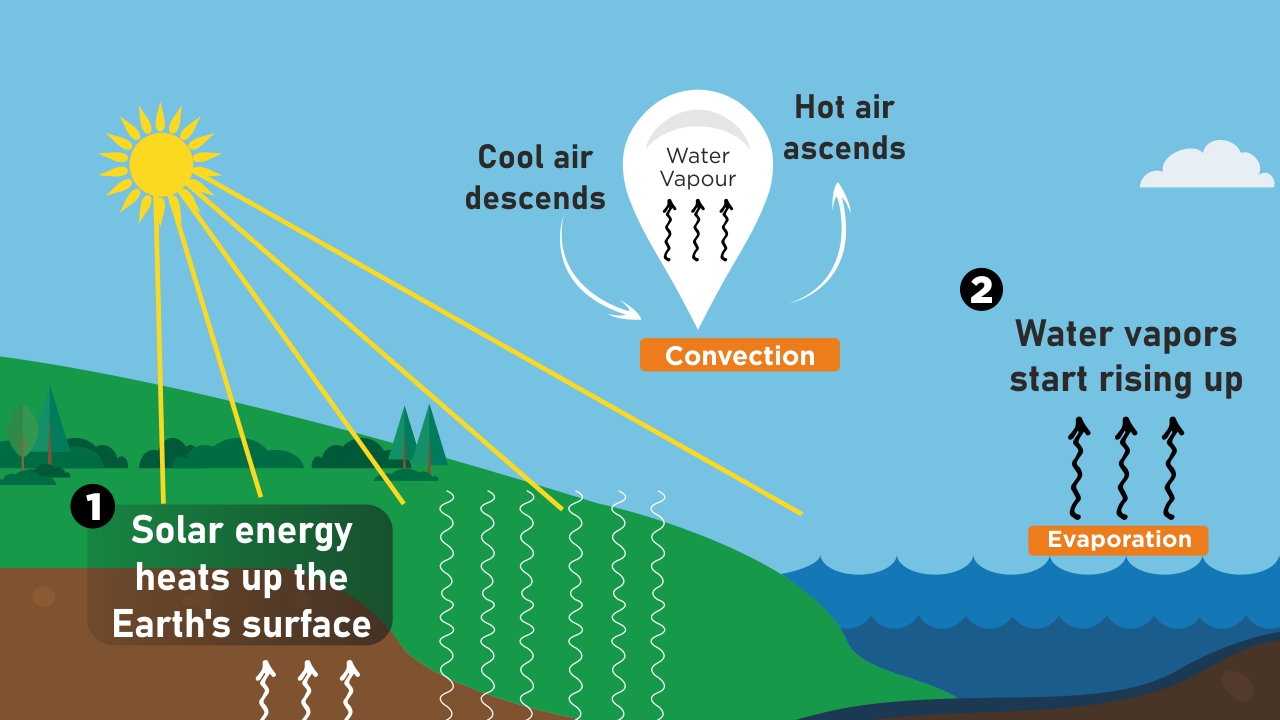
Step 1: Rising air begins the process
Cloud formation starts when warm, moist air moves upward into the atmosphere. This upward movement can happen for several reasons:
- Solar energy heating the Earth's surface, causing air to warm and rise (convection)
- Air being pushed upward when it encounters mountains or hills (orographic lifting)
- Weather fronts forcing air masses to rise
Note
Convection is the most common cause of cloud formation. As the sun heats the Earth's surface throughout the day, different areas warm at different rates, creating pockets of rising warm air that can develop into clouds.
Step 2: Temperature decreases with altitude
As the warm air ascends to higher altitudes, it encounters progressively cooler temperatures. This temperature drop is crucial because cooler air has a reduced capacity to hold moisture compared to warm air.
The rising air begins to cool down, and its ability to contain water vapour decreases significantly.
Step 3: Reaching the dew point
When the rising air cools to a specific temperature called the dew point, it becomes completely saturated with moisture. At this critical stage, the air cannot hold any additional water vapour.
The dew point represents the temperature at which the air's moisture content reaches 100% humidity.
Important
Understanding the Dew Point is Critical
The dew point is the exact temperature where condensation begins. If air doesn't cool to its dew point, no clouds will form, regardless of how much moisture is present in the atmosphere.
Step 4: Condensation requires tiny particles
For visible clouds to develop, water vapour needs something to condense onto. These essential particles are called condensation nuclei and include:
- Dust particles
- Salt crystals from ocean spray
- Pollution particles
Without these tiny particles, water vapour would struggle to condense effectively, even when the air becomes saturated.
Important
Common Misconception Alert
Many people think clouds form simply when air gets cold enough. However, without condensation nuclei, water vapour cannot easily condense into visible droplets, even in saturated air. This is why completely clean air rarely produces clouds.
Step 5: Formation of cloud droplets
Once condensation begins, water vapour transforms into countless tiny water droplets or ice crystals around the condensation nuclei. These microscopic droplets cluster together, creating the visible cloud structure we observe.
The type of droplets formed (water or ice) depends on the temperature at the condensation level - very cold conditions produce ice crystals, while warmer conditions create water droplets.
Example
Worked Example: Cloud Formation in Action
Scenario: A sunny morning heats the ground to 25°C, with air humidity at 80%.
Step 1: Solar heating causes air to rise from the warm ground surface.
Step 2: As air rises 1000 metres, temperature drops to 15°C (typical cooling rate: ~10°C per 1000m).
Step 3: Air continues rising and cooling until it reaches its dew point at 12°C.
Step 4: Water vapour condenses around dust particles and salt crystals in the air.
Step 5: Millions of tiny water droplets form, creating a visible cloud at approximately 1300 metres altitude.
Result: A cumulus cloud appears in the sky as the condensation process makes water vapour visible.
Key factors affecting cloud formation
Temperature gradient: The difference between surface temperature and upper atmosphere temperature drives the rising air process.
Moisture availability: Areas with higher humidity provide more water vapour for potential cloud formation.
Condensation nuclei concentration: Regions with more particles in the atmosphere (including pollution) can produce more clouds, though this isn't always beneficial for weather patterns.
Note
Pollution and Cloud Formation
While pollution particles can increase cloud formation by providing more condensation nuclei, this doesn't necessarily mean better weather. Polluted areas may experience more frequent but less efficient precipitation, affecting local climate patterns.
Summary
Key Points to Remember:
- Cloud formation requires warm, moist air rising and cooling to the dew point
- Condensation nuclei (dust, salt, pollution) are essential for water vapour to condense into visible droplets
- The cooling process occurs because air temperature decreases with altitude
- Clouds form when countless tiny water droplets or ice crystals cluster together around condensation nuclei
- No condensation nuclei means no visible clouds, even if the air is saturated with moisture