The Coriolis Effect (Leaving Cert Geography): Revision Notes
📚Revision Notes
The Coriolis effect
What is the Coriolis effect?
The Coriolis effect is a key geographical concept that describes how Earth's rotation influences the movement of air and water masses across our planet. This effect occurs because our planet spins faster at the equator than at the poles, creating differences in rotational speed that affect moving objects.
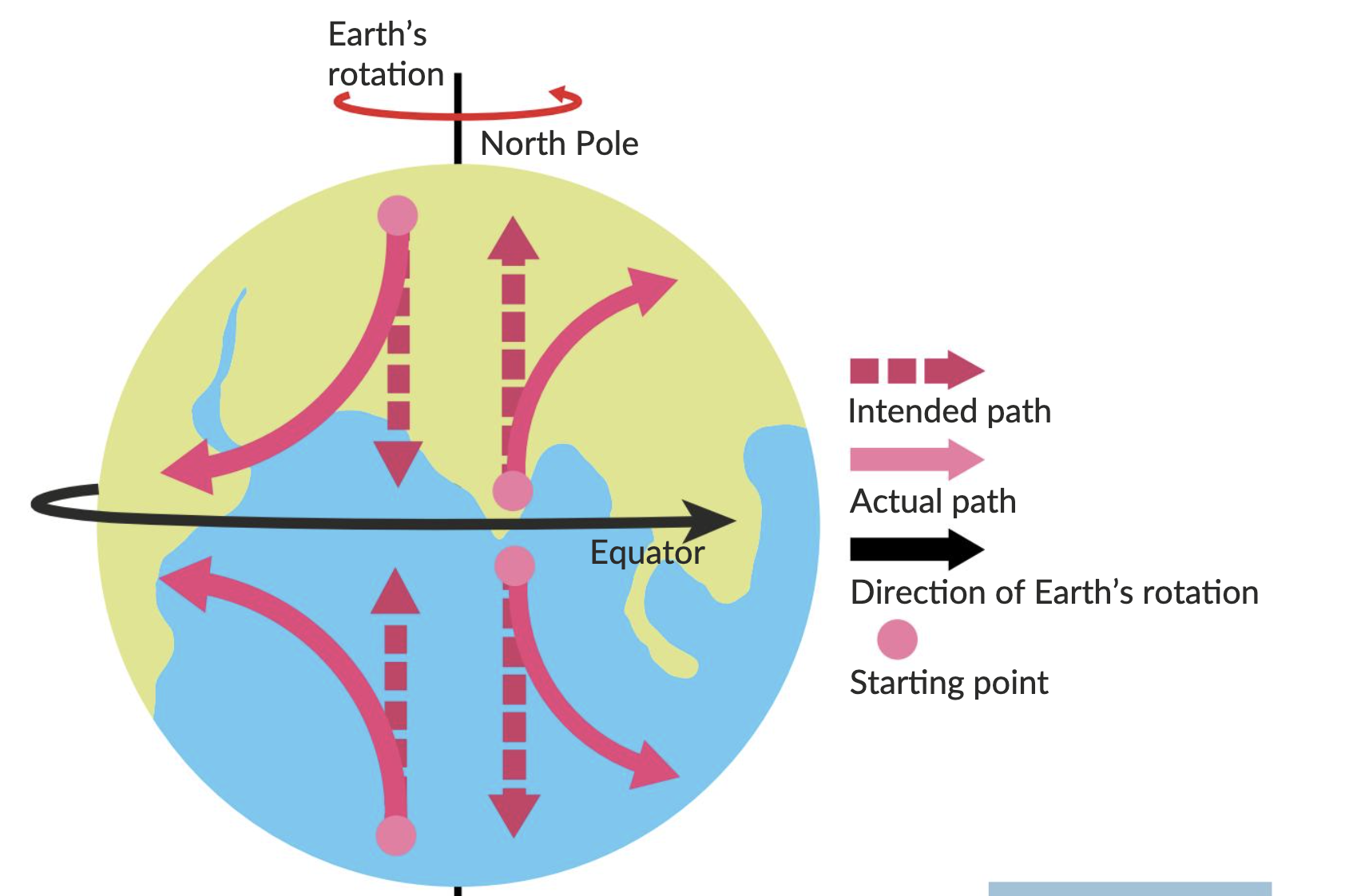
When air or water moves across Earth's surface, it appears to curve away from its intended straight-line path. This happens because different parts of Earth are rotating at different speeds - the equator moves much faster than areas closer to the poles.
Note
The Coriolis effect is named after French mathematician Gaspard-Gustave de Coriolis, who described this phenomenon in 1835. It's a fundamental concept for understanding how our planet's rotation affects everything from weather patterns to ocean currents.
The cause of deflexion
Earth's rotation is the driving force behind the Coriolis effect. The planet rotates faster at the equator compared to the poles, which creates varying rotational velocities across different latitudes.
When objects like air masses or ocean currents move across these different zones, they experience this variation in rotational speed. This causes them to appear to veer off their straight path, even though no actual force is pushing them sideways.
Important
It's important to understand that the Coriolis effect doesn't create movement - it only changes the direction of objects that are already moving. This is a common misconception that many students have about this phenomenon.
Direction of deflexion in each hemisphere
The Coriolis effect works differently depending on which hemisphere you're in:
- Northern hemisphere: Moving air and water deflect to the right of their intended direction of travel
- Southern hemisphere: Moving air and water deflect to the left of their intended direction of travel
This difference occurs because of the way Earth's rotation interacts with moving objects in each hemisphere. The diagram shows how objects starting from the same point will curve in opposite directions depending on whether they're north or south of the equator.
Impact on weather systems
The Coriolis effect plays a crucial role in shaping global weather patterns and atmospheric circulation.
Cyclone rotation: This effect determines how storms spin. In the northern hemisphere, cyclones rotate anticlockwise, while in the southern hemisphere, they rotate clockwise. This consistent pattern helps meteorologists track and predict storm behaviour.
Example
Worked Example: Hurricane Rotation
When a hurricane forms in the Atlantic Ocean (northern hemisphere):
- Warm air rises from the ocean surface
- The Coriolis effect deflects the incoming air to the right
- This creates an anticlockwise rotation pattern
- The storm system maintains this rotation throughout its lifecycle
In contrast, a cyclone forming in the South Pacific will rotate clockwise due to leftward deflexion in the southern hemisphere.
Wind patterns: The Coriolis effect influences major global wind systems. It affects the direction of prevailing winds, including trade winds and westerlies, which are fundamental to understanding global climate patterns.
These weather impacts demonstrate why the Coriolis effect is essential for understanding atmospheric circulation and predicting weather systems on a global scale.
Summary
Key Points to Remember:
- The Coriolis effect is caused by Earth's rotation and different rotational speeds at different latitudes
- In the northern hemisphere, moving air and water deflect to the right
- In the southern hemisphere, moving air and water deflect to the left
- The effect doesn't cause movement - it only changes the path of already moving objects
- It's crucial for understanding cyclone rotation and global wind patterns