The structure of the US Government (Leaving Cert History): Revision Notes
📚Revision Notes
The structure of the US Government
Note
How is the US Government organised?
Why does this matter?
This introduction to US politics, and the number of notes that accompany it, matter because many LC History questions deal with the power that presidents hold. Some presidents have made great strides in domestic policy such as Lyndon B. Johnson and Harry Truman, and knowing key terms or ideas that relate to the political system will add context to the your answers (congress, legislation, senate, acts etc).
It should also be noted that if you are answering a question on a president and you don't know how the political system works or what party they belong to, it may appear that you have not studied! This is the backbone for the US and Wider World unit, so be sure to get familiar with it!
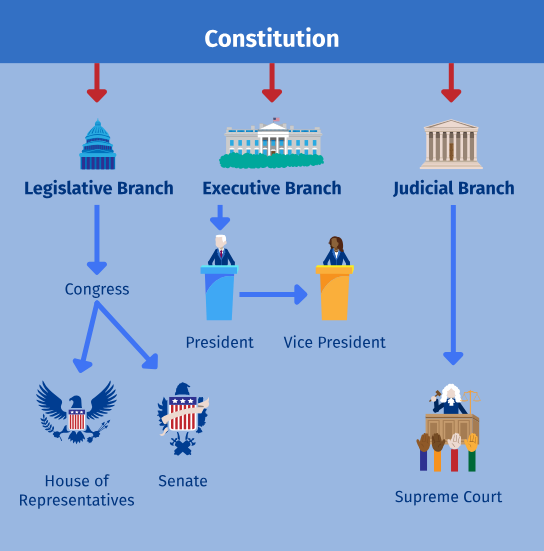
The Structure of the US Government
The United States government is built on principles of federalism, separation of powers, and checks and balances. This structure ensures that power is distributed and balanced to prevent any single entity from gaining too much control.
Below is an overview of the key components and functions of the US government.
The constitution of the US, drawn up in 1787, divides areas of responsibility between the federal government and state governments.
1. Federal Structure
Federalism is the division of power between the national (federal) government and state governments. This ensures that both levels of government have distinct areas of authority and can operate independently in certain domains.
It also means that one specific area of government does not have too much power. Here are some of the powers:
- Enumerated Powers: Powers specifically granted to the federal government by the Constitution, such as regulating interstate commerce, coining money, and maintaining a military.
- Reserved Powers: These powers are not delegated to the federal government, nor are they prohibited to the states; therefore, they are reserved for the states under the Tenth Amendment.
- Concurrent Powers: These are powers shared by both the federal and state governments, such as the power to tax, build roads, and create lower courts.
2. Checks and Balances (Important to know)
The system of checks and balances ensures that no single branch of government becomes too powerful. Each branch has specific powers that can limit or check the powers of the other branches.
- Legislative Branch (Congress): Can override a presidential veto, approve presidential appointments, and impeach the president and judges.
- Executive Branch (President, Vice President): Can veto legislation, appoint federal judges, and pardon individuals.
- Judicial Branch (Supreme Court): Can declare laws or executive actions unconstitutional.
3. Branches of Government
Legislative Branch
Congress: The bicameral (two-chamber) legislature of the federal government, consisting of the House of Representatives and the Senate.
| House of Representatives: | |
|---|---|
| Members | 435 members, with representation based on state population |
| Term | 2 years |
| Powers | 1. Initiates revenue bills 2. Impeaches federal officials 3. Elects the President in the case of an Electoral College tie |
| Senate | |
|---|---|
| Members | 100 members, with 2 senators per state. |
| Term | 6 years |
| Powers | 1. Confirms presidential appointments 2. Ratifies treaties 3. Conducts impeachment trials |
Executive Branch
President: The head of state and government, and the commander-in-chief of the armed forces.
Powers: Enforces laws, vetoes bills, conducts foreign policy, appoints federal judges and other officials, and grants pardons.
Vice President: Supports the President and serves as President of the Senate, casting tie-breaking votes.
Judicial Branch
Supreme Court: The highest court in the United States.
- Justices: Nine justices, including one Chief Justice.
- Powers: Interprets the Constitution, reviews laws, and decides cases involving states' rights.
Additional Components
Cabinet: Advisors to the President, composed of the heads of the executive departments (e.g., Secretary of State, Secretary of Defence).
Federal Agencies: Organisations that carry out specific functions, such as the Environmental Protection Agency (EPA) and Federal Bureau of Investigation (FBI).
Why do Checks and Balances Matter?
There are 4 key reasons as to why checks and balances in the US Government matter.
Checks and balances are crucial in the US government because they prevent any one branch from becoming too powerful and ensure that power is distributed fairly.
This system creates a balance of power among the legislative, executive, and judicial branches.
- Firstly, checks and balances protect against tyranny. By requiring each branch to obtain the consent of the others for many of its actions, the system ensures that no single branch can dominate. For example, the President can veto legislation passed by Congress, but Congress can override that veto with a two-thirds vote.
- Secondly, checks and balances encourage collaboration and compromise. As each branch has some control over the others, they must work together to govern effectively. This collaboration often leads to more balanced and well-considered policies that will help the people of the US.
- Thirdly, this system protects individual liberties. The judiciary, for instance, can declare laws or executive actions unconstitutional, safeguarding citizens' rights. As Alexander Hamilton noted, "the judiciary acts as a guardian of the Constitution."
- Finally, checks and balances promote accountability. Each branch monitors the others, which helps prevent abuse of power and corruption. For instance, Congress can impeach the President or federal judges for misconduct.
Note
Why do checks and balances matter?
- Protection against tyranny
- Encourage collaboration and compromise
- Protection of individual liberties
- Promotes accountability
