The Circle (Leaving Cert Mathematics): Revision Notes
📚Revision Notes
A Circle Intersecting the Axes
Understanding axis intersections
When we talk about a circle intersecting the axes, we mean the points where the circle crosses or touches the x-axis and y-axis on a coordinate plane. These intersection points have special properties that make them easier to find.
A circle can intersect each axis at:
- Two points (if the circle passes through the axis)
- One point (if the circle is tangent to the axis)
- No points (if the circle doesn't reach the axis)
Note
The number of intersection points depends on the circle's position and size relative to the axes. Understanding this concept helps you predict how many solutions to expect when solving.
Key rules for finding intersection points
Important
The most important rules to remember are:
For x-axis intersections:
- The y-coordinate is always 0
- Set y = 0 in the circle equation and solve for x
For y-axis intersections:
- The x-coordinate is always 0
- Set x = 0 in the circle equation and solve for y
This makes sense because any point on the x-axis has a y-coordinate of 0, and any point on the y-axis has an x-coordinate of 0.
Finding x-axis intersections
To find where a circle intersects the x-axis, follow this systematic approach:
- Take the circle equation
- Substitute y = 0
- Solve for x
- Write the coordinates as (x, 0)
The intersection points will always have the form (a, 0) and (b, 0).
Note
Remember that when you substitute y = 0, you're essentially "flattening" the circle equation onto the x-axis, which simplifies your calculation considerably.
Finding y-axis intersections
To find where a circle intersects the y-axis, use this parallel process:
- Take the circle equation
- Substitute x = 0
- Solve for y
- Write the coordinates as (0, y)
The intersection points will always have the form (0, c) and (0, d).
Worked examples
Example
Worked Example 1: Circle with centre at origin
Find the coordinates of the points where: (i) the circle intersects the x-axis (ii) the circle intersects the y-axis
Solution:
(i) Finding x-axis intersections for
Since the circle intersects the x-axis where y = 0:
Substitute y = 0:
Therefore, intersects the x-axis at (4, 0) and (-4, 0).
(ii) Finding y-axis intersections for
Since the circle intersects the y-axis where x = 0:
Substitute x = 0:
Therefore, intersects the y-axis at (0, 1) and (0, 3).
Example
Worked Example 2: Circle touching the axes
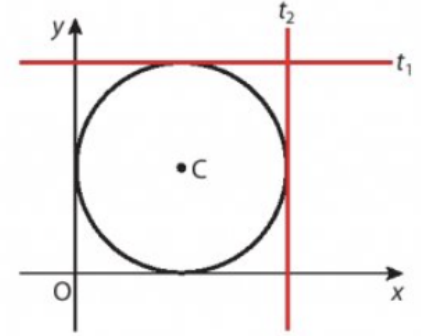
Consider a circle with centre C and radius length 3 that touches both the x-axis and y-axis. When a circle touches an axis (is tangent to it), it intersects at exactly one point.
If a circle with centre (a, b) and radius r is tangent to:
- The x-axis: the distance from centre to x-axis equals the radius, so |b| = r
- The y-axis: the distance from centre to y-axis equals the radius, so |a| = r
Note
Exam tips
- Always substitute the correct value: y = 0 for x-axis, x = 0 for y-axis
- Don't forget the ± when taking square roots - circles usually intersect axes at two points
- Check your answers by substituting back into the original equation
- Remember the coordinate format: x-axis points are (x, 0), y-axis points are (0, y)
Summary
Key Points to Remember:
- X-axis intersections: Set y = 0, solve for x, coordinates are (x, 0)
- Y-axis intersections: Set x = 0, solve for y, coordinates are (0, y)
- Intersection points can be found by substitution and solving quadratic equations
- Tangent circles touch an axis at exactly one point
- Always write coordinates in the correct format with the appropriate zero value