Circle with Centre (h,k) and Radius r (Leaving Cert Mathematics): Revision Notes
📚Revision Notes
Circle with Centre (h,k) and Radius r
Understanding the standard form equation
When we have a circle with a specific centre and radius, we can write its equation using coordinate geometry principles. The key concept is that every point on the circle is exactly the same distance (the radius) from the centre.
Note
The fundamental principle of a circle is that all points on the circumference are equidistant from the centre. This constant distance is what we call the radius, and it forms the basis for deriving the circle's equation.
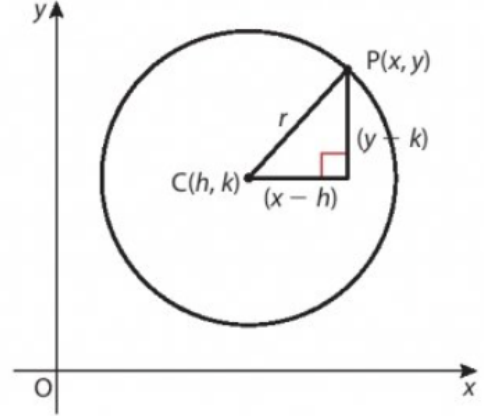
Let's say we have a circle with centre C at coordinates (h, k) and radius r. If P(x, y) is any point on the circle, then the distance from the centre C to point P must equal the radius r.
Using the distance formula, we can establish this relationship:
Since the distance equals the radius, we can square both sides to eliminate the square root:
Important
Key Formula: The equation of a circle with centre (h, k) and radius r is:
This is known as the standard form of a circle's equation.
Finding the equation when given centre and radius
To write the equation of a circle, you need two pieces of information:
- The centre coordinates (h, k)
- The radius r
The process involves direct substitution into the standard form equation.
Example
Worked Example 1: Basic substitution
Find the equation of the circle with centre (2, -3) and radius 5.
Solution: Using the standard form:
Substitute the values:
- h = 2, k = -3, r = 5
Important: Notice how the negative centre coordinate (-3) becomes positive (+3) in the equation because of the subtraction in the standard form.
Finding centre and radius from a given equation
When you're given an equation in standard form, you can identify the centre and radius by comparing it to . The key is to carefully observe the signs in the equation.
Example
Worked Example 2: Extracting information
Find the centre and radius of the circle .
Solution: Compare with the standard form:
From :
- means (opposite sign)
- means
- , so
Therefore: Centre = (-3, 4) and radius =
When the circle passes through a given point
Sometimes you're told the centre of a circle and that it passes through a particular point. You need to find the radius first using the distance formula, then write the equation.
Example
Worked Example 3: Circle through a point
The circle with centre (1, 3) passes through the point (3, 5). Find the equation of the circle.
Solution: First, find the radius using the distance from centre to the given point:
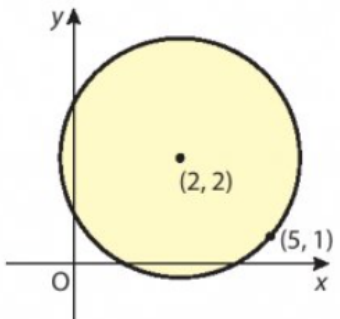
Radius =
Now substitute into the standard form:
Exam tips and common mistakes
Understanding these common pitfalls will help you avoid the most frequent errors in circle problems.
Important
Common Mistakes to Avoid:
-
Sign errors: Remember that in , if the centre is (2, -3), then h = 2 and k = -3, giving you
-
Radius squared: The right-hand side of the equation is r², not r. If , then
-
Distance formula: When finding the radius from a centre to a point, always use
-
Simplifying: Leave your final answer in the form unless asked to expand
Summary
Key Points to Remember:
- The standard equation of a circle is where (h, k) is the centre and r is the radius
- The signs in the equation are opposite to the signs of the centre coordinates
- To find the radius when a circle passes through a point, use the distance formula between the centre and that point
- Always square the radius value when writing the final equation
- Check your signs carefully - this is the most common source of errors in circle problems