Graphing Lines (Leaving Cert Mathematics): Revision Notes
📚Revision Notes
Graphing Lines
What is Graphing a Line?
Graphing a line involves plotting all the points that satisfy the equation of the line in a Cartesian plane. The equation of a line can take various forms, such as:
Slope-Intercept Form:
- is the slope.
- is the .
Point-Slope Form:
- Used when the slope and a point on the line are known.
General Form:
Steps to Graph a Line
- Rewrite the Equation: Convert the equation to slope-intercept form, , if necessary.
- Identify Key Features:
- Slope (): Rise over run, indicating steepness and direction.
- Y-Intercept (): The point where the line crosses the .
- Plot the Y-Intercept: Start by marking the y-intercept on the graph.
- Use the Slope: From the y-intercept, use the slope to find additional points.
- Draw the Line: Connect the points with a straight line extending in both directions.
Horizontal and Vertical Lines
- Horizontal Line ()****: All points have the same .
- Vertical Line ()****: All points have the same .
Worked Examples
Note
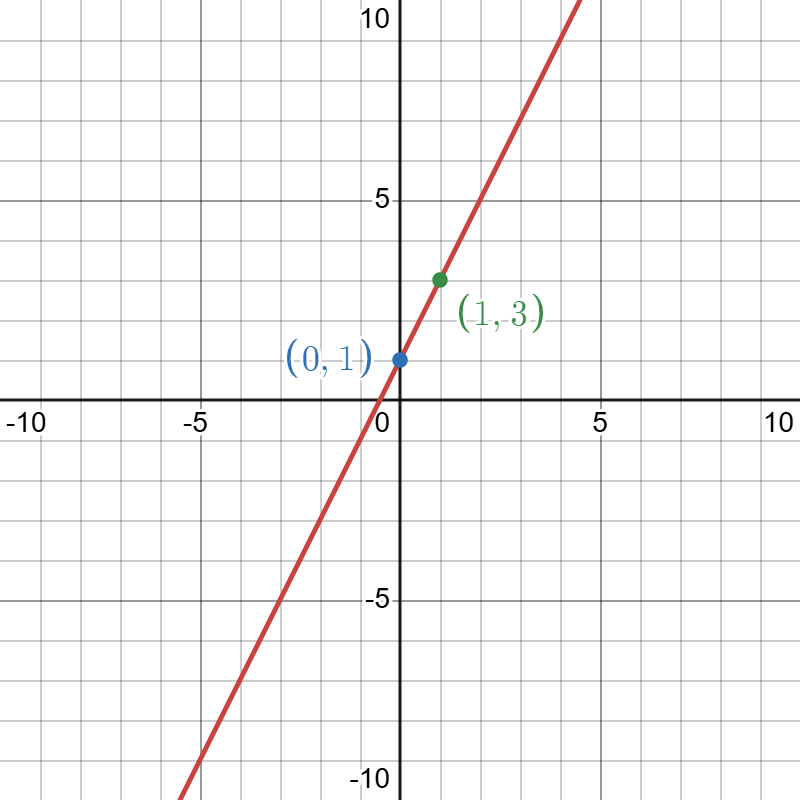
Example 1:
Graph
- Identify the ():
- Identify the slope (): (rise = , run = ).
- Plot the
- From , move units up and unit right to find another point
- Draw the line through and
Note
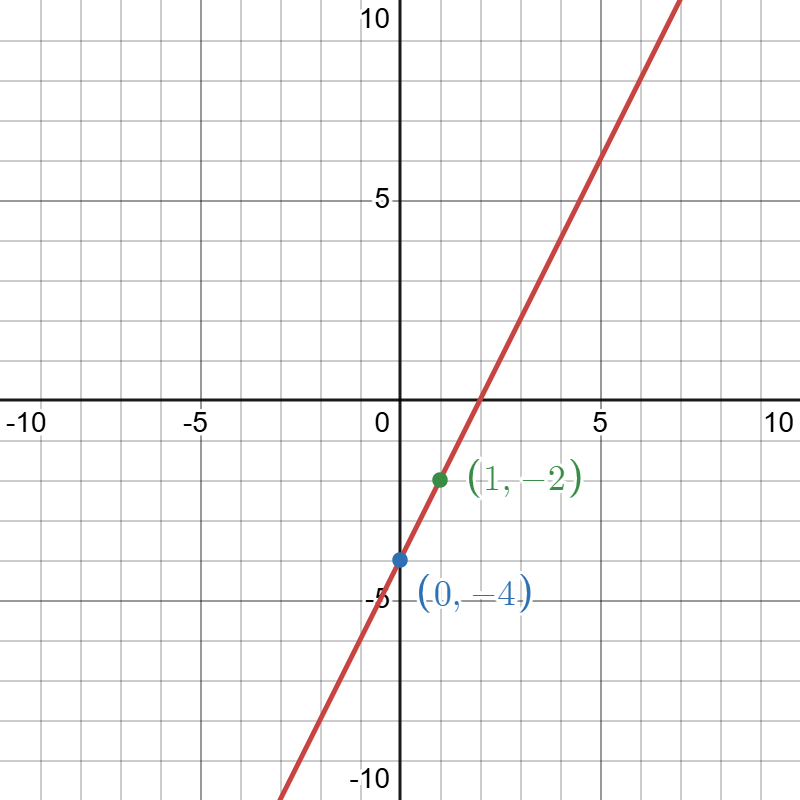
Example 2:
Graph
- Rewrite the equation in slope-intercept form:
- Slope ():
- Y-intercept ():
- Plot the
- From , use the slope to find another point:
- Move 2 units up and 1 unit right to
- Draw the line through and
Summary
- Graphing Steps: Rewrite the equation, identify the slope and intercept, plot key points, and draw the line.
- Forms of Line Equations: 10. (slope-intercept form). 11. (point-slope form). 12. (general form).
- Special Lines:
- Horizontal line (): Parallel to .
- Vertical line (): Parallel to .
- Practice graphing lines to improve understanding and precision.