Distance Between Two Points (Leaving Cert Mathematics): Revision Notes
📚Revision Notes
Distance Between Two Points
What is the distance between two points?
When we have two points on a coordinate plane, we often need to find the straight-line distance between them. This is like measuring the length of a piece of string stretched directly from one point to the other, rather than following the grid lines.
The distance between any two points can be calculated using a special formula that comes from the Pythagorean theorem. This method works for any two points, regardless of which quadrant they're in or whether they have positive or negative coordinates.
The distance formula
To find the distance between two points A and B, we use the distance formula:
How the formula works
The distance formula comes directly from the Pythagorean theorem. When we connect two points on a coordinate plane, we create a right-angled triangle:
Note
Understanding the Right Triangle Connection
When plotting two points on a coordinate plane and connecting them:
- The horizontal leg has length
- The vertical leg has length
- The hypotenuse is the distance we want to find
Using Pythagoras' theorem:
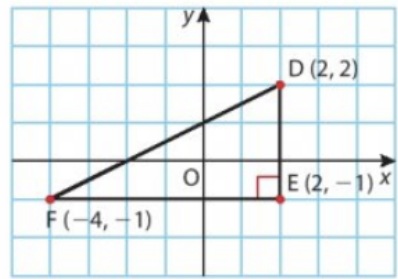
Therefore:
Step-by-step method
To calculate the distance between two points, follow this systematic approach:
Note
The Five-Step Process
- Identify the coordinates: Label your points as and
- Find the differences: Calculate and
- Square the differences: Calculate and
- Add the squares: Add the results from step 3
- Take the square root: Find the square root of your answer from step 4
Worked example 1: Basic distance calculation
Example
Worked Example: Finding Distance Between Two Points
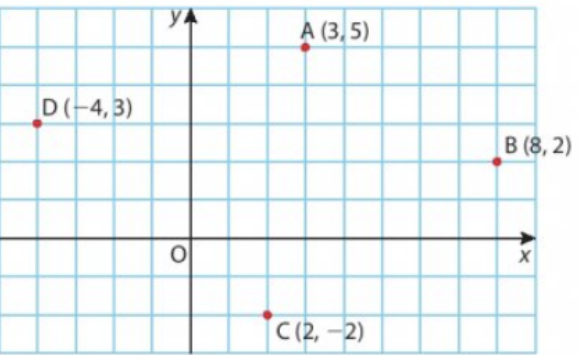
Find the distance between points A(3, 5) and B(8, 2).
Solution:
- Identify coordinates: A(3, 5) means and B(8, 2) means
- Find differences: and
- Square the differences: and
- Add the squares:
- Take square root:
Therefore, the distance between A and B is √34 units (approximately 5.83 units).
Worked example 2: Proving equidistant points
Example
Worked Example: Proving Equidistant Points
Show that point D(2, 4) is equidistant from points E(-5, 1) and F(5, -3).
Solution: Equidistant means the same distance from both points, so we need to show .
Finding where D(2, 4) and E(-5, 1):
- Distance
Finding where D(2, 4) and F(5, -3):
Since |DE| = |DF| = √58, point D is equidistant from points E and F.
Worked example 3: Finding unknown coordinates
Example
Worked Example: Finding Unknown Coordinates
If the distance between points (2, 3) and (5, k) is , find the possible values of k.
Solution: Using the distance formula:
Squaring both sides:
Therefore: or
The two possible values are k = 2 and k = 4.
Common exam tips
Important
Critical Points to Avoid Common Mistakes
- Always square the differences: Remember that , not
- Don't forget the square root: The distance formula ends with taking the square root
- Check your arithmetic: Double-check your calculations, especially when squaring negative numbers
- Leave answers in surd form: Unless asked to approximate, leave answers like rather than converting to decimals
- Set up equations carefully: When finding unknown coordinates, set up the distance formula as an equation first
Applications in geometry
The distance formula is essential for solving many geometric problems. It allows us to work with shapes and relationships in the coordinate plane with precision and accuracy.
Note
Key Applications in Geometry
The distance formula is essential for:
- Finding side lengths of triangles and quadrilaterals
- Calculating the radius of circles when given centre and a point on the circle
- Proving that triangles are isosceles (two equal sides)
- Showing that points are collinear or form specific shapes
Summary
Key Points to Remember:
- The distance formula is
- The formula comes from Pythagoras' theorem applied to coordinate geometry
- Squaring eliminates the need to worry about positive or negative differences
- Equidistant points are the same distance from a reference point
- Always take the square root at the end - distance is always positive