Parallel and Perpendicular Lines (Leaving Cert Mathematics): Revision Notes
📚Revision Notes
Parallel and Perpendicular Lines
Understanding parallel and perpendicular lines
Parallel lines are lines that never meet and always maintain the same distance between them. The key characteristic of parallel lines is that they have exactly the same slope.
Perpendicular lines are lines that meet at right angles (90°). The slopes of perpendicular lines have a special relationship - they are negative reciprocals of each other.
Note
Understanding these fundamental definitions is crucial for solving problems involving line relationships. The slope relationship is the key to identifying and working with parallel and perpendicular lines.
Slope relationships
For parallel lines
If two lines are parallel, their slopes are equal:
- Line 1: slope =
- Line 2: slope =
- If lines are parallel, then
For perpendicular lines
If two lines are perpendicular, their slopes are negative reciprocals:
- Line 1: slope =
- Line 2: slope =
- If lines are perpendicular, then , or
Important
Critical Relationship: For perpendicular lines, the product of their slopes always equals -1. This is the fundamental test for perpendicularity.
Finding the slope from the general form
When a line is given in the general form , you can find its slope by rearranging it into the form .
Note
Method:
- Start with
- Rearrange to get:
- Divide by :
- The slope is
Finding equations of parallel lines
To find the equation of a line parallel to a given line and passing through a specific point, you need to follow a systematic approach that utilises the fact that parallel lines have identical slopes.
Steps:
- Find the slope of the given line
- Use the same slope for your new parallel line
- Use the point-slope form:
- Substitute the known point and slope
- Simplify to get the final equation
Finding equations of perpendicular lines
To find the equation of a line perpendicular to a given line and passing through a specific point, the key step is calculating the perpendicular slope correctly.
Steps:
- Find the slope of the given line
- Calculate the perpendicular slope using
- Use the point-slope form:
- Substitute the known point and perpendicular slope
- Simplify to get the final equation
Important
Common Mistake Alert: When finding the negative reciprocal, remember that if the original slope is , the perpendicular slope is (flip the fraction AND change the sign).
Example
Worked Example: Finding a perpendicular line
Question: Find the equation of the line through the point which is perpendicular to the line .
Solution: Step 1: Find the slope of the given line
- Rearrange:
- Multiply by :
- The slope is
Step 2: Find the perpendicular slope
- Perpendicular slope =
Step 3: Use point-slope form with and slope
- Multiply through by :
- Rearrange:
Answer:
Example
Worked Example: Identifying parallel and perpendicular lines
Given these line equations:
- a:
- b:
- c:
- d:
- e:
- f:
Parallel lines: Lines a and f (both have slope ) Perpendicular lines: Lines b and e (slopes and are negative reciprocals)
Example
Worked Example: Reading slope from a graph
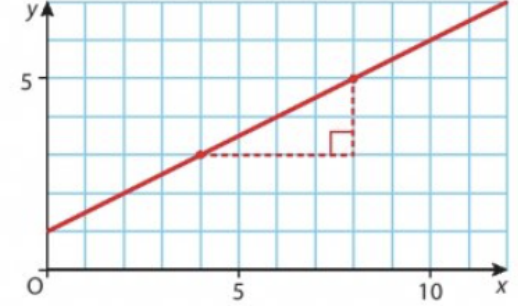
From the graph above, we can determine the slope by identifying two points on the line and using the slope formula. The line passes through the origin and the marked point at approximately , giving a slope of .
Exam tips
When working with parallel and perpendicular lines in exams, there are several key strategies that will help you avoid common mistakes and work more efficiently.
Note
Essential Exam Strategies:
- Always check that perpendicular slopes multiply to give
- For parallel lines, simply use the same slope as the given line
- When finding slopes from general form , remember the slope is
- Practice converting between different forms of line equations
- Double-check your arithmetic when calculating negative reciprocals
Summary
Key Points to Remember:
- Parallel lines have equal slopes and never meet
- Perpendicular lines meet at right angles and have slopes that are negative reciprocals
- Slope relationship: If slopes are and , then perpendicular lines satisfy
- Point-slope form is essential for finding line equations
- Always verify your answer by checking the slope relationship